
How to Tell a Block From a Charge—or a No-Call
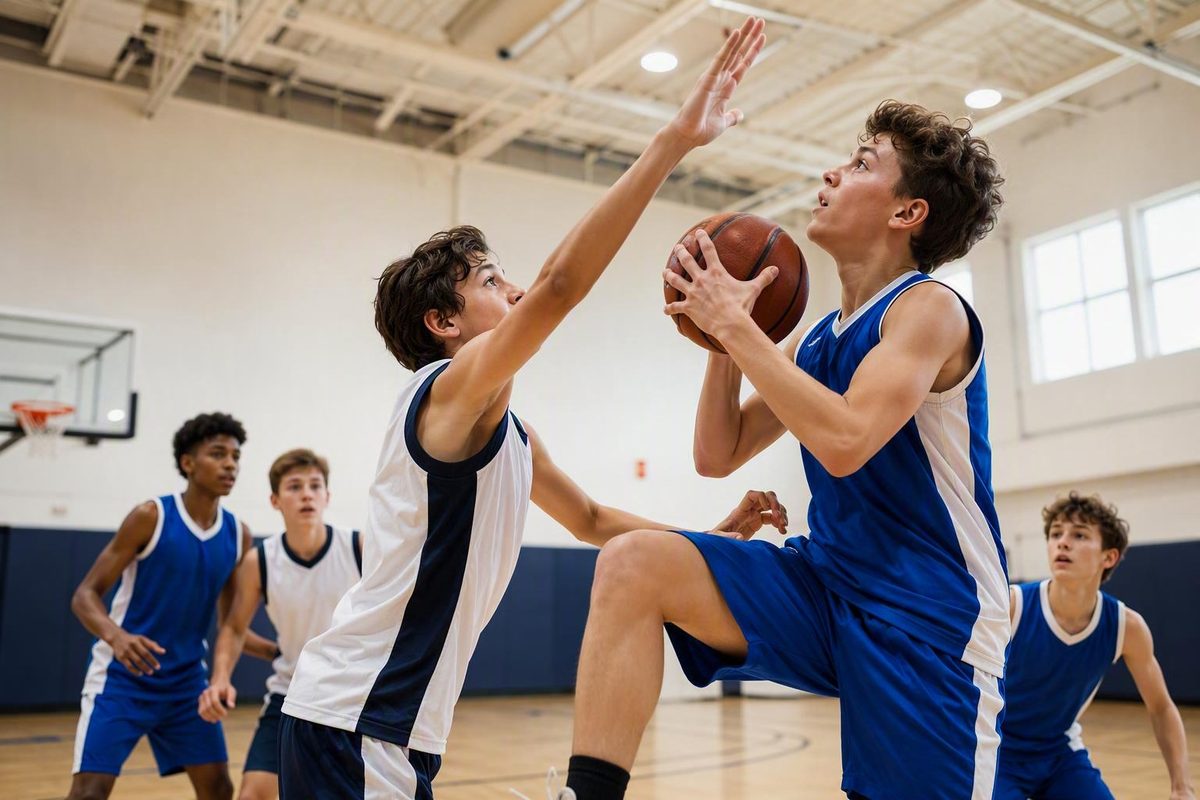
The call usually involves illegal contact that stops or reroutes an opponent without legal guarding position. Sideways or backward movement can be legal.
A block-charge decision is not simply a race to see whether the defender “got there first.” It is also not determined by whether the defender’s feet were moving at the instant of contact.
A more useful way to evaluate the play is to follow the entire sequence:
- Did the defender establish legal guarding position?
- How did the defender move after establishing it?
- Who moved into whom?
- Did the contact meaningfully impede, reroute, or displace a player?
- Does the competition use a restricted-area rule or another relevant exception?
This is a general teaching framework, not a substitute for a league’s rulebook. Exact definitions, exceptions, and penalties can differ among professional, school, recreational, and tournament basketball. That distinction is especially important in youth games, where local modifications may apply.
What a blocking foul means
A blocking foul in basketball generally involves illegal contact that impedes or reroutes an opponent when a defender has not legally established or maintained guarding position. It is usually a defensive personal foul (Basketball for Coaches’ blocking-foul explanation).
A common example occurs when a help defender moves across the lane as a driver approaches the basket. If the defender has not established a legal position and then creates contact that stops or changes the drive, a blocking call becomes more likely. Describing the defender as “late” is practical shorthand, not a universal timing test; the applicable rulebook determines precisely what position and timing are required.
The essential elements are illegal contact and its effect on the opponent. Merely standing near another player is not a foul. Neither is every bump, brush, or moment of shared space. The contact must be illegal under the governing rules and significant enough to affect the opponent’s movement or play.
Blocking can occur in two broad settings:
- On the ball: A defender illegally impedes a dribbler or another player controlling the ball.
- Off the ball: A defender illegally obstructs or reroutes a cutter, potential receiver, or another player who does not possess the ball.
The ball therefore does not have to be at the point of contact. A defender can commit a blocking foul by stepping into a cutter, extending a hip, or otherwise preventing an off-ball player from following a legal route.
Blocking is most often discussed as a defensive foul, but illegal obstruction can also occur during offensive screening. If a screener moves into an opponent and creates illegal contact, illegal screen or offensive foul is generally clearer terminology than “defensive block.” The underlying issue is still whether a player illegally used position or movement to impede an opponent, but the role of the player responsible for the contact has changed.
Terminology and enforcement are not identical everywhere. NBA examples can illustrate positioning and illegal impedance, but NBA procedures should not automatically be applied to a youth league, school association, or weekend tournament.
Legal guarding position: the starting point for the call
Legal guarding position is the starting point for analyzing many block-charge plays. It is not the end of the analysis.
A commonly taught formulation is that a defender initially establishes legal guarding position by:
- facing the opponent; and
- having both feet on the court.
Youth coaching guidance also explains that, after establishing that position, a defender may move backward or sideways and may jump straight upward (MOJO Sports’ guide to common defensive fouls).
That distinction matters. Both feet do not necessarily have to remain planted until the collision.
Establishing position versus maintaining it
Establishing position refers to the initial moment when the defender enters a legal guarding relationship with the opponent. Maintaining position refers to what the defender does as the play continues.
After establishing position, a defender may generally be able to:
- move laterally to stay in front;
- retreat or move backward;
- turn or adjust as the opponent changes direction; and
- jump vertically to contest a shot.
A defender can therefore be moving at the time of contact without automatically committing a blocking foul. The more useful question is not, “Were the defender’s feet moving?” It is, “Where and how was the defender moving relative to the opponent?”
Movement that can turn legal defense into a block
A defender may establish position legally and then lose the advantage through later movement. Conduct that can support a blocking call includes:
- lunging forward into the opponent;
- leaning or drifting into the opponent;
- body-checking the ball handler;
- extending a hip or shoulder into the path;
- sticking out a leg or knee;
- using an arm or hand to reroute the opponent; or
- moving across an opponent’s path without satisfying the applicable positioning requirements.
Under NBA Rule 12, a player may not impede an opponent by extending a hand, arm, leg, or knee or by bending the body into an abnormal position. The rule also treats contact that reroutes an opponent as a foul, subject to its stated exceptions (NBA Rule No. 12 on fouls and penalties).
Those provisions illustrate illegal impedance in NBA play. They do not establish the complete rule for every youth competition.
Verticality
A defender who has established position may be able to jump straight upward within a normal vertical space. That does not give the defender permission to drift into the shooter.
Compare two contests:
- Potentially legal: The defender arrives under control, stays balanced, jumps straight upward, and does not move the torso or lower body forward into the shooter.
- Potential block: The defender jumps toward the shooter, leans across the shooting path, or brings a hip or shoulder forward and causes displacement.
“Hands up” does not make a contest automatically legal. A defender may have both arms raised while the torso or lower body continues moving into the opponent.
Off-ball time and distance
Guarding an opponent without the ball can involve additional time-and-distance considerations. The general idea is that a moving off-ball player may need sufficient opportunity to avoid a newly occupied position.
One instructional source describes the necessary space as usually one stride, but that should not be treated as a universal measurement. The governing code and the circumstances of the play control (Basketball for Coaches’ discussion of off-ball guarding).
Consider this sequence:
- A defender faces the dribbler and establishes position with both feet on the court.
- The dribbler changes direction, and the defender slides laterally while remaining balanced.
- The dribbler gains an advantage past the defender’s outside foot.
- Instead of retreating, the defender lunges forward and across the dribbler’s route.
- The defender’s hip reroutes the dribbler.
The initial position may have been legal. The lateral slide may also have been legal. The later forward lunge and resulting reroute are what make a blocking call more likely.
Block, charge, or no-call: a practical decision framework
Officials do not have to choose only between a block and a charge. No-call is a third possible result when contact is incidental or does not materially affect the play. Another type of foul—such as a push, hold, or illegal screen—may also fit the action better.
Use the following sequence when evaluating a collision.
1. Was legal guarding position established?
Start before the collision. Did the defender face the opponent and initially establish position with both feet on the court? Or did the defender enter the route without first satisfying the applicable positioning requirements?
If the defender never establishes legal guarding position, a block becomes more likely when the defender’s contact impedes or reroutes the opponent.
Do not reduce this question to whether the defender occupied a particular patch of floor first. Position includes orientation, timing, body placement, and whatever additional requirements the governing code imposes.
2. Did the defender maintain that position legally?
Do not freeze the play at the first instant the defender reaches the area. Watch what happens next.
A defender who slides sideways or retreats may maintain legal position. A defender who lunges forward, leans, rotates a hip into the route, or body-checks the opponent may not.
This is why “the defender was there first” is incomplete. Arrival matters, but so does everything the defender does between arrival and contact.
3. Who moved into whom?
A charge is more likely when a legally positioned defender absorbs meaningful contact initiated by the offensive player. A block is more likely when the defender fails to establish legal position or moves into the opponent.
This question is not always easy to answer. Both players may be moving, and their routes may converge. The official must judge the direction and timing of each player’s movement rather than treating movement by the defender alone as decisive.
Forceful offensive actions can also affect the ruling. A push-off, extended forearm, shoulder, or elbow may support an offensive-foul decision. But there is no reliable universal shortcut saying that every forceful offensive action erases any problem with the defender’s positioning. The complete play and governing rules control.
4. Did the contact materially affect the play?
Contact alone does not require a whistle. Slight contact may be incidental when it does not impede, reroute, displace, or otherwise affect either player.
The NBA expressly considers effects on an offensive player’s speed, quickness, balance, or rhythm when evaluating certain contact (NBA Rule No. 12). That is NBA language rather than a universal youth test, but it offers a useful viewing question: Did the contact change the player’s route, pace, body control, or ability to continue the play?
A light brush followed by uninterrupted movement may justify no call. A hip check that sends a dribbler sideways is materially different.
5. Does a ruleset-specific exception apply?
Restricted-area provisions, airborne-player rules, screening standards, post-defense exceptions, and foul-administration procedures can differ among competitions.
A sound general analysis may therefore change when a specific rule applies. An NBA clip can illustrate a concept, but it does not prove what must be called in a local youth game.
Three paired scenarios
Late slide: likely block
- A driver turns the corner and advances along a clear route.
- A help defender moves sideways into that route without first establishing the position required by the applicable rules.
- The defender’s hip or torso stops or redirects the drive.
The deciding evidence is not simply that the defender was moving. It is that the defender did not establish and legally maintain position before creating meaningful contact.
Legal lateral defense: possible charge
- The defender establishes position in front of the ball handler.
- The defender slides laterally or backward without lunging into the ball handler.
- The ball handler lowers a shoulder and displaces the defender through the torso.
A charge is possible because the defender may have maintained legal guarding position while the offensive player initiated meaningful contact. The exact ruling still depends on the full action and any relevant exception.
Slight contact: possible no-call
- The defender and dribbler brush shoulders as their routes narrow.
- Neither player is displaced.
- The dribbler’s speed, balance, and route remain substantially unchanged.
An official may treat the contact as incidental. Third-party coaching guidance similarly notes that minimal contact that does not substantially affect the play may result in neither a block nor a charge (MOJO Sports’ charge explanation).
Torso contact can help observers understand these plays, but it is not conclusive. Contact to the defender’s torso may suggest that the offensive player entered the defender’s space. The defender, however, might have moved forward immediately before impact, leaned sideways, or never established legal guarding position. The point of contact is evidence, not an automatic ruling.
The myth that a defender must stand still
A moving defender can draw a charge.
The misconception comes partly from phrases such as “feet set” and “beat the player to the spot.” Both can be useful coaching shorthand, but neither expresses the complete analysis.
“Feet set” is most helpful when describing the initial establishment of legal guarding position. Once that position exists, the defender does not ordinarily have to remain frozen. Defenders must react as attackers change speed and direction, which can require sliding, retreating, turning, or jumping.
The critical distinction is between:
- moving to maintain legal position, commonly through lateral or backward movement; and
- moving into the opponent, such as through a forward lunge, lean, body check, or extended hip.
Coaching guidance specifically identifies the claim that a defender must remain stationary as a myth and distinguishes sideways or backward movement from forward movement into a dribbler (MOJO Sports’ charge explanation).
Imagine a defender guarding near the sideline. The defender establishes position, then retreats diagonally while remaining between the dribbler and the basket. The dribbler lowers a shoulder and knocks the defender backward. The defender’s moving feet do not automatically create a block.
Now change one fact. After being beaten, the defender steps forward and thrusts a hip across the dribbler’s route. That later movement may support a blocking call even if the defender occupied the general area first.
“Got there first” is similarly incomplete. A defender might reach an area first and then:
- lean into the opponent;
- move forward before contact;
- spread the legs beyond a normal stance;
- extend an arm, hip, or shoulder; or
- create contact that would not otherwise have occurred.
Any of those later actions can change the ruling.
What parents can watch from the sideline
When a close collision occurs, look for four things:
- The defender’s torso: Was it already in the route, or did it rotate or lean into the opponent?
- Direction of movement: Was the defender sliding sideways or backward, or moving forward into contact?
- Point of contact: Did the offensive player enter the defender’s established space, or did a hip, shoulder, arm, or leg reach into the offensive player’s route?
- Effect of contact: Was either player stopped, rerouted, knocked off balance, or displaced?
This checklist will not resolve every call. Spectators may have a poor angle, and other players can obscure the defender’s feet, hips, or initial position. An official may also be applying a competition-specific rule that is not apparent from the stands.
Use the checklist to understand the decision—not to assume that one viewing angle makes every close ruling certain.
Common situations that produce blocking calls
Blocking does not occur only when a driver collides with a defender under the basket. It can arise during perimeter defense, help rotations, cuts, shot contests, screens, and pick-and-roll coverage.
Late help defense
A secondary defender sees a teammate get beaten and moves across the lane. If that defender does not establish legal guarding position before creating contact that stops or reroutes the driver, a block becomes more likely.
Watch most closely: When and how the defender entered the route, followed by the defender’s direction of movement at contact.
Do not rely only on where the defender falls. A fall can result from significant contact, poor balance, or an attempt to emphasize the collision. It does not decide the call by itself.
On-ball recovery after being beaten
A perimeter defender is beaten off the dribble and tries to recover. Instead of retreating and reestablishing a legal angle, the defender cuts across the dribbler’s body or delivers a side-to-side body check.
Watch most closely: Whether the defender legally regained the route or simply moved into the dribbler.
The NBA Video Rulebook includes multiple on-ball blocking examples in which the defender does not establish legal guarding position (NBA Video Rulebook’s on-ball blocking archive).
Pick-and-roll hedge
In a pick-and-roll, the screener’s defender may step outward—or “hedge”—to delay the ball handler. A hedge can become illegal when that defender enters the ball handler’s route and creates contact without establishing legal guarding position.
Watch most closely: Whether the hedging defender first established position or initiated a body check while entering the dribbler’s route.
The NBA Video Rulebook archive specifically includes a category involving a pick-and-roll hedging defender who fails to establish legal guarding position. That supports the concept for NBA play, although youth leagues may teach or enforce pick-and-roll contact differently.
Extended hip, knee, leg, arm, or shoulder
A defender may be generally beside an opponent but extend one body part to stop the opponent’s movement. Examples include:
- placing a knee or leg in a cutter’s route;
- swinging a hip into a dribbler;
- extending an arm across an opponent’s body; or
- leaning a shoulder into a player moving past.
Watch most closely: Whether the extended body part created the obstruction or rerouted the opponent.
A nearby foot or torso does not make every other movement legal. Officials evaluate the player’s whole body position and the effect of the contact.
Off-ball cutter
An offensive player cuts from the wing toward the basket without the ball. A defender enters the cutter’s route or turns sideways and uses a hip or forearm to stop the cut.
Watch most closely: Whether the defender met the applicable positioning and time-and-distance requirements and whether the contact altered the cutter’s route.
Parents may miss this contact while following the ball. Officials also monitor matchups away from the dribbler.
Vertical shot contest
A defender establishes position, stays balanced, and jumps straight upward to contest a shot. Contact from that vertical contest may be legal, depending on the full play and governing rules.
By contrast, a defender who jumps forward, drifts under the shooter, or leans into the shooting path may be responsible for illegal contact.
Watch most closely: The direction of the defender’s torso and lower body during the jump—not merely whether the hands were raised.
Screening action
An offensive player takes a position to screen a defender. If the screener then slides, leans, or steps into the opponent and creates illegal contact, the clearer ruling is generally an illegal screen or offensive foul, not a defensive blocking foul.
Watch most closely: Whether the screener held a permitted position or moved into the opponent to create the contact.
None of these situations guarantees one ruling. Timing, movement, displacement, the opponent’s conduct, and the governing code remain relevant.
What happens after a blocking foul
A defensive blocking foul ordinarily counts toward:
- the individual defender’s personal-foul total; and
- the defending team’s team-foul total.
That does not mean every blocking foul results in free throws.
A non-shooting foul may lead to an inbound when the defense has not reached the applicable team-foul penalty. Free throws may follow when the foul occurs during a shot or when the defense is in the competition’s bonus or team-foul penalty situation (Under Armour’s guide to basketball fouls and violations).
It helps to separate two officiating decisions:
- What happened? The official determines whether the contact was a defensive block, an offensive foul, incidental contact, or another foul.
- How is it administered? The official applies the competition’s rules for shooting status, team-foul count, possession, continuation, and free throws.
Those administration rules vary. Families should not assume that NBA foul limits, bonus procedures, or continuation standards apply to a school, recreational, or tournament game.
Instead of memorizing one supposedly universal threshold, ask:
- Which rule code governs the competition?
- Does the league modify the team-foul penalty?
- How does the competition define and administer a shooting foul?
- Does the tournament use shortened games or special foul rules?
- How does play resume after a non-shooting defensive foul?
Understanding the block-charge distinction explains the whistle. Understanding the local penalty rules explains what happens next.
Restricted areas and other ruleset differences
Some competitions use a restricted area or no-charge area near the basket. Others may omit it, modify it, or apply different standards and exceptions.
The available evidence does not support one comprehensive, current comparison of NBA, NCAA, NFHS, FIBA, and youth restricted-area rules. Dimensions, timing standards, and exceptions should therefore be checked in the rulebook governing the actual game.
Two cautions are especially important.
First, being outside a restricted area does not automatically make a collision a charge. The defender must still establish and legally maintain position, and the contact must support an offensive-foul decision rather than a block or no-call.
Second, being inside a restricted area does not mean every collision must be called a block. The applicable provision and the complete play still control. Incidental contact may also produce no whistle. General explanations of restricted-area play likewise caution that location alone does not produce one uniform result (Under Armour’s block-and-charge guide).
Timing is another source of confusion. Different competitions may use different standards involving a help defender, an airborne player, takeoff, or upward motion. Those formulations should not be blended into one universal rule.
For parents, the practical verification list is short:
- Ask which rule code the league follows.
- Ask whether the league publishes local modifications.
- Check whether a restricted or no-charge area is used in the age division.
- Confirm how the applicable rule treats help defenders and airborne players.
- Ask how shooting fouls and team-foul penalties are administered.
- Recheck tournament rules, which may differ from regular-season rules.
When watching a game, treat restricted-area location as one fact in the sequence—not the entire decision.
How youth defenders can reduce blocking fouls
Good technique cannot guarantee that a defender will never be called for a block. It can reduce the number of situations in which the defender must make a desperate, late movement.
Arrive early
The best time to establish position is before the attacker gains a clear advantage.
Defenders should learn to recognize:
- when an on-ball teammate has been beaten;
- which driving lane is opening;
- where help is supposed to come from; and
- when a rotation is unlikely to produce a controlled legal position.
A late rotation often leaves a defender choosing between conceding the route and lunging across it. Earlier recognition provides more time to arrive balanced.
Control the angle
Youth defenders do not need to win every possession by stepping directly in front of a fast dribbler. Often the better objective is to influence the route.
A defender can use body and foot position to guide the ball handler:
- toward a help defender;
- toward the sideline;
- away from the middle;
- away from a preferred hand; or
- toward a less favorable area of the court.
Angle control reduces the temptation to chase and body-check after being beaten.
Move laterally or backward under control
Teach defenders to push off the outside foot, keep the upper body balanced, and avoid unnecessary crossing of the feet. When the ball handler gains an advantage, retreating may be safer than lunging forward.
A useful progression is:
- Establish position.
- Slide laterally.
- Retreat when beaten.
- Reestablish the angle.
- Contest without drifting forward.
The goal is to remain between the opponent and the target area without throwing the torso into the opponent’s route.
Keep limbs within a normal defensive space
Young defenders commonly reach with an arm, knee, or hip when their feet are late. Coaches should discourage the use of an extended body part as a barrier.
That means:
- no hip swing to stop a cutter;
- no leg placed across a dribbler’s route;
- no shoulder lean into a driver;
- no arm bar used to reroute an opponent; and
- no desperate reach that becomes a body collision.
These are practical applications of the broader principle that a player should not extend a limb or use an abnormal body position to impede or reroute an opponent.
Use the torso as a coaching reference—not a verdict
Coaches often tell defenders to “take contact in the chest.” The cue encourages players to arrive early, stay square, and avoid reaching with the hips or limbs.
It should not be taught as an automatic rule that torso contact always means a charge. Officials must still consider whether the defender established position, whether the defender moved forward, who initiated the contact, and how the collision affected the play.
The torso is a useful coaching reference, not a conclusive test.
Contest vertically
For shot defense, teach players to:
- arrive under control;
- stop excessive forward momentum;
- remain balanced;
- raise the arms without swinging through the shooter;
- jump straight upward when appropriate; and
- avoid drifting under or into an airborne opponent.
A shorter, controlled contest may be more effective than a dramatic forward jump that creates illegal contact.
Practice the situations that create blocks
Age-appropriate drills should reproduce the decisions defenders face instead of rehearsing only stationary stances.
Establish-and-slide drill
The defender establishes position in front of a coach or partner, then reacts to lateral and backward movement. Emphasize balance and direction rather than speed alone.
Late-help recognition drill
Start a help defender in several locations. On some repetitions, the defender can rotate early and establish position. On others, the defender cannot arrive under control and must avoid stepping across the driver. This teaches that conceding a route may be better than creating an illegal or uncontrolled collision.
Vertical-contest drill
A coach or partner drives into a controlled shot while the defender arrives, stops forward momentum, and contests straight upward.
Pick-and-roll positioning drill
Teach the screener’s defender where to stand, how to communicate, and how to delay the dribbler without stepping into the dribbler’s body.
These habits reduce risk; they do not eliminate officiating judgment. Even technically sound defenders will sometimes be called for fouls. Young players should learn to listen to the explanation, adjust, and defend the next possession.
The simplest cue is:
Arrive early, stay balanced, move sideways or back, and avoid reaching or leaning into the opponent.
Frequently asked questions
Does a defender have to be completely still to draw a charge?
No. After establishing legal guarding position, a defender may generally move laterally or backward and may be able to jump vertically.
The key distinction is whether the defender legally maintained position or moved forward, leaned, extended a body part, or otherwise entered the opponent’s route. “Feet set” can describe the initial establishment of position, but it is misleading if it suggests that the defender must remain frozen through contact.
Can a blocking foul happen away from the ball?
Yes. A defender can illegally obstruct a cutter or another offensive player who does not possess the ball.
Off-ball plays may involve additional time-and-distance considerations because the defender must satisfy the applicable requirements for occupying a new position in the moving player’s route. The exact standard depends on the governing rules.
Is every collision either a block or a charge?
No. Contact may be incidental and produce no call, particularly when it does not materially impede, reroute, displace, or affect either player.
An official may also identify a different foul, such as a push, hold, illegal screen, or illegal use of an extended arm. “Block or charge” is not the only possible choice.
Does a blocking foul always give the offense free throws?
No. A non-shooting blocking foul may result in an inbound when the applicable team-foul penalty has not been reached.
Free throws may follow when the foul occurs during a shot or when the defense is in the bonus or another team-foul penalty situation. The exact administration depends on the competition’s rules.
Are blocking-foul rules the same in youth basketball and the NBA?
No. The broad concepts of legal guarding position, legal movement, illegal impedance, and meaningful contact are useful teaching tools across basketball. Restricted-area provisions, timing standards, exceptions, foul limits, and penalty administration can differ.
Use NBA materials as illustrations, not proof that NBA rules apply unchanged to a youth game. Check the current league, school association, or tournament rulebook and any local modifications.
The bottom line
The clearest way to understand a block-charge play is to follow the sequence rather than freeze the instant of collision. Determine whether the defender established legal guarding position, watch how the defender moved afterward, identify who created meaningful contact, and consider whether that contact actually impeded, rerouted, or displaced a player.
For youth games, use that framework as a viewing and coaching tool while deferring to the competition’s current rulebook and local modifications.