
How to Make Sense of Bombardment’s Many Ways to Play
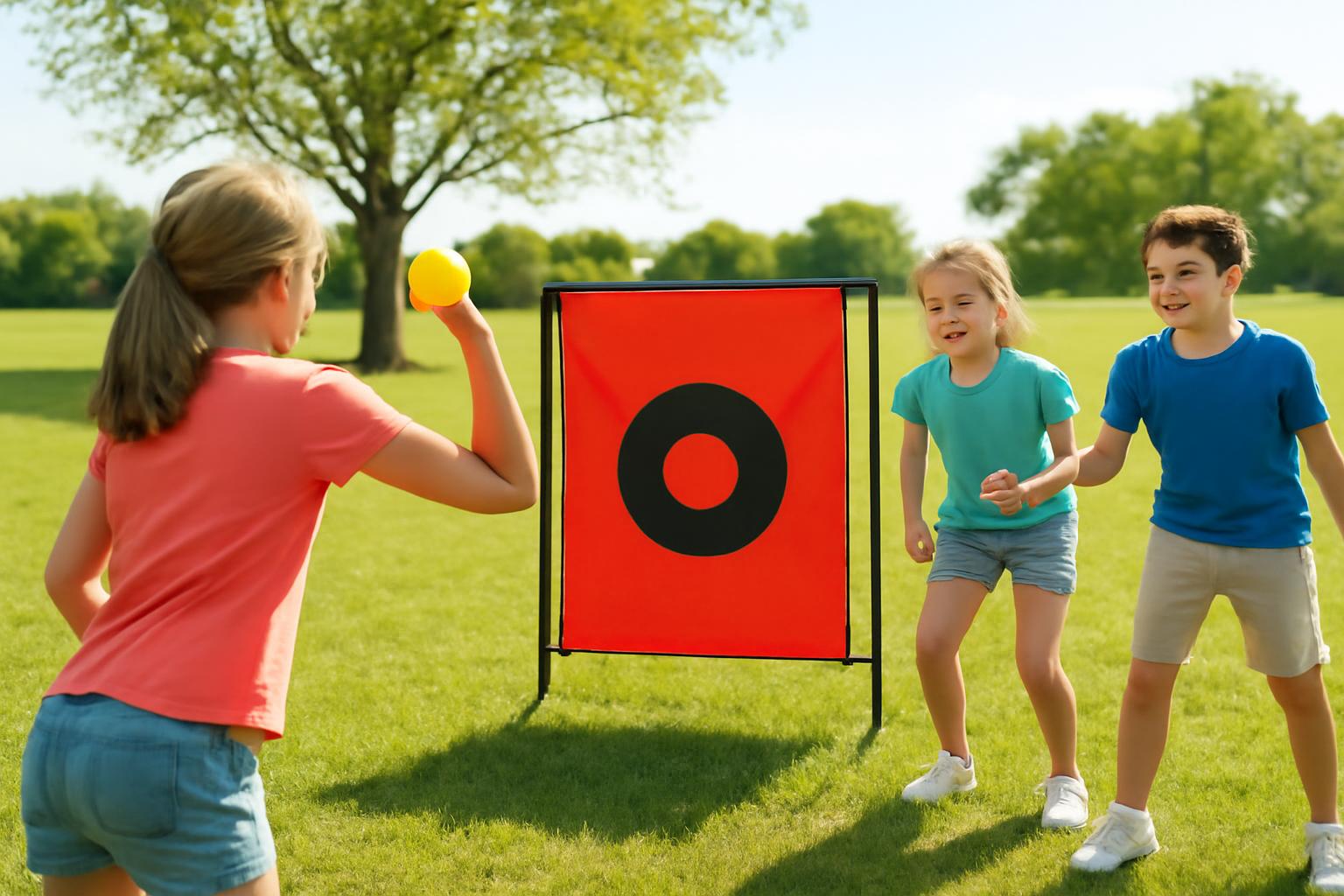
The familiar dodgeball-style version has two teams throwing balls at defended targets, with possible player elimination. Catches, revivals and scoring vary.
“Bombardment game” does not identify one official sport with a universal rulebook. It is better understood as a family of team throwing games whose objectives, court layouts, elimination rules, targets, scoring systems, and names vary among schools, camps, and recreation programs.
Two organizers can therefore advertise Bombardment while offering noticeably different activities. One may run a dodgeball-style elimination game with pins at each end. Another may award points for knocking over different targets. A third may direct throws at a large central ball rather than treating players as targets.
The practical answer is not to search for a supposedly official rule. Identify the version being offered, request its complete local rules, and distinguish documented mechanics from choices made by the organizer. Because the available evidence does not provide authoritative game-specific safety standards, this article is a terminology, setup, and rules-planning guide—not validated safety guidance for a particular group.
What Is the Bombardment Game?
Teams throw balls across a divided playing area while defending their players, targets, or both. Depending on the version, a team might win by knocking down opposing pins, eliminating opposing players, or completing both objectives.
A general-reference overview describes Bombardment as a dodgeball variation played with balls and pins. It also lists Pin Guard, Battle Ball, and Bombardo as alternate names. The same page reports a two-zone court with a central no-man’s-land, catch-and-revival rules, ball-on-ball deflections, a backboard-revival variation, and a four-team format. However, it carries cleanup notices and says it lacks sufficient inline citations. Its details should therefore be treated as examples of reported play, not authoritative standards. See the general-reference overview of Bombardment variations.
Several similarly named activities use related throwing concepts without sharing the same mechanics:
- Dodgeball-style Bombardment generally has opposing teams attack players, pins, or both.
- Galactic Bombardment is a timed target-scoring game with targets carrying different point values.
- Four-team Bombardment divides the playing area into quadrants and uses a last-team-remaining objective.
- Bombard has participants throw tennis balls at a large ball to propel it toward a finish zone.
- Bombard the Ball has opposing teams throw rings or sandbags at a central ball to move it into the other team’s territory.
Bombard and Bombard the Ball should not be inserted into a list of “official Bombardment variations” as though they were interchangeable rules for one standardized game. They are separately documented activities.
Throughout this guide, mechanics fall into three categories:
- Documented version: A format or rule described in an available activity guide.
- Optional house rule: A locally chosen rule that must be announced rather than assumed.
- Editorial planning recommendation: A practical step for turning the selected format into a clear local ruleset.
This distinction matters whenever a facilitator fills gaps left by an activity description. A reasonable local decision does not become a universal Bombardment rule merely because it makes the game playable.
Core Objective and Ways a Team Can Win
The basic two-sided concept is attack and defense. Each team attacks something on the opposing side while protecting its own side. What is being defended may be the players, a row of pins, several point-valued targets, or a combination of players and objects.
In one commonly reported dodgeball-style version, a team can win by:
- knocking down all opposing pins;
- eliminating all opposing players; or
- satisfying both conditions if the organizer combines the objectives.
These are documented possibilities, not official Bombardment win conditions.
Pins do not always perform the same function. In an elimination-oriented round, knocking down every opposing pin may end the game immediately. In a target-scoring format, each fallen target may add points without ending the round.
Galactic Bombardment illustrates the scoring approach. Players use gator balls to knock down targets on the opposing side and total their points after a five-minute round. The description also awards points for prisoners held at the end, although it does not explain how prisoners are created or released. PE Universe describes the five-minute Galactic Bombardment format.
Before play, the organizer should announce exactly how the round ends. Possible local formats include:
- Target elimination: The first team to knock down all opposing targets wins.
- Player elimination: The first team to eliminate all opposing players wins.
- Combined elimination: A team must eliminate the opposing players and knock down their targets.
- Point threshold: The first team to reach an announced score wins.
- Time limit: The team with the higher score when time expires wins.
- Last-team-standing format: The round continues until only one team remains.
When pins decide the round, target defense becomes central. When eliminated players cannot return, preserving active players has greater importance. If catches restore teammates, attempting a catch may reverse a numerical disadvantage. In a timed target game, high-value objects can matter more than eliminating every opponent.
Organizers should also decide what happens if the chosen condition produces a tie. The available descriptions do not establish a standard tiebreaker. A replay, sudden-death target, extra timed period, or shared result would therefore be a house rule and should be disclosed before play.
Equipment and Playing-Area Setup
- soft playground or dodgeball-style balls selected for the group and venue;
- pins or other clearly identifiable targets;
- cones, tape, or existing floor markings for boundaries; and
- an unobstructed playing area suitable for the selected format.
The available descriptions do not establish required numbers of balls, targets, or players. They also do not provide universal court dimensions, ball specifications, target spacing, or target-to-thrower distances.
Equipment terminology varies by source. A broad Bombardment description refers to dodgeballs, while Camp Ozark describes its local two-team activity as using soft playground balls. The camp groups participants by age and ability but does not publish detailed court, scoring, elimination, or retrieval rules. Camp Ozark outlines its local Bombardment activity.
One reported indoor layout divides a gym into three areas:
- one team’s zone;
- a central no-man’s-land; and
- the opposing team’s zone.
That description permits players to move within their own zone and the center area. It does not establish that players may enter the center in every activity called Bombardment. An organizer could instead keep participants behind a center line, allow entry only for retrieval, or divide the center into separate access lanes.
A simple planning diagram could look like this:
OUTER BOUNDARY
┌───────────────────────────────────────────────────────────────┐
│ Team A targets │ Team A zone │ Center │ Team B zone │ Team B targets │
└───────────────────────────────────────────────────────────────┘
OUTER BOUNDARY
Every measurement added to an actual diagram should be labeled as locally selected, not standard. Mark where participants begin, where targets stand, which lines may be crossed, and where eliminated or waiting players go.
Before a round, resolve these operational questions:
- May players enter the center area?
- May they cross the center completely?
- When may loose balls be retrieved?
- Who retrieves balls that leave the playing area?
- What happens to possession when a ball goes out of bounds?
- Can one player hold multiple balls?
- May targets be moved, shielded, or reset?
- What happens if a target falls without being struck by a legal throw?
- Where do eliminated players wait?
- Who confirms hits and fallen targets?
- What conditions pause play?
These are planning questions, not hidden official rules. Answering them before the opening signal prevents participants from discovering consequential mechanics only after the round has begun.
Hits, Catches, Deflections and Player Revival
Player elimination appears in dodgeball-style Bombardment, but not in every activity carrying the name. In one reported version, a player struck by a thrown ball is out. The same account says that catching an incoming throw generally eliminates the thrower and returns an eliminated teammate, although revival rules can vary.
That account also permits a player to deflect an incoming throw with a ball already being held. For children’s play, it describes qualifying hits as landing below the neck. This is a reported rule from one general-reference description—not an authoritative safety standard and not a substitute for applicable program or facility requirements. The reported version includes hits, catches, deflections, and revival variations.
Even if an organizer adopts catch-and-revival play, several questions remain:
- Which eliminated teammate returns?
- Does the first eliminated player return first?
- May the catcher choose who returns?
- Does one catch restore one teammate or several?
- Does revival happen immediately or after play stops?
- Where does the returning player re-enter?
- What happens if no teammate has been eliminated?
The available evidence does not establish universal answers. Each decision is a house rule.
A more dramatic reported variation makes contact with the opposing basketball backboard a team-revival event: all eliminated teammates return. Players need to know whether the backboard is an active target, what kind of contact counts, and whether the same team may trigger revival repeatedly.
Pregame ruling box
Announce all of the following before the opening signal:
- Legal hit areas: Which body areas count, and which do not?
- Completed catches: Must the ball be controlled before touching the floor, wall, ceiling, target, or another player?
- Catch consequence: Is the thrower eliminated?
- Revival: Does a catch return a teammate? If so, which teammate and when?
- Rebounds: Can a rebounding ball eliminate a player?
- Deflections: May a player block with a held ball, and what happens if that ball is dropped?
- Simultaneous events: How will near-simultaneous hits, catches, and target falls be handled?
- Waiting area: Do eliminated players wait outside the boundary, behind an end line, or in another marked area?
- Return procedure: Where and when do revived players re-enter?
The available descriptions do not resolve simultaneous catches, floor-first balls, pin rebounds, or blocked throws in enough detail to justify presenting one ruling as standard. A facilitator may choose consistent resolutions, but those resolutions should be identified as house rules and applied equally.
A Configurable Two-Team House-Rules Template
The following format is an editorial synthesis and proposed house-rules template. It combines documented elements into a playable structure, but it is not standardized, governing-body-approved, medically validated, or appropriate by default for every venue or participant.
1. Select the basic format
Start with:
- two teams;
- soft playground or dodgeball-style balls selected for the group and venue;
- targets placed at opposite ends;
- one marked zone for each team; and
- a clearly marked center area or center boundary.
Do not assume a particular team size, ball quantity, target quantity, court measurement, or round duration. None is established universally by the supplied descriptions. These details must be chosen locally.
2. Choose one primary end condition
Before play, select and announce one of the following:
- all opposing targets knocked down;
- all opposing players eliminated;
- both opposing players and targets eliminated; or
- a locally selected timed scoring format.
Avoid changing the objective during the round. If targets initially determine victory, they should not become point-only objects because one side gains an early advantage.
If a tie is possible, state the tiebreaking procedure at the same time.
3. Resolve movement and retrieval
Specify:
- whether players may enter the center;
- whether center access is continuous or limited to retrieval;
- whether participants may reach across a boundary;
- who retrieves out-of-bounds balls;
- when retrieved balls become live; and
- whether a facilitator may redistribute balls if one side controls all of them.
Ball redistribution is not established as a universal Bombardment mechanic. If used, it is a house rule intended to keep the locally selected format moving.
4. Choose the elimination package
Decide whether:
- a legal hit eliminates the struck player;
- a catch eliminates the thrower;
- a catch revives a teammate;
- ball-on-ball deflections are legal;
- rebounds remain live; and
- targets may be defended with a held ball.
Identify the legal hit areas and the waiting location for eliminated players. If the group is using a target-only format, state explicitly that throws are directed at the designated objects rather than at participants.
5. Explain the game in a fixed sequence
A concise pregame explanation can follow this order:
- Show the outer boundaries and center markings.
- Identify the areas players may and may not enter.
- Place and identify the targets.
- Assign teams to their starting sides.
- Explain legal throws, hits, catches, blocks, and retrieval.
- Explain whether eliminated players return and how that happens.
- State the target rules and scoring system.
- Announce the exact round-ending condition and any tiebreaker.
- Begin on one clear signal.
- Stop play when the announced condition is met.
- Confirm the result and reset the players, balls, and targets.
If a complicated rule cannot be explained clearly before the round, simplify it rather than improvising multiple exceptions after play begins.
6. Run a fairness check between rounds
If one side dominates, first examine whether the local setup contributes to the imbalance:
- one end has less usable space;
- targets are harder to defend on one side;
- loose balls collect near one team;
- the center-access rule favors particular movement patterns;
- revival happens so frequently that elimination has little effect; or
- one target is disproportionately easy to hit or valuable.
When revising the setup, change only one variable at a time when practical. For example, move the targets without simultaneously changing catch rules and round duration. Tell both teams what changed before restarting.
This fairness check is an editorial planning method, not a documented Bombardment rule. The overall template also cannot replace facility policies, participant-specific assessment, or the supervision arrangements required by the organization running the activity.
Galactic and Four-Team Bombardment Variations
Named Bombardment variations can change more than a minor rule. They may replace elimination with scoring, introduce unusual targets, change the number of teams, or use a different revival trigger.
| Version | Objective | Targets | Scoring | Player status | Duration | Court format |
|---|---|---|---|---|---|---|
| Dodgeball-style Bombardment | Attack opposing targets, players, or both | Commonly pins | Targets may end the game rather than carry point values | Reported versions may use hits, catches, revival, and deflections | Locally selected | Commonly opposing team zones with a center area |
| Galactic Bombardment | Knock down point-valued targets on the opposing side | Bowling pins, fuzzy dice, sun, Cosmic Chicken | Target values plus points for prisoners held at the end | Prisoners affect scoring, but capture and release rules are not supplied | Timed; documented details below | Opposing sides; detailed layout not supplied |
| Four-team Bombardment | Remain after the other teams have been eliminated | Not consistently specified | Not consistently specified | Continues until one team remains | Not specified | Four quadrants |
| Backboard-revival variation | Pursue the selected Bombardment objective while creating a revival opportunity | Opposing basketball backboard acts as a revival trigger | Not specified | A backboard hit returns eliminated teammates | Not specified | Requires a basketball court and locally defined backboard rules |
The table compares reported formats; it does not establish a hierarchy of official variations.
Galactic Bombardment
Galactic Bombardment uses gator balls to knock over targets positioned on the opposing team’s side. Its documented scoring system is:
- Bowling pin: 1 point
- Fuzzy dice: the displayed value when the die falls
- Sun: 3 points
- Cosmic Chicken: 7 points
- Prisoner held at the end: 1 point
A round lasts five minutes, after which the points are totaled. The source categorizes the activity for grades 3–4, grades 5–6, and middle or junior high. Those are the source’s listing categories, not universal suitability findings. The Galactic Bombardment listing provides the target values, duration, and grade categories.
The reference to prisoners creates an important evidence limit. The written description does not say how a player becomes a prisoner, where prisoners wait, how they are released, or whether ordinary elimination rules apply. An organizer adopting this format must locate or create the missing procedures but should not present an invented prisoner system as part of the documented version.
Four-team and backboard-revival versions
The reported four-team version divides the playing area into quadrants and continues until only one team remains. The general-reference account says this version may be called German Bombardment, but it does not establish a verified historical origin for that name.
A multi-team court creates operational questions that do not arise in a two-sided game. Organizers must decide whether a team may attack any opponent, whether adjacent and diagonal throws are both permitted, what happens to an eliminated quadrant, and whether active players may retrieve balls from a vacant area. Those decisions are local rules.
The backboard-revival version demonstrates how one mechanic can reshape the game. Instead of returning one player through a catch, contact with the opposing basketball backboard restores eliminated teammates.
Bombard and Bombard the Ball Are Different Games
Bombard and Bombard the Ball are separately documented activities. Although their names resemble Bombardment and all involve throwing, neither should be presented as an official alternative ruleset for dodgeball-style Bombardment.
Bombard
Bombard is a cooperative target-ball activity. Participants line up behind a throwing line and throw tennis balls at a large ball, attempting to propel it toward and beyond a finish zone. The large ball—not another participant—is the stated target.
One sample setup places the large ball about two metres from the throwing line and the finish zone about ten metres away. These distances are recommendations and may be shortened. The listed equipment includes cones, tennis balls, other balls, and an exercise ball when available. The listed duration is 10 minutes. Kiddo provides the Bombard setup, duration, and adaptations.
Players continue throwing until the available tennis balls run out. They then collect the balls, refill the supply, and play again. Documented options include:
- using underarm throws;
- shortening the distances;
- creating opposing teams that push the large ball toward one another’s side;
- introducing a time limit; and
- requiring throws with the non-dominant arm.
The cooperative base format offers a clear alternative when an organizer wants the designated target to be a large ball rather than a player. That is a mechanical distinction, not evidence that the activity is safer, more accessible, or developmentally superior for every participant.
Bombard the Ball
Bombard the Ball is another central-ball activity, but it normally uses two facing teams. Participants throw rings or sandbags at a large ball positioned on a territorial boundary. A team scores when its throws move the ball into the opposing territory.
The published listing labels the activity beginner level and gives an age listing of six and older, a group range of 12–30 participants, and large-ball sizes from 14 to 48 inches. These specifications belong to that particular activity listing and do not apply to dodgeball-style Bombardment. Omnikin describes Bombard the Ball’s setup, listed participant range, equipment sizes, and variations.
The game may end at a selected point total or after a time limit. Suggested adaptations include:
- changing the throwing distance;
- placing teams side by side and racing separate balls toward a finish line;
- rolling or sliding objects;
- changing the throwing technique;
- playing while seated or standing;
- omitting scoring; and
- running two simultaneous games for four teams when space permits.
These options demonstrate that the published format can be modified. They do not establish that any particular modification is suitable for every participant or setting.
The key distinction is the stated target:
- In dodgeball-style Bombardment, players may attack opposing players, defended targets, or both.
- In Bombard, participants throw tennis balls at a large ball to move it toward a finish zone.
- In Bombard the Ball, opposing teams throw rings or sandbags at a central ball to move it into the other team’s territory.
Choosing Rules for a Youth Group—and Knowing the Evidence Limits
For a parent, the name “Bombardment” provides too little information to evaluate the activity. Ask the organizer to describe the actual format rather than relying on the title.
Begin with these questions:
- Which version of Bombardment are you using?
- Are participants intended targets, or are throws directed at objects?
- What counts as a legal hit?
- Which body areas count?
- What happens when a ball is caught?
- Can eliminated players return?
- If revival is possible, who returns and when?
- Are held-ball deflections permitted?
- What role do the pins or other targets play?
- Where do eliminated or waiting players stand?
- How does a round end?
- How are ties and disputed calls resolved?
Then ask how the activity will operate:
- What are the court boundaries?
- May players enter the center?
- Who retrieves balls from the center or outside the court?
- How are participants grouped?
- Who supervises play?
- What happens after a disputed or prohibited throw?
- Which school, camp, recreation, or facility requirements apply?
- What local modifications are available for an individual participant?
Camp Ozark recommends its own soft-playground-ball activity for ages seven and older and says participants are grouped by age and ability. That information describes the camp’s local format; it does not make seven a universal minimum age for Bombardment or establish the suitability of another organizer’s version. Camp Ozark states its local recommendation and grouping approach.
Likewise, Galactic Bombardment’s grade categories do not answer every practical question. Its written description does not provide safety procedures, team sizes, court dimensions, or equipment quantities.
The available evidence does not establish authoritative, game-specific standards for:
- legal hit zones;
- spacing between participants;
- ball size, material, or inflation;
- target placement;
- court dimensions;
- ball and target quantities;
- supervision levels;
- revival mechanics; or
- accessibility modifications.
Accordingly, this guide does not certify a format as safe or suitable. As a prudent planning step, organizers should follow the requirements of the school, camp, recreation program, and facility running the activity, while accounting for the needs of the actual participants.
If the organizer specifically wants to avoid player-targeting or elimination mechanics, Bombard or Bombard the Ball provides a clearer central-ball format. That is a format choice, not a proven safety, accessibility, or developmental recommendation.
Ultimately, asking for “the rules of the Bombardment game” does not produce one universal answer. The recognizable dodgeball-style version combines two teams, thrown balls, defended targets, and possible player elimination, but catches, revivals, center access, scoring, and match length remain variable. Identify the exact version and obtain its complete local rules before participation: the activity’s name is less informative than what players will actually be asked to do.
Is Bombardment the same as dodgeball?
Not exactly. One commonly reported form is a dodgeball variation in which two teams throw balls while attacking players, pins, or both. A camp may also use Bombardment as the name for its own local two-team activity.
Other similarly named formats emphasize target scoring or moving a central ball. Ask whether players are targets, what the pins do, and whether eliminated players can return.
What happens when a player catches a ball in Bombardment?
In one reported version, catching a thrown ball eliminates the thrower and returns an eliminated teammate. That rule is not universal.
The organizer should specify whether a catch eliminates the thrower, whether it revives anyone, which player returns, and what constitutes a completed catch. Rebounds, simultaneous hits, and balls that touch another object first require explicit local rulings if the chosen activity guide does not address them.
How long does a Bombardment game last?
There is no standard match length. An elimination round may continue until its selected player or target condition is met, while a scoring version may use a fixed period or point threshold.
Some named activities publish their own durations, but those timings apply only to those documented formats. The organizer should announce the local round length and any overtime or tiebreaking procedure before play.
What is the difference between Bombardment, Bombard and Bombard the Ball?
Dodgeball-style Bombardment generally has opposing teams attack players, defended targets, or both.
Bombard has participants throw tennis balls at a large ball to move it toward a finish zone. Bombard the Ball normally has opposing teams throw rings or sandbags at a central large ball to move it into opposing territory.
The similar names describe related throwing concepts, not one standardized game.
What age is Bombardment suitable for?
No universal age threshold is established. Available activity pages use their own age or grade classifications, but those labels apply only to the versions they describe.
Parents and facilitators should evaluate the exact local rules, whether participants are targeted, the equipment, court layout, grouping method, available modifications, and supervision arrangements rather than relying on the activity’s name or a single age label.