
Which Shoes Should Your Child Wear on an Artificial Field?
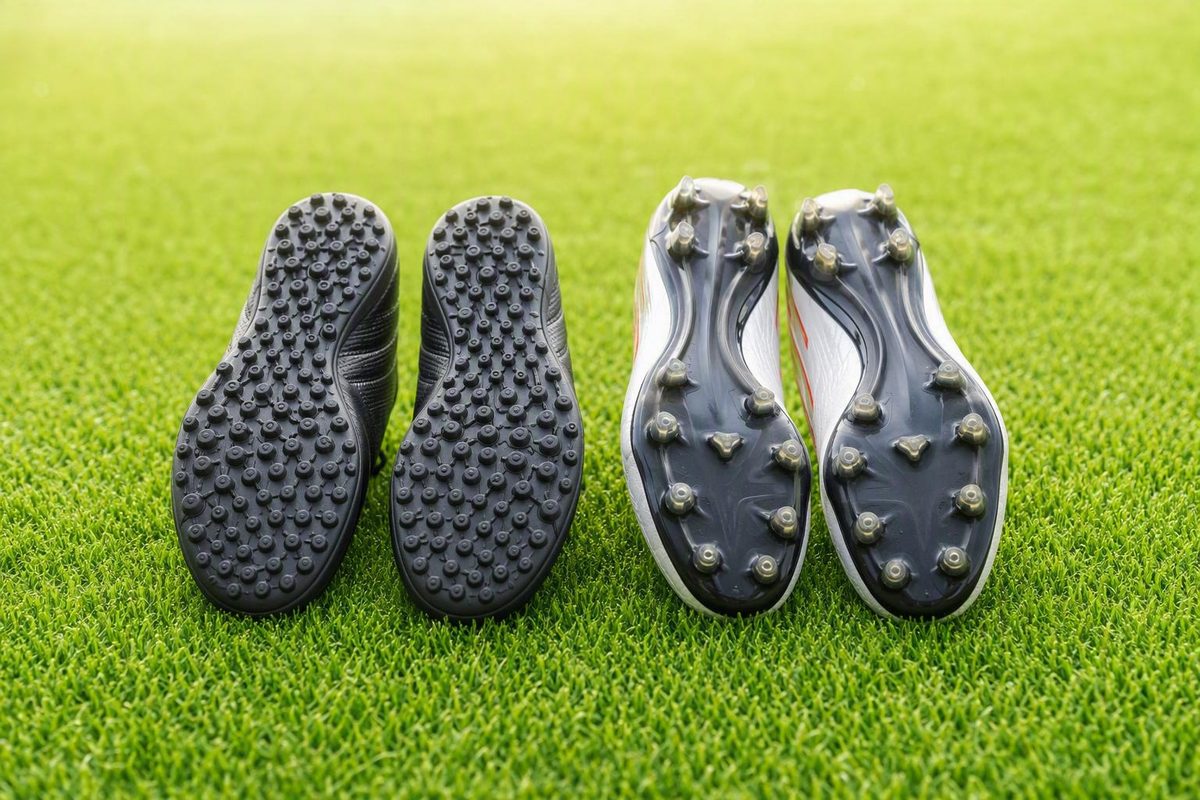
AG may suit compatible modern artificial grass, while TF generally suits short or hard turf. Never assume long, aggressive, bladed, or metal studs are suitable.
The short answer: Some cleats work on turf, but not every cleat does
Yes, a child can wear some turf-compatible cleated shoes on some artificial fields. But “Can you wear cleats on turf?” does not have a universal yes-or-no answer. The correct choice depends on:
- the field’s construction and current condition;
- the shoe’s soleplate and manufacturer-approved uses;
- the sport being played; and
- the facility, league, tournament, and age-group rules.
For soccer and footwear using soccer-style surface labels, start with this rule:
- Modern artificial grass with deeper fibers and infill: Look for AG footwear or a specific MG model approved for that surface.
- Short, compact, carpet-like turf: Use TF turf shoes with dense, low rubber nubs.
- Hard indoor court: Use flat, non-marking IC or indoor shoes.
- Natural grass: Use grass-specific footwear matched to the field condition.
Baseball, softball, football, and lacrosse families should treat those labels as useful descriptions—not universal rules for their sports. Use sport-specific footwear approved for the surface, then confirm the local equipment policy.
Conventional FG soccer cleats are primarily intended for firm natural grass. Some selected FG models may be usable on certain artificial fields, but that does not make every FG sole appropriate. SG shoes with long or metal studs—and shoes with aggressive, long, or widely spaced blades—should not be used on artificial turf by assumption. Youth soccer guidance allows qualified use of some FG models on turf but generally favors AG footwear for synthetic grass (Barça Residency Academy’s surface-based cleat guide).
There is also an important difference between physical usability and permission. A molded shoe may appear to grip the surface but still be prohibited. The facility may restrict cleats to protect its field, while the league or tournament imposes a separate equipment rule. Some indoor artificial-turf programs prohibit cleats altogether, so parents should check the participating program’s requirements rather than relying only on the outsole category (clinician-authored guidance on youth sports cleats).
| Playing surface | Usual starting choice | What not to assume |
|---|---|---|
| Modern infill artificial grass | In soccer, manufacturer-rated AG or approved MG; in other sports, surface-rated sport-specific footwear | That every FG or molded-plastic cleat is compatible |
| Short, compact, or carpet-style turf | TF or sport-specific turf shoes with many small rubber nubs | That longer cleats provide better controlled traction |
| Dry or slightly damp natural grass | Sport-appropriate firm-ground footwear | That TF shoes provide enough grip everywhere |
| Wet, soft, or muddy natural grass | Permitted grass-specific footwear suited to soft conditions | That metal or long SG studs are allowed in a youth league |
| Hard indoor court | Flat, non-marking indoor shoes | That TF shoes or any field cleat belongs on a hard court |
Treat the table as a screening tool, not final authorization. Practical footwear guidance comes largely from manufacturers, retailers, academies, clubs, and field companies, and terminology can vary. The specific shoe documentation and local rules control the final decision.
First identify what the facility means by “turf”
Parents often receive conflicting advice because “turf” describes more than one type of synthetic surface. One coach may mean a modern outdoor artificial-grass field. Another may mean a short, firm indoor carpet. Recommendations that sound contradictory may concern different fields.
Modern artificial grass
Loose infill may be visible between the fibers, although its composition, depth, and condition vary.
In soccer, AG footwear is designed for this broad category. Its sole generally distributes numerous short studs across more of the foot instead of relying on a small number of long penetration points. An MG shoe may also work if its manufacturer identifies that specific model as compatible with artificial grass.
For baseball, softball, football, or lacrosse, do not assume that a soccer AG label answers the question. Look for sport-specific manufacturer guidance and the field’s policy.
Short or carpet-like turf
Short turf looks and feels more like dense outdoor carpet.
This is where TF turf shoes or sport-specific turf trainers are usually the better starting point. Their soles have many small rubber nubs or a dense tread pattern, creating broad contact without requiring long studs to penetrate the surface. Soccer guidance similarly distinguishes AG cleats for synthetic grass from nubbed turf shoes for shorter or older artificial surfaces.
Visual checks that help—but do not settle the answer
From the sideline, look for:
- Fiber depth: Does the surface have upright grass-like blades, or does it look nearly flat?
- Visible infill: Can you see loose granules between the fibers?
- Firmness: Does it feel like a deeper field system or a thin carpet over a hard base?
- Wear: Are fibers flattened, seams exposed, or high-traffic areas noticeably thinner?
- Field setting: Is it a full outdoor field, indoor multipurpose space, batting area, or hard court?
Appearance alone does not guarantee compatibility. Two fields that look similar may have different installation systems, maintenance conditions, or footwear policies. If you cannot identify the surface, ask the coach or facility manager:
Is this modern infill artificial grass or short carpet turf, and which outsoles are allowed for this sport?
Field condition also matters. The word “turf” on the schedule does not resolve those variables.
How to read AG, MG, FG, SG, TF, and IC shoe labels
These abbreviations are most commonly used in soccer footwear. They may appear on the box, product page, tongue, insole, or soleplate. They are a useful first filter, but the same abbreviation does not guarantee identical construction across manufacturers.
| Label | Full name | Typical visible sole features | Intended surface | Main turf caveat |
|---|---|---|---|---|
| AG | Artificial Ground or Artificial Grass | Numerous short studs, often rounded or conical and distributed across the sole | Compatible modern artificial grass | Still requires model-specific and venue approval |
| MG | Multi-Ground | Mixed stud pattern intended for more than one surface category | Only the surfaces listed by the manufacturer | “Multi” does not mean every field |
| FG | Firm Ground | Fewer, longer molded studs; may be conical, chevron-shaped, or bladed | Dry or slightly damp natural grass | Selected models may work on some turf, but AG or approved MG is preferable |
| SG | Soft Ground | Longer, often removable studs; some configurations use metal | Wet, soft, or muddy natural grass | Long or metal configurations should not be assumed suitable or permitted on synthetic fields |
| TF | Turf | Many small, low rubber nubs across a broad sole | Short, compact, worn, or hard synthetic turf | Usually offers less traction on wet, soft, muddy, or uneven grass |
| IC/IN | Indoor Court/Indoor | Flat, usually non-marking rubber sole with no field studs | Hard indoor courts | Not designed as an artificial-grass cleat |
AG: artificial ground or artificial grass
AG shoes are cleated shoes, but they are not the same as conventional long-stud grass cleats. They generally use more numerous, shorter studs spread across the sole. Many designs favor rounded or conical geometry, although exact patterns differ.
Use AG only where the manufacturer identifies the model for artificial grass and the facility permits it. “AG” is a design category, not a promise that the shoe suits every synthetic installation.
MG: multi-ground
MG footwear attempts to cover more than one surface. It can be a reasonable compromise for a child who regularly switches between compatible artificial grass and firm natural grass.
Read the model description carefully. “Multi-ground” is not a universal license for modern artificial grass, carpet turf, mud, and hard courts. Confirm that the manufacturer lists the actual surfaces in the child’s schedule.
FG: firm ground
FG cleats are designed primarily for firm natural grass. They commonly have molded plastic or rubber studs that are longer and less densely distributed than an AG pattern. Some guidance allows selected FG models on certain synthetic surfaces, while other guidance recommends avoiding conventional FG designs, particularly aggressive blades.
That variation is a reason to inspect the specific shoe, not just the letters. An FG shoe with short, rounded studs may interact differently from one with long blades, but neither should be treated as turf-approved without model documentation and local permission.
SG: soft ground
SG footwear is designed to penetrate wet, soft, or muddy natural ground. It often has fewer, longer studs, and some models use removable metal components. Those properties make SG a poor default for a firm synthetic field.
Do not improvise with SG shoes on turf merely because they are already in the equipment bag.
TF: turf
TF shoes have a broad rubber outsole covered with many small nubs. They are the usual soccer choice for short, compact, hard, worn, or carpet-like synthetic surfaces. The many low contact points distinguish them from AG shoes, which still have recognizable field studs.
Other sports sell comparable turf trainers without using the TF abbreviation.
IC or IN: indoor court
Indoor shoes have flat, non-marking soles for hard gym or futsal-style courts. A facility being indoors does not automatically mean it requires IC footwear: an indoor building may contain carpet turf, deeper artificial grass, rubberized training material, or a hard court.
A quick visual shortcut
If the label is hard to find, turn the shoe over:
- Dense, tiny rubber nubs: probably TF or another turf trainer.
- Many short, rounded studs: likely AG or a related artificial-surface design.
- Fewer long or widely spaced studs: likely FG or SG.
- Long blades or metal components: stop and verify before using the shoe on turf.
- Flat rubber outsole: likely IC or another court shoe.
Visual identification helps parents ask the right question. It cannot establish manufacturer approval or permission by itself.
Why stud length, shape, spacing, and material matter
Grass-oriented studs are designed to enter soil. Natural ground can compress, deform, or break away under load. Synthetic fibers over a constructed base may respond differently, particularly when the surface is firm, worn, cold, or unevenly filled.
A soleplate can affect several distinct aspects of play:
- Pressure underfoot: A small number of long studs concentrates load at fewer points. On a firm surface, a child may feel individual studs pressing through the sole.
- Straight-line traction: The player needs enough grip to accelerate and stop without repeated uncontrolled sliding.
- Rotational release: During a cut or pivot, the planted foot needs to turn or release rather than feel excessively fixed.
- Field protection: Long or sharp spikes may pull at fibers or damage the playing surface.
Stronger grip is not automatically better. The practical target is controlled traction: enough grip for running and direction changes, but not so much that the shoe appears to lock into the field.
Mass General Brigham describes a plausible injury mechanism in which cleats remain momentarily fixed in artificial fibers during running, cutting, or pivoting. If the planted foot does not release while the athlete’s body continues moving, force may transfer to lower-body tissues. The medical overview also cautions that evidence does not establish that artificial turf alone universally causes more non-contact injuries than natural grass; turf construction, weather, conditioning, fitness, and previous injuries can also affect risk (Mass General Brigham’s review of turf, grass, and injury mechanics).
That mechanism supports careful footwear matching. It does not prove that AG cleats or turf shoes prevent knee, ankle, tendon, or ligament injuries. Natural grass has its own variables, including divots, mud, hardened ground, and inconsistent maintenance.
Stud material does not answer the question by itself. Plastic can still be long, sparse, bladed, or poorly matched to the field. Metal may face stricter restrictions, but “no metal” does not mean “all molded plastic approved.”
Field damage is a separate issue from athlete movement. Some facilities prohibit traditional spikes because they may tear or create holes in synthetic surfaces. Baseball-oriented manufacturer guidance also notes that traditional baseball cleats are often restricted at turf facilities because of field-damage and catching concerns (Under Armour’s guide to baseball turf footwear).
Rules differ by sport, facility, league, and age group
Footwear advice from one sport should not automatically be transferred to another. Soccer, baseball, softball, football, and lacrosse use different footwear designs, playing areas, movement patterns, and equipment rules. Even within one sport, an indoor practice center may have a stricter policy than an outdoor stadium.
Sport-by-sport summary
| Sport or setting | Practical starting point | What is not universal |
|---|---|---|
| Soccer on modern artificial grass | AG or manufacturer-approved MG footwear | Not every FG or molded shoe is approved |
| Soccer on short or hard turf | TF shoes | TF is not automatically best for deeper infill grass |
| Baseball or softball at a turf-only facility | Sport-specific turf shoes are commonly favored | No single rule applies to every facility |
| Baseball or softball switching between surfaces | An approved molded or hybrid option may be a compromise | Molded construction alone does not establish permission |
| Football or lacrosse on artificial grass | Sport-specific footwear approved for the field and ruleset | Soccer labels do not automatically control |
| Indoor artificial-turf program | Ask whether turf shoes, approved cleats, or flats are required | Some programs prohibit cleats entirely |
| Hard indoor court | Flat, non-marking indoor shoes | Turf shoes and field cleats are not court shoes |
Soccer
For soccer, AG cleats are a common recommendation on compatible modern artificial grass. TF shoes generally suit short, compact, or hard synthetic turf. Selected FG designs may sometimes be permitted, but AG or an approved MG model is the clearer starting point.
Do not assume that a shoe is appropriate because a professional player appears to wear a similar upper. The soleplate variant matters, and the child’s venue may impose its own rule.
Baseball and softball
Turf-only baseball and softball facilities commonly favor turf shoes. For schedules alternating between synthetic and natural surfaces, some sport-specific guidance presents molded or hybrid shoes as a practical compromise. That does not establish universal approval: the exact outsole and local rules still matter (SQAIRZ’s comparison of turf, molded, and metal baseball footwear).
Traditional baseball spikes may be prohibited at some turf facilities because of field-protection or catching concerns. A metal ban does not imply that every molded baseball cleat is acceptable.
Football and lacrosse
Football and lacrosse footwear may look similar to soccer cleats, but sport-specific construction and rules differ. Check the team equipment list and governing rules rather than buying solely from a soccer-oriented AG/FG chart.
The field operator may also impose a policy stricter than the league’s general equipment rule. A shoe can satisfy one requirement and fail the other.
Indoor programs
“Indoor” describes the building, not necessarily the floor. An indoor center might contain:
- short carpet turf;
- deeper infill artificial grass;
- rubberized training material; or
- a hard court.
Some indoor artificial-turf programs prohibit cleats entirely. Ask what outsole is required rather than assuming that every indoor field accepts TF shoes—or that every artificial field accepts AG cleats.
Before game day, check:
- the program equipment list;
- facility signage or website;
- tournament or league rules; and
- the coach’s current instructions.
If they conflict, ask the organizer which rule governs that event. Posted permission and personal traction preference are separate questions.
What to do if your child has only one pair for today’s game
Do not decide based only on whether the studs are metal or plastic. Use this five-step check.
1. Identify the field
Determine whether the field is modern infill artificial grass, short carpet-like turf, a hard indoor court, or natural grass. If you cannot tell, ask the facility or coach before the child warms up.
2. Inspect the sole label
For soccer-style footwear, look for AG, MG, FG, SG, TF, IC, or IN on the shoe, box, product listing, or manufacturer documentation.
- AG: possible choice for compatible modern artificial grass.
- Approved MG: possible mixed-surface choice.
- TF: usual alternative for short or carpet-like turf.
- IC/IN: hard indoor court.
- FG: requires closer review and explicit turf approval.
- SG: do not improvise on synthetic fields.
For another sport, identify the exact model and its listed surfaces rather than forcing it into a soccer category.
3. Check stud material and geometry
Turn the shoe over. Molded plastic does not prove turf compatibility. Long, sparse, sharp, or bladed molded studs may still be poorly matched or prohibited.
Do not use SG metal studs or conventional spikes when approval cannot be confirmed. Previous use on natural grass—or even on another artificial field—does not establish that they are appropriate today.
4. Confirm the rules
Look for posted signs near the entrance, bench, or field gate. Check the registration email and tournament instructions. Ask a precise question:
Are these specific molded AG, MG, FG, or sport-specific studs allowed?
That is more useful than asking, “Are cleats okay?” If the answer remains uncertain, ask the coach to obtain a ruling before play begins.
5. Use warmups as a precautionary screen
Even an approved shoe may feel different as field and weather conditions change. During controlled warmups, ask about:
- painful pressure from individual studs;
- repeated or uncontrolled sliding;
- instability when stopping;
- a catching or sticking sensation during gentle pivots; or
- new discomfort.
This is a precautionary observation, not a validated test proving that a shoe is safe. Do not ask a child to perform increasingly aggressive cuts to test release. If the shoe causes pain, repeated slipping, instability, or obvious catching, stop using it and consult the coach or facility staff about another permitted option.
A brief or one-time use is not automatically safe because the shoes worked elsewhere. Surface construction, field condition, weather, and movement demands may differ.
Have the child change into ordinary shoes before walking across asphalt, concrete, or gravel.
If no permitted, compatible shoe is available, speak with the coach. A loaner pair, modified participation, or sitting out may be more appropriate than guessing with long, aggressive, or metal studs.
Choosing footwear for turf-only and mixed-surface schedules
The right buying strategy depends on the full season, not just one away game. Review practice locations, home fields, tournament venues, and indoor winter sessions before purchasing.
Buying path 1: Occasional turf use
If the child plays primarily on natural grass but has a few games on modern artificial grass, first check whether the existing shoe is manufacturer-approved and accepted by those venues.
An approved MG model may be a practical budget compromise when:
- the manufacturer lists both relevant surfaces;
- the stud pattern is appropriate for the synthetic field;
- the sport permits the design; and
- the facility allows it.
If the occasional venue uses short carpet turf, a turf shoe may still be necessary. A shoe intended for deeper artificial grass is not automatically the best match for a hard indoor carpet.
Buying path 2: Regular turf-only play
For regular soccer on modern artificial grass, consider manufacturer-rated AG footwear. For regular play on short, compact, or hard turf, consider TF footwear or the equivalent sport-specific turf trainer.
This is usually the clearest path because the sole is selected around the surface the child encounters most often. Do not buy solely for maximum grip. Fit, comfort, sport-specific construction, field condition, and facility rules all matter.
Buying path 3: Frequent switching between synthetic and natural fields
Separate surface-specific pairs are often the most straightforward option:
- AG for compatible modern artificial grass or TF for short synthetic turf; and
- FG or other sport-appropriate footwear for dry or slightly damp natural grass.
This costs more initially, and children may outgrow both pairs. The advantage is clarity: each sole has a defined job, reducing reliance on an ambiguous compromise.
AG cleats may provide usable traction on dry, firm natural grass but can be less suitable when grass becomes soft or wet. TF shoes generally provide less traction on wet, soft, muddy, or uneven natural ground. Retailer guidance likewise distinguishes flat indoor shoes, short-lug turf footwear, and longer-stud grass cleats according to surface interaction (Soccer.com’s turf-shoe and cleat comparison).
Before buying, answer:
- How many practices are on modern artificial grass?
- How many games are on short indoor turf?
- How often will the child play on natural grass?
- Are wet or muddy fields common?
- Does the league restrict metal, blades, or particular stud types?
- Will tournaments use different venues?
- Is there a clearly approved MG or sport-specific hybrid option?
If the schedule is almost entirely on one surface, buy for that surface rather than for a hypothetical exception. If the schedule is genuinely split, compare the cost and clarity of two pairs with the limitations of one approved mixed-surface pair.
A parent’s pre-play footwear checklist
Use this checklist before a new season, away game, tournament, or unfamiliar facility.
1. What is the surface?
- [ ] Modern artificial grass with deeper fibers and visible or detectable infill
- [ ] Short, compact, worn, or carpet-like synthetic turf
- [ ] Hard indoor court
- [ ] Dry or slightly damp natural grass
- [ ] Wet, soft, or muddy natural grass
- [ ] Surface is unclear—stop and ask the facility or coach
Reassess when the field is wet, frozen, worn, unusually hard, or uneven. Those conditions can change traction, but no one outsole recommendation covers every installation and weather condition.
2. What is the soleplate?
For soccer-style footwear:
- [ ] AG
- [ ] MG
- [ ] FG
- [ ] SG
- [ ] TF
- [ ] IC/IN
- [ ] No readable label
Inspect the outsole:
- [ ] Many short, rounded studs
- [ ] Dense, low rubber nubs
- [ ] Fewer long or widely spaced studs
- [ ] Long or aggressive blades
- [ ] Metal or removable components
- [ ] Flat, non-marking rubber sole
If the label is missing and the geometry is unclear, do not infer approval merely because the studs are molded.
3. What does the manufacturer approve?
- [ ] The exact model is rated for this surface
- [ ] The manufacturer’s surface list has been checked
- [ ] “MG” or “hybrid” explicitly includes both intended surfaces
- [ ] Any relevant care or warranty restrictions have been reviewed
- [ ] Approval cannot be confirmed—stop and ask
Look up the exact model, not just the product family.
4. What does the venue allow?
- [ ] Facility policy checked
- [ ] League or tournament equipment rule checked
- [ ] Age-group restriction checked
- [ ] Coach instructions checked
- [ ] Metal restrictions checked
- [ ] Molded, bladed, or other stud restrictions checked
- [ ] Posted rules conflict with online guidance—ask the organizer
Remember: allowed does not mean preferred, and personally comfortable does not mean permitted.
5. How does the shoe behave during warmups?
- [ ] No painful stud pressure
- [ ] No repeated uncontrolled sliding
- [ ] No obvious catching during controlled pivots
- [ ] No instability when stopping or changing direction
- [ ] Fit remains secure and comfortable
- [ ] Conditions have not changed enough to require reassessment
This precautionary check may reveal an obvious problem, but it cannot prove that a shoe will prevent injury or remain suitable during full-speed play.
Compact decision tree
Is the field modern artificial grass?
- Yes, and the child plays soccer: Is the shoe manufacturer-rated and venue-approved?
- Yes: Use AG or an approved MG option.
- No or unclear: Stop and ask; do not assume FG, molded plastic, blades, or metal are acceptable.
- Yes, and the child plays another sport: Use sport-specific footwear approved by the manufacturer and local rules.
Is the field short, compact, or carpet-like turf?
- Yes: Use TF or sport-specific turf shoes unless the facility specifies another permitted outsole.
Is it a hard indoor court?
- Yes: Use flat, non-marking indoor shoes.
Is it natural grass?
- Yes: Use sport- and condition-appropriate grass footwear, considering whether the field is firm, wet, soft, or muddy.
No generic guide overrides a facility’s equipment policy or a manufacturer’s model-specific instructions. The reliable decision is not simply “cleats” versus “no cleats.” It is to identify the exact surface, inspect the exact soleplate, verify its approved uses, and confirm the rules for that sport and event.
Frequently asked questions
Can molded plastic cleats be worn on artificial turf?
Sometimes, but molded plastic is a material description—not proof of turf compatibility.
An AG or approved MG soccer shoe may use molded studs and be appropriate on compatible modern artificial grass. Some baseball and softball guidance also treats selected molded or hybrid shoes as mixed-surface options. Conventional FG or sport-specific molded cleats, however, may have long, sparse, or bladed studs that are poorly matched or prohibited.
Check the model’s approved surfaces and the venue rule. A ban on metal does not automatically approve every plastic cleat.
Are metal cleats allowed on turf?
Do not assume so. Some facilities prohibit metal cleats or traditional spikes because of concerns about surface damage or spikes catching in synthetic fibers. Rules vary, so it would be inaccurate to say that metal is universally prohibited on every artificial field (Under Armour’s baseball turf guidance).
SG metal studs are intended for soft natural ground, not as a default artificial-turf option. Confirm the facility, league, tournament, sport, and age-group rules before use.
What is the difference between AG cleats and turf shoes?
AG cleats have recognizable studs—generally shorter and more numerous than conventional FG studs—and are intended for compatible modern artificial grass.
TF turf shoes have a broad rubber outsole covered with many small, low nubs. They are generally used on short, compact, hard, older, or carpet-like synthetic turf.
In shorthand: many short studs suggest AG; dense tiny nubs suggest TF. These are primarily soccer labels, and neither category overrides local rules.
Can AG cleats or turf shoes also be worn on natural grass?
AG cleats may provide usable traction on dry, firm natural grass, but they may not grip adequately on soft or wet ground. TF shoes can sometimes function on very dry, short grass, but their low nubs generally offer less traction on wet, muddy, soft, or uneven natural surfaces.
For children who switch frequently, separate surface-specific pairs are often clearer: AG or TF for the applicable synthetic field and FG for firm natural grass. An approved MG shoe may be a budget compromise when its manufacturer and both venues support the intended uses.
Can cleats get stuck in artificial turf and cause an injury?
A cleat can momentarily remain fixed in artificial fibers during running, cutting, or pivoting. If the planted foot does not release while the body continues moving, force may transfer to lower-body tissues. Stud geometry, footwear, turf construction, weather, maintenance, conditioning, fitness, and previous injuries can all influence what happens (Mass General Brigham’s review of the mechanism and evidence limits).
That mechanism is plausible, but it does not prove that artificial turf alone universally causes more non-contact injuries than natural grass. Nor does it prove that AG or TF footwear prevents a particular injury.
The final decision is straightforward even when the answer is not universal: identify the surface, choose sport- and surface-appropriate footwear, verify the exact model’s approved uses, and follow the venue’s rules. AG may suit compatible modern artificial grass, while TF generally suits short or hard turf; long, aggressive, bladed, or metal studs should never be used by assumption.