
Breaking Down the True Price of Building a Backyard Tennis Court
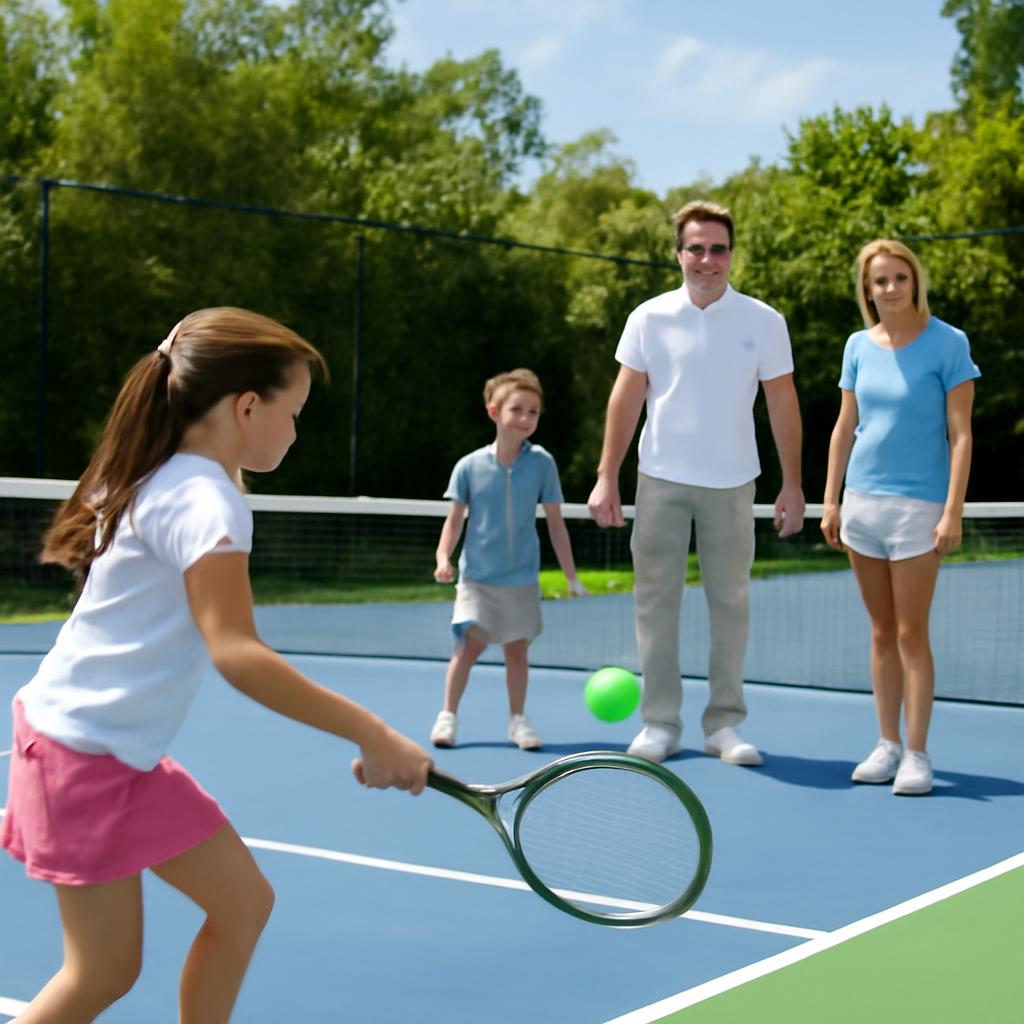
A slab-only or tile-only number is not a court number. Compare real costs across site work, base, surface, fencing, lighting and stated exclusions.
For a family with serious tennis players at home, a private court can sound like a clean alternative to recurring court rentals, club time, or constant driving to practice. But the numbers online are messy because many published estimates are not pricing the same project. Some cover a full outdoor regulation build. Some blend in resurfacing jobs, compact practice courts, or partial backyard installs. Others quote only one product layer, not the slab, excavation, drainage, fencing, or lighting beneath and around it.
That scope problem is the reason tennis court pricing can look wildly inconsistent. In this guide, the homeowner-facing numbers are treated as the main budgeting base, while school- and club-oriented figures are used only as directional context where helpful. On that narrower residential reading, a durable, regulation-size outdoor backyard court is more often a mid-five-figure to low-six-figure project than a casual backyard upgrade: Bankrate’s overview puts the average regulation doubles court around $65,000, Northwest Fence & Iron translates installed costs to roughly $40,000 to $100,000 for a standard 120-by-60-foot footprint, and Hybrid Clay’s guide places outdoor courts around $50,000 to $100,000.
That makes this less of a “fun addition” decision and more of a construction-budget decision. If you are weighing that kind of one-time spend against the recurring cost of lessons, leagues, and travel, it can help to compare it with the broader family sports budget in What Youth Sports Actually Cost.
The clearest way to plan a court is to break it into four buckets: site preparation, base and surface, perimeter features such as fencing and lighting, and long-term maintenance. Once you separate the project that way, the quotes become much easier to compare.
Total Cost Ranges for a Tennis Court
A realistic all-in price for a full outdoor tennis court depends heavily on scope, so the first step is to normalize what each published number is actually describing.
| Scope you are pricing | Published number | What that number most usefully means |
|---|---|---|
| Homeowner database average | Angi and HomeAdvisor both show $14,889 average, with a normal range of $5,776 to $24,002 | Best treated as a mixed bucket that likely includes smaller courts, simple backyard jobs, and resurfacing/remodel work alongside some new builds |
| Full outdoor residential regulation court | Bankrate gives an average of $65,000 and an overall $25,000 to $115,000 range; Northwest Fence & Iron gives $40,000 to $100,000 for a 120-by-60-foot court; Hybrid Clay gives $50,000 to $100,000 for outdoor courts | This is the most useful lane for homeowners pricing a full backyard court |
| Modular tile package only | VersaCourt gives $22,000 to $30,500 | Not turnkey: that figure explicitly excludes excavation, subsurface prep, concrete, accessories, and shipping |
| Indoor or enclosed build | HomeAdvisor gives $70,000 to $150,000 for indoor courts and $6,000 to $150,000 for tennis bubbles; Hybrid Clay gives $200,000 to $400,000 for indoor courts | A different project class entirely |
| School/club directional benchmark | Sports Venue Calculator gives $25,000 to $120,000 for a regulation court | Useful as broad context, but not the best primary anchor for a backyard homeowner budget because the source is aimed at schools and sports clubs |
If you rely on a square-foot approach instead, the results line up more cleanly for a full build: Angi, Bankrate, and Northwest Fence & Iron all cite roughly $5 to $14 per square foot installed. Applied to a common 120-by-60-foot minimum footprint, or 7,200 square feet, that implies about $36,000 to $100,800 before unusually difficult site work, premium surfaces, or more elaborate add-ons.
A practical way to read the market is this:
- Around $40,000 to $100,000 is the most useful planning band for many full outdoor residential courts, based on Northwest Fence & Iron, Bankrate, and Hybrid Clay.
- Above $100,000 becomes more plausible once you add premium surfaces, difficult terrain, serious lighting, canopies, indoor structures, or other upgrades, as shown by Sports Venue Calculator, HomeAdvisor, and Hybrid Clay.
So if the question is, “What should a homeowner actually budget for a solid backyard tennis court?” the most defensible answer is conditional rather than universal: many full-size outdoor residential builds appear to land around $40,000 to $100,000, with about $65,000 serving as a reasonable midpoint placeholder before local quotes come in (Bankrate; Northwest Fence & Iron).
Costs by Court Surface Type
Surface choice is usually the single biggest cost decision because it affects both the upfront build and the years of maintenance that follow.
Asphalt is one of the most common recreational hard-court options. Homeowner-facing estimates put asphalt around $40,000 to $80,000 at HomeAdvisor and $45,000 to $60,000 at Hybrid Clay. A broader school/club benchmark from Sports Venue Calculator stretches asphalt to $40,000 to $105,000. Taken together, asphalt usually sits in the middle of the hard-court price range: less expensive than many concrete builds, but not cheap once full site work and enclosure items are included.
Concrete, especially post-tension concrete, generally costs more upfront. HomeAdvisor lists post-tensioned concrete at $45,000 to $80,000, Hybrid Clay’s pricing article gives $60,000 to $90,000, Hybrid Clay’s guide gives $65,000 to $100,000, and broader national guidance runs up to $115,000 to $120,000 at Bankrate and Sports Venue Calculator. The clear pattern is higher initial cost in exchange for a surface category that is commonly presented as lower-maintenance than clay.
Clay or Har-Tru often looks competitive on installation price, but it carries a heavier maintenance burden. Bankrate gives $25,000 to $90,000 for clay or Har-Tru. Hybrid Clay gives $30,000 to $60,000, while its broader guide gives $30,000 to $75,000 (Hybrid Clay). Sports Venue Calculator places clay at $35,000 to $95,000. Annual maintenance, however, is repeatedly higher: Hybrid Clay estimates $1,500 to $4,000 per year, and HomeAdvisor notes about $2,000 annually.
Artificial turf or synthetic grass is usually presented as a lower-maintenance alternative to clay. HomeAdvisor lists artificial grass at $25,000 to $80,000, Sports Venue Calculator gives artificial turf at $25,000 to $80,000, and Bankrate gives turf a broader $35,000 to $95,000 range. That puts turf below many concrete builds on the front end in some estimates, while still avoiding the ongoing care associated with true clay.
Modular tiles require especially careful reading because the published sticker price often covers only the surface package. VersaCourt gives $22,000 to $30,500 for a backyard tennis court package, but it explicitly excludes excavation, subsurface preparation, concrete, accessories, and shipping. The same source also says the court sections are designed for easier assembly. So modular systems can simplify the surface-install piece, but they are not the same thing as a complete court budget.
For readers comparing overseas examples, the UK numbers are best used only as directional context. Harrod Sport says an outdoor court averages around £45,000, with synthetic-surface examples from roughly £53,000 to £70,000.
If you want the short version by surface:
- Asphalt: usually a mid-range hard-court option at roughly $40,000 to $80,000 in many residential estimates, with broader guidance extending higher (HomeAdvisor; Hybrid Clay; Sports Venue Calculator).
- Concrete/post-tension: commonly $45,000 to $100,000+, with the highest published ranges pushing into the low six figures (HomeAdvisor; Hybrid Clay; Bankrate).
- Clay/Har-Tru: often competitive on installation, but more demanding to own over time because annual upkeep can run $1,500 to $4,000 (Bankrate; Hybrid Clay).
- Artificial turf: often lands below premium hard courts on upfront price in several sources and is generally framed as lower-maintenance than clay (HomeAdvisor; Sports Venue Calculator).
- Modular tiles: the published price can look low because it may exclude the slab and much of the real construction work (VersaCourt).
Site Preparation and Base Costs
Site work is the part of the budget that homeowners most often underestimate and the part that can do the most damage later if it is done poorly.
A practical residential budget for site preparation, excavation, and grading is roughly $5,000 to $25,000. Angi and Hybrid Clay’s pricing article both put standard site preparation around $5,000 to $15,000, while Hybrid Clay’s broader guide expands the range to $10,000 to $25,000 when clearing, grading, and excavation get more involved. Angi also breaks out pieces of that work, citing site clearing at $1,000 to $4,000, tree removal at $200 to $2,000 per tree, and grading at $1,000 to $10,000.
The lot itself is what determines where in that range you land. A flat, open, easily accessible site is one job. A sloped, wooded, rocky, or poorly drained yard is another. Hybrid Clay explicitly notes that sloped areas and poor soil can push site-prep costs higher.
If your chosen system requires a concrete base, the slab can become one of the biggest single line items. VersaCourt recommends a 4-inch, 3000 PSI concrete slab and gives a national average of $4 to $10 per square foot, excluding site prep. Applied to a 7,200-square-foot footprint, that implies about $28,800 to $72,000 just for the slab itself before excavation, grading, drainage, fencing, or accessories are added (VersaCourt; Northwest Fence & Iron).
Drainage deserves its own budget line because water problems are expensive to correct after the court is built. Hybrid Clay’s pricing article lists French drains at $3,000 to $7,000, while Hybrid Clay’s guide gives a broader $5,000 to $15,000 range for drainage and slope-related work. A reasonable allowance, then, is about $3,000 to $15,000, depending on runoff conditions and whether water has to be redirected away from structures or neighboring properties.
Permits are smaller but still material. Angi puts permits at $200 to $2,000. Hybrid Clay’s pricing article gives $500 to $2,500, and its guide stretches that to $500 to $5,000. For planning purposes, $200 to $5,000 is a reasonable working range.
The main budgeting lesson here is not just that site work is expensive. It is that scope labeling matters. A slab-only or tile-only number is not a court number. A surface quote that assumes an ideal base already exists is not the same as a full construction quote.
Tennis Court Dimensions and Size Impact
The painted lines on a tennis court are not the same thing as the actual area you need to build.
For the regulation playing area, doubles measures 78 feet by 36 feet, or 2,808 square feet, according to USA Shade and Northwest Fence & Iron. A singles court keeps the 78-foot length but narrows to 27 feet wide, as noted by USA Shade and Hybrid Clay.
What homeowners usually need to budget, though, is the full footprint, including runoff and surrounding clearance. A common minimum overall size is about 120 feet by 60 feet, or 7,200 square feet, according to Northwest Fence & Iron, HomeAdvisor, and Hybrid Clay. Bankrate goes even larger, saying many full courts use about 130 feet by 70 feet overall. The practical takeaway is that 120 by 60 is closer to a minimum planning footprint than a generous one.
That full footprint matters because nearly every major cost scales with it:
- clearing and grading;
- excavation volume;
- base or slab area;
- surfacing;
- fencing perimeter; and
- lighting layout.
This is also why smaller practice courts can be so much cheaper. Angi prices a half-size 39-by-18-foot court at $3,500 to $9,800 and a mini or youth 36-by-18-foot court at $3,240 to $9,000. Hybrid Clay adds that smaller practice courts can reduce base costs by about 15% to 25%.
That does not mean the entire project drops by exactly 15% to 25%, because some costs do not shrink proportionally. Permits, design, mobilization, and some accessory items can stay stubbornly fixed. Still, the economic logic is clear: if you do not truly need full doubles play at home, downsizing the footprint can change the project dramatically.
For families, this is one of the most important early questions:
- If the goal is full-match play, private lessons at home, or long-term resale appeal to tennis-focused buyers, a regulation-size footprint makes sense.
- If the goal is ball striking, footwork, child practice, or casual family rallies, a half-court or compact practice court may deliver much of the utility at a fraction of the cost (Angi; Hybrid Clay).
That size decision should happen before you start comparing surfaces, because reducing the footprint can save money across multiple budget lines at once.
Fencing, Lighting and Accessory Expenses
This is the section where a surface quote starts turning into a full facility budget.
Fencing is often the first major add-on. Sports Venue Calculator lists fencing at $4,000 to $7,200. Residential sources are higher: HomeAdvisor gives $5,000 to $15,000, Angi gives $5,000 to $12,000, and Hybrid Clay gives $8,000 to $15,000 for standard 10- to 12-foot chain-link fencing, with another stage estimate reaching $10,000 to $18,000. Put together, a practical planning range is about $4,000 to $18,000, depending on height, perimeter, gates, and finish.
Lighting has one of the widest spreads in the whole project. Basic residential guidance from Angi starts at $1,500 to $6,000, and HomeAdvisor gives $2,000 to $6,000. More serious LED systems rise sharply: Hybrid Clay’s pricing article gives $8,000 to $15,000, its guide gives $15,000 to $30,000, and a construction-stage estimate there reaches $20,000 to $35,000. So “lighting” can mean anything from modest residential illumination to a much more robust night-play installation with tall poles and heavier electrical work.
Nets and posts are smaller, but still not trivial. Hybrid Clay lists $500 to $2,000, while Sports Venue Calculator gives $1,200 to $2,600. A working allowance of about $500 to $2,600 covers most of the examples in the evidence.
Painting and line work also vary widely. Sports Venue Calculator lists painting at $250 to $650, while Hybrid Clay gives $4,000 to $7,000 for painting packages plus $500 to $1,500 for striping in some scenarios.
Then there are the optional extras that are easy to underestimate:
- Windscreens, seating, and storage: Hybrid Clay gives $3,000 to $10,000 for seating, windscreens, and storage; its guide gives $2,000 to $4,000 for windscreens alone.
- Accessories more broadly: Angi budgets $1,500 to $5,000 for accessories.
- Sprinklers for clay courts: Sports Venue Calculator prices sprinkler systems at $2,800 to $6,200.
For budgeting, this is where homeowners can lose the thread if they are not careful.
Labor, Installation and DIY Considerations
Labor is a major share of the cost to make a tennis court, even when surface material gets most of the attention.
As a broad directional benchmark, Sports Venue Calculator puts installation at $22,200 to $44,800 on full projects. Because that source is aimed at schools and sports clubs, it is more useful here as a scale check than as a literal residential labor quote. Homeowner-oriented sources break labor out less cleanly, but Angi says a general contractor commonly runs about 10% to 20% of total project cost. On a $60,000 project, that alone would imply around $6,000 to $12,000 for GC overhead and coordination before specialized trade work is considered.
Angi also notes that additional professionals may be involved, such as:
- a landscape architect at $70 to $150 per hour,
- a surveyor at $400 to $800, and
- an electrician at $50 to $130 per hour.
That is why DIY appeals to some homeowners. Angi says DIY materials can range from $10,000 to $50,000. In a best-case scenario, that creates room for real savings. But the same source warns about the risks of uneven surfaces and drainage issues, and those are not minor cosmetic problems on a tennis court. Court performance, standing water, and long-term cracking all depend on precise grading and a stable base.
Modular systems are the most DIY-friendly option in the evidence pack. VersaCourt says its sections are designed for easier assembly, and that is a genuine advantage if the subsurface is already properly built. But that easier assembly should not be confused with easy court construction overall. VersaCourt also makes clear that its published price excludes major foundational work such as excavation, subsurface preparation, and concrete.
HomeAdvisor and Angi both recommend hiring professionals, and the reasoning is consistent with the cost breakdowns: tennis courts are precision surfaces that rely on drainage, leveling, and code-compliant construction.
For many homeowners, the sensible middle ground is not “all DIY” or “all turnkey,” but scope splitting. The technical parts—excavation, grading, drainage, concrete, fencing, electrical—can stay with professionals, while lower-risk finishing items such as storage, some accessories, or non-technical add-ons can be handled later by the owner.
Ongoing Maintenance and Long-Term Costs
The true cost of a tennis court is not only what it costs to build. It is also what it costs to keep playable.
Across surface types, annual maintenance often falls around $1,000 to $4,000. Hybrid Clay’s pricing article gives that exact range, and Bankrate cites an average annual maintenance cost of about $1,800.
Clay shifts that equation. Hybrid Clay’s guide estimates $1,500 to $4,000 per year for clay maintenance, and HomeAdvisor notes about $2,000 annually. The reason is routine care: clay systems often require irrigation and regular surface attention to stay consistent.
Hard courts are lower-maintenance on a routine basis in the published comparisons, but they are not maintenance-free. Hybrid Clay’s pricing article says resurfacing is typically needed every 4 to 8 years at $6,000 to $10,000, and its guide gives a similar $5,000 to $10,000 range on the same 4- to 8-year cycle. HomeAdvisor also mentions smaller asphalt or acrylic maintenance jobs at about $1,000 to $2,000 every few years, which suggests a difference between lighter repair or recoating work and a more complete resurfacing cycle.
Expected lifespan varies as well. HomeAdvisor says tennis courts generally last about 10 to 25 years, depending on material and maintenance. That is broad, but it fits the basic construction logic: good drainage, a stable base, and consistent upkeep matter as much as the surface itself.
A simple way to think about long-term ownership is by surface category:
- Hard court: higher initial install, lower routine upkeep, periodic resurfacing every few years (Hybrid Clay).
- Clay: potentially competitive install price in some estimates, but higher annual maintenance and often irrigation-related care (Bankrate; Hybrid Clay).
- Turf or modular systems: often presented as lower-touch than clay, but still dependent on the quality of the base underneath (VersaCourt; Bankrate).
For a family thinking in 10- or 15-year ownership terms, that long view matters. A cheaper install is not automatically the cheaper decision.
Key Factors Influencing Your Total Cost
A few variables move the final number far more than the national averages do.
1. Location and labor market Angi notes that costs tend to run higher in urban and high-cost areas and lower in rural markets and some lower-cost regions such as parts of the Midwest and South. Concrete, electrical work, fencing labor, and permit costs all vary locally.
2. Site conditions A flat, accessible lot is fundamentally cheaper than a sloped, wooded, or drainage-prone one. Hybrid Clay puts site prep at $10,000 to $25,000 and notes that poor soil or slope can raise the total. Sports Venue Calculator also warns that extra work, including removing an existing surface, can increase the budget.
3. Court type and project class A backyard outdoor court is one thing. An enclosed or indoor build is another. Hybrid Clay gives $50,000 to $100,000 for outdoor courts and $200,000 to $400,000 for indoor courts. HomeAdvisor gives $70,000 to $150,000 for indoor courts and $6,000 to $150,000 for tennis bubbles. Those are not small upgrades to an outdoor plan; they are different project categories.
4. Surface selection Surface costs overlap enough to confuse shoppers, but the ownership burden does not overlap as cleanly. Clay may compete on initial cost in some sources, yet clay maintenance is consistently higher than hard-court maintenance (Bankrate; Hybrid Clay).
5. Custom features This is where budgets quietly drift upward. Sports Venue Calculator prices canopies at $9,000 to $31,000, while HomeAdvisor gives tennis bubbles at $6,000 to $150,000. Add better lighting, windscreens, storage, multiple gates, landscaping, or drainage upgrades, and the final number can move fast.
The best defense against budget confusion is to normalize every quote to the same checklist. Ask each contractor to break out:
- site clearing and grading,
- drainage,
- base or slab,
- surface system,
- fencing,
- lighting,
- net and accessories,
- permits,
- and all exclusions.
That is the only reliable way to compare the cost to make a tennis court on your property rather than compare two different definitions of the word “court.”
In practical terms, most families should approach this as a $40,000 to $100,000 outdoor residential project unless they are intentionally building smaller, buying only a surface package, or adding premium features that push the budget higher (Northwest Fence & Iron; Bankrate; Hybrid Clay). If that number feels disproportionate to how often the court will be used, it is worth comparing the build against structured local coaching or league options, reviewing typical annual youth sports costs, and using guides like How to Read a Youth Sports Program Before You Register to judge whether paid access might be the better value.
What is the average cost to build a backyard tennis court?
The average depends on which scope you mean.
For a full-size outdoor residential court, the more useful planning numbers are higher: Bankrate puts the average regulation doubles court at about $65,000, while Northwest Fence & Iron gives about $40,000 to $100,000 for a standard 120-by-60-foot footprint. For many homeowners, that is the more realistic budget lane.
Which tennis court surface is the cheapest?
There is no single universal winner, but clay/Har-Tru and artificial turf often appear toward the lower end of the upfront install ranges in several sources. Bankrate lists clay/Har-Tru at $25,000 to $90,000 and turf at $35,000 to $95,000, while Sports Venue Calculator gives clay at $35,000 to $95,000 and artificial turf at $25,000 to $80,000.
But cheapest to build is not always cheapest to own. Hybrid Clay estimates clay maintenance at $1,500 to $4,000 per year, so a low initial price can be offset by higher ongoing care.
How much space is needed for a full tennis court?
The regulation playing area for doubles is 78 feet by 36 feet, and singles is 78 feet by 27 feet, according to USA Shade and Northwest Fence & Iron.
But for an actual home build, the more important number is the full footprint with runoff and clearance. A common minimum is about 120 feet by 60 feet, or 7,200 square feet, based on Northwest Fence & Iron, with Bankrate citing a more generous overall need of about 130 feet by 70 feet in many cases.
What does fencing and lighting add to the total?
Fencing commonly adds about $4,000 to $18,000, depending on height, perimeter, and gate count, based on ranges from Sports Venue Calculator, HomeAdvisor, Angi, and Hybrid Clay.
Lighting can add anywhere from about $1,500 to $35,000. The lower end reflects simpler residential setups in Angi and HomeAdvisor; the upper end reflects more serious LED pole systems in Hybrid Clay.
Together, those two items alone can move a court budget by $10,000 to $30,000 or more.
How often do tennis courts need resurfacing?
For hard courts, a common resurfacing cycle is every 4 to 8 years. Hybrid Clay’s pricing article gives $6,000 to $10,000 for resurfacing, and Hybrid Clay’s guide gives a similar $5,000 to $10,000 range on that same cycle.
HomeAdvisor also notes smaller asphalt or acrylic maintenance jobs at around $1,000 to $2,000 every few years, so in practice homeowners should expect lighter touch-ups sooner and fuller resurfacing on a longer cycle.