
Choose the Bat Standard Your Child Can Actually Use
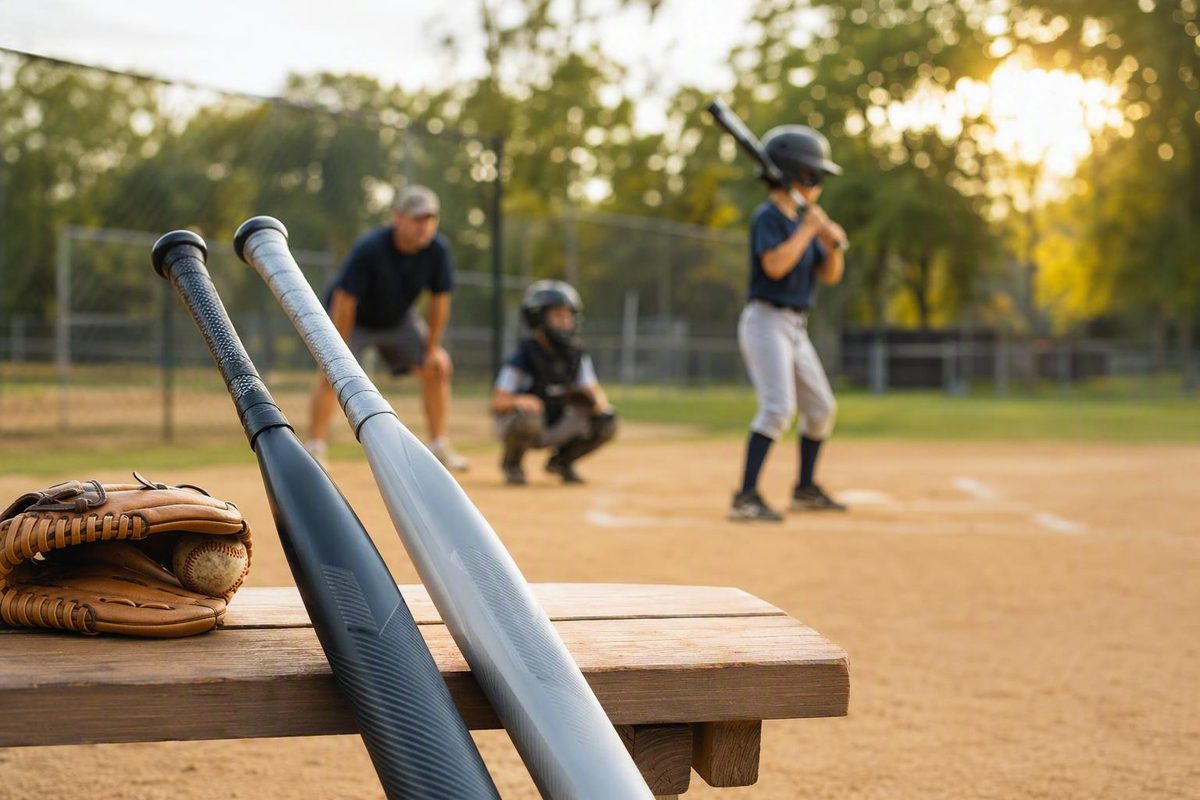
Little League bars USSSA 1.15 BPF bats in Majors and below, Intermediate and Junior. Event rules determine whether one bat can cover rec and travel play.
The difference between USA and USSSA bats is primarily a difference in certification and permitted performance—not brand, material, price, or overall quality. Alloy, composite, and hybrid bats are available under both standards.
USA Baseball requires approved USABats to perform at a wood-like standard. Commercial equipment guides generally describe USSSA youth bats as allowing greater performance potential under a different standard. That does not make a USSSA bat the better purchase if the child’s league or tournament prohibits it.
Use this buying order:
- Obtain the written rules for the player’s exact league, division, tournament, and season.
- Identify the accepted certification.
- Verify the bat’s length, weight, drop, barrel diameter, condition, and approval status.
- Only then compare construction, fit, feel, and price.
Rules reviewed August 11, 2026. Official league, division, and event rules take precedence over retailer charts and general comparisons. Because the available USSSA specifications in this guide come from commercial equipment guides rather than a current national USSSA rulebook, treat them as shopping guidance—not universal permission for a particular event.
USA vs. USSSA bats at a glance
USA and USSSA labels identify two youth-baseball bat standards. They are not manufacturers, materials, or quality grades. A manufacturer may sell similarly named models in separate USA and USSSA versions.
| Feature | USA bat | USSSA youth bat |
|---|---|---|
| Certification mark | USA Baseball mark | Commonly a USSSA thumbprint-style, NTS-Tested, or applicable 1.15 BPF mark; verify the mark accepted by the event |
| Performance target | Tested to a wood-like performance standard | Commercial guides describe a higher permitted performance ceiling under a different youth standard |
| Commonly cited maximum barrel diameter | 2 5/8 inches | Up to 2 3/4 inches in common youth big-barrel guidance; confirm the division and event |
| Common playing environment | Many recreational organizations that adopted USABat | USSSA-sanctioned travel, select, and tournament play |
| Controlling legality check | Current rules for the exact league, division, event, and season | Current rules for the exact league, division, event, and season |
For qualifying non-wood and laminated bats in Little League Majors and below, Intermediate, and Junior divisions, Little League requires the USA Baseball logo, prohibits BPF 1.15 bats, and caps barrel diameter at 2 5/8 inches. Its rules include separate provisions for solid one-piece wood bats and BBCOR bats in specified divisions. Review Little League’s division-specific bat requirements.
The USSSA side of the table is less authoritative. Commercial guides commonly identify youth USSSA bats by a USSSA or 1.15 BPF mark and cite 2 3/4 inches as the maximum youth big-barrel diameter. Those are useful shopping clues, but they do not establish eligibility for every age group or tournament. One event may require a particular mark, set a smaller barrel limit, restrict drop, or permit several standards. See a representative comparison of the commonly used marks and barrel guidance.
“Recreational usually means USA” and “travel usually means USSSA” are reasonable starting patterns, not rules. A recreational league may use its own equipment policy, while a travel event may permit USSSA, USA, BBCOR, wood, or some combination of them.
The practical distinction is therefore broader than “less pop versus more pop.” The marks represent different eligibility systems. A high-performing bat that cannot legally enter the batter’s box is the wrong bat.
What the two performance standards mean
Players and equipment guides often call this the trampoline effect or barrel flex.
Certification standards limit that bat-and-ball interaction.
USA Baseball implemented the USABat standard for non-wood youth bats on January 1, 2018. Approved designs bearing the USA Baseball mark are performance tested and required to perform at a wood-like standard. USA Baseball may also conduct compliance testing after a design has been approved. USA Baseball explains the performance standard and continuing compliance process.
“Wood-like performance” does not mean every USA bat feels like a wood bat. Manufacturers can still vary the bat’s balance, handle design, construction, stiffness, vibration management, and weight distribution. The certification addresses compliance with the performance standard, not identical feel.
Commercial comparison guides describe USSSA youth bats as permitting more barrel response and greater performance potential than USABats. That is the basis for the informal description that USSSA bats have more “pop.” It is a comparison of permitted performance—not a guaranteed increase in exit velocity, distance, or game results. BaseballMonkey provides one commercial overview of the USA, USSSA, and BBCOR categories.
The term 1.15 BPF should be treated as a certification designation. It does not mean a batted ball will travel 15% farther or leave the bat 15% faster, and it should not be used to calculate home-run distance or expected exit velocity.
Greater permitted performance also does not create eligibility. If a league requires the USA Baseball mark, a USSSA-certified bat does not become legal because it may offer greater performance potential.
Two bats carrying the same certification can also feel very different. The stamp establishes compliance with a category, not a universal swing weight, sweet-spot size, vibration level, or outcome.
How to identify the certification marks and barrel limits
Inspect the physical bat before buying it. Do not rely entirely on an online product title, category filter, seller description, team custom, or memory of last season’s rules.
A USA-certified bat should display the USA Baseball certification mark. Commercial guides commonly show the mark near the taper—the narrowing section above the grip—although placement can vary with the graphics. The important questions are whether the required mark is authentic, readable, and attached to the exact bat being purchased.
A USSSA youth bat commonly displays a thumbprint-style USSSA mark or an applicable 1.15 BPF designation on the barrel or taper. Some newer commercial listings use NTS-Tested terminology. Because the reviewed commercial guides are not a substitute for a current national rulebook, confirm the exact mark accepted by the tournament.
Barrel diameter requires a separate check:
- The cited Little League rules cap the barrel at 2 5/8 inches in Majors and below, Intermediate, and Junior divisions.
- Commercial USSSA youth big-barrel guidance commonly cites 2 3/4 inches as the upper limit.
- A smaller barrel can still satisfy a rule that establishes only a maximum.
- A permitted barrel diameter does not compensate for the wrong certification.
A 2 5/8-inch USSSA bat does not become a USA bat merely because it shares a diameter commonly used in USA-certified play. Likewise, placement in an online “youth big barrel” category does not prove that a bat is eligible for a specific event. One retailer’s big-barrel guide defines the category as greater than 2 1/4 inches but no more than 2 3/4 inches, while also warning that certification and age requirements must be checked separately. Review the retailer’s USSSA big-barrel guidance.
Before paying, find these details on the exact bat:
- Certification mark
- Length in inches
- Weight in ounces
- Drop designation
- Barrel diameter
- Model name and model number
- Any wording limiting the bat to a particular type of play
Where to look on the bat
Check the taper and barrel for the certification; the model graphics or area near the knob for length and weight; the printed specifications for barrel diameter; and the manufacturer labeling for the exact model number.
When shopping online—especially for a used bat—ask for clear photographs of these areas. A stock image may show a different length, drop, or certification from the exact item being sold.
Readable labeling matters. Paint wear, tape, aftermarket grip placement, or damage may obscure information an umpire or tournament official needs to inspect. A receipt or archived product listing may help identify a bat, but it does not guarantee that an event will accept a physical bat with an illegible required mark.
Where USA and USSSA bats are commonly used
USA bats are commonly associated with recreational organizations that adopted the USABat standard. USA Baseball’s information names organizations including Little League, Babe Ruth and Cal Ripken Baseball, PONY Baseball, AABC, NABF, and Dixie programs among adopters. USSSA-certified bats are commonly associated with USSSA-sanctioned travel, select, and tournament baseball.
That pattern helps parents decide where to begin their research. It does not determine eligibility. “Travel,” “select,” and “recreational” are descriptions of playing environments, not certification rules.
Little League provides a documented example. In Majors and below, Intermediate, and Junior divisions, qualifying non-wood and laminated bats must bear the USA Baseball logo, BPF 1.15 bats are prohibited, and the barrel may not exceed 2 5/8 inches. Minor and Major bats may be no longer than 33 inches, while Intermediate and Junior bats may be no longer than 34 inches. BBCOR bats are additionally permitted in Intermediate and Junior play under the cited rules.
Those are Little League requirements, not universal recreational-baseball rules. Another organization may adopt USABat while applying different length or division provisions. An independent local league may establish its own equipment policy.
The same caution applies to travel baseball. A team described as a “USSSA team” may enter events operated by several organizations. One tournament may require a USSSA mark; another may accept multiple standards; a third may apply different drop or barrel restrictions.
Before purchasing, obtain the written rule covering:
- the current season;
- the player’s age or grade division;
- regular-season and postseason play;
- every scheduled tournament;
- permitted certification marks;
- maximum barrel diameter and length;
- drop restrictions;
- wood-bat provisions; and
- local additions to national or organizational rules.
Use the official event page, current rulebook, or a written answer from the tournament director. A coach may help locate the correct rule, but memory from a prior season should not control an expensive purchase.
Watch for terms such as “USA only,” “USSSA NTS,” “1.15 BPF,” “BBCOR,” “wood only,” or “USA/USSSA permitted.” If a rule says only “youth bat,” request clarification.
Can the two bat types be used interchangeably?
Not universally.
The clearest direction is from USSSA to a USA-only setting. A USSSA 1.15 BPF bat cannot be used in the cited Little League divisions because Little League expressly prohibits BPF 1.15 bats there. More generally, a USSSA bat should not be treated as eligible whenever the rule requires USA certification.
The reverse direction is event-specific. Some commercial guides say USA bats may be accepted in USSSA play, while others describe the certifications as non-interchangeable or say a USSSA mark is required. Because that third-party guidance conflicts, neither a universal “yes” nor a universal “no” is justified. The event’s written rule must decide the question. JustBats is one commercial guide that says USA bats may be used in USSSA play.
| Playing setting | USA bat | USSSA 1.15 BPF bat |
|---|---|---|
| League requiring USA certification only | Eligible only if every other requirement is met | Generally not eligible |
| Little League Majors and below, Intermediate, or Junior | Required for qualifying non-wood and laminated bats, subject to division rules and stated alternatives | Prohibited |
| USSSA tournament | Verify the event: do not assume acceptance | Verify the event: confirm the mark, division, drop, and dimensions |
| Event expressly permitting multiple standards | May be eligible if specifically listed | May be eligible if specifically listed and otherwise compliant |
Even if an event accepts a USA bat, there is a practical tradeoff: the USA bat was certified to a wood-like performance standard, while commercial guides describe USSSA bats as having a higher permitted performance ceiling. A family may therefore consider a separate USSSA bat for an event that accepts both. That is a budget and equipment decision, not proof that two bats are mandatory.
Conversely, one USA bat can be a sensible choice when every scheduled event expressly accepts it and the player is comfortable with it. Familiarity with one properly fitted bat may matter more than owning two poorly fitted bats simply because two certification categories exist.
Do not assume a universal penalty for an ineligible bat. Consequences depend on the applicable rulebook, when the bat is discovered, and the event’s enforcement procedure.
When uncertain, send the event director a photograph showing the stamp, model number, length, drop, and barrel size. Ask a narrow question: “Is this exact bat legal in the 11U division for this tournament?” A model-specific written answer is more useful than asking whether USA bats are generally allowed in travel ball.
A legality checklist that goes beyond the stamp
A visible certification logo does not automatically make a bat legal.
The required mark may be only one part of the rule. A league or tournament can also regulate dimensions, drop, condition, alterations, readable labeling, and approval status. Requirements can change by season, age group, and event.
Use this checklist before purchasing and again before the first game.
Confirm the playing rules
- [ ] Exact league or tournament
- [ ] Exact division or age group
- [ ] Current season
- [ ] Regular-season rules
- [ ] Postseason and tournament rules
- [ ] Local modifications
- [ ] Whether multiple certifications are accepted
Confirm the bat specifications
- [ ] Required certification mark is present and readable
- [ ] Barrel diameter is within the division limit
- [ ] Length is permitted
- [ ] Drop is permitted
- [ ] Exact model and model number match the listing
- [ ] Any approved-manufacturer or approved-model requirement is satisfied
Inspect the bat’s condition
- [ ] No cracks or sharp edges
- [ ] No visibly misshapen areas
- [ ] No apparent performance-enhancing alteration
- [ ] Required markings remain readable
- [ ] The exact model, length, and drop have not been decertified
- [ ] Any additional event inspection standard is satisfied
The first four condition items reflect common inspection concerns; the event rule determines whether a particular defect makes the bat ineligible. For example, Little League directs that cracked bats, bats with sharp edges, altered bats, and bats with illegible certification marks cannot be used under its cited requirements.
A bat can pass its original certification and later lose approval. USA Baseball may purchase retail production bats and retest them to determine whether the products being sold continue to match the approved design and performance requirements.
Decertification may apply narrowly. USA Baseball decertified the 30-inch, 20-ounce Easton Ghost X, models YBB18GX10 and LL18GHX, with a 2 5/8-inch barrel. The action covered the specified 30-inch, drop -10 versions; USA Baseball stated that other certified lengths and drops in the model family remained approved. Check USA Baseball’s model-specific decertification notice.
The lesson is not that the entire Ghost X family is prohibited. It is that a model-family name may be too broad. Different lengths and drops can be treated as separate designs.
Compare all three of these details against current approval and decertification information:
- Exact model number
- Exact length
- Exact drop or listed weight
Apply the same process to used equipment. “It is the same model my teammate uses” does not establish that the two bats have the same specifications or approval status.
If a rule is unclear, save a screenshot or PDF of the current language and retain any written clarification from the event director. Recheck before the season and before major tournaments. A saved rule does not freeze future requirements, but it records the information used for the purchase.
Choose construction, length, and drop only after certification
Treat the purchase as four separate decisions:
- Legal certification
- Construction
- Player fit
- Budget
Making those decisions in order prevents a common mistake: choosing an appealing bat first and then trying to justify its eligibility.
Both USA and USSSA categories include alloy, composite, and hybrid bats. Material does not determine certification. A composite bat is not automatically USSSA, and an alloy bat is not automatically USA.
Common construction categories include:
- Alloy: Usually a metal barrel, often in a one-piece design.
- Composite: Uses layered composite materials and may be built as one or two pieces.
- Hybrid: Commonly combines an alloy barrel with a composite handle or another mixed-material design.
Alloy bats are commonly described as game-ready. Follow the instructions for the exact model, including any guidance on temperature or ball type.
Understanding drop weight
Drop is the signed weight-to-length difference used in bat labeling.
A 30-inch bat weighing 20 ounces is a drop -10:
20 ounces − 30 inches = -10
People may describe the same bat by saying the unsigned difference between length and weight is 10, or by calling it a “minus ten.” The printed designation is -10. A commercial comparison guide provides the same 30-inch, 20-ounce example.
For bats of the same length, a larger negative drop number means a lighter listed weight:
- A 30-inch, 20-ounce bat is drop -10.
- A 30-inch, 22-ounce bat is drop -8.
- A 30-inch, 25-ounce bat is drop -5.
That does not mean the largest negative number is automatically best.
Commercial availability is also different from eligibility. A manufacturer may sell a certification in several drops, while a division permits only a narrower range. A bat is not legal merely because a retailer placed it in the correct certification category.
Fit the player who exists now
Choose a bat the child can control now, rather than an oversized model intended to last through several growth spurts.
In a safe fitting area, compare controlled dry swings with legal bats of different lengths, weights, and balance profiles. Practical signs of manageable fit include:
- a stable stance;
- the ability to start and stop the barrel;
- posture that does not collapse under the bat’s weight;
- no obvious dragging of the barrel;
- repeatable movement across several swings; and
- comfort without excessive choking up solely to manage weight.
These are fitting observations, not governing eligibility rules. A child may be able to hold a bat still yet struggle to move it through a realistic swing. Static holding tests can offer a clue, but they are not a complete fitting method.
Do not prescribe length or drop by age alone. Children in the same division can differ in height, strength, coordination, experience, and preferred balance. The appropriate bat is one that satisfies the written rule and can be controlled consistently.
Certification does not guarantee that one model swings lighter, vibrates less, offers a larger sweet spot, or is more forgiving. Compare those qualities across actual models only after the legal category has been settled.
A rule-first decision path for rec, travel, and older divisions
A child playing on multiple teams may need one bat or two. The answer comes from comparing actual schedules—not from the labels “rec” and “travel.”
Step 1: List every place the child will play
Include:
- recreational league;
- travel league;
- weekend tournaments;
- all-star and postseason events;
- showcases;
- school baseball; and
- any older division the player may enter during the bat’s expected useful life.
Step 2: Record the exact rule for each setting
Create a table with columns for:
- event;
- division;
- season;
- accepted certification;
- maximum barrel diameter;
- length limit;
- drop restriction; and
- approved-model or manufacturer requirement.
Do not combine events into one row unless they use the same published rule.
Step 3: Look for overlap
If every scheduled setting accepts the same USA bat specifications, one bat may cover the schedule. The same principle applies if all events accept the same USSSA specifications.
If one setting requires USA certification and another expressly requires a USSSA mark, one bat cannot satisfy both requirements. Two bats may then be necessary.
Step 4: Evaluate conditional overlap
Consider a player participating in Little League Majors and travel baseball. A USSSA 1.15 BPF bat cannot cover Little League Majors because that division prohibits BPF 1.15 bats. Whether a USA bat can cover the travel schedule must be checked tournament by tournament.
There are three possible outcomes:
- Every travel event expressly accepts the USA bat: One bat may be sufficient.
- Some travel events accept USA while others require USSSA: Two bats may be needed for the full schedule.
- The travel schedule requires a separate USSSA specification: Two bats are likely necessary if the player participates in both settings.
Even if one USA bat is accepted everywhere, a family may consider a separate USSSA bat because commercial guides describe it as having greater permitted performance potential. That second purchase remains optional unless an event requires the USSSA certification.
Step 5: Treat BBCOR as a separate standard
BBCOR is not a heavier USA bat or a subtype of USSSA youth bat. It is a separate certification generally used in high-school and college baseball.
Older youth divisions can have their own transition rules. Little League, for example, additionally permits BBCOR bats in Intermediate and Junior divisions. Senior League applies separate requirements to non-one-piece-wood bats, including BBCOR and weight-to-length provisions. Under the cited rules, Senior League bats may not exceed 36 inches and may be no lighter than a -3 length-to-weight difference. Consult Little League’s current division-by-division provisions.
One-piece wood bats can also be treated differently. Little League’s cited rules exempt solid one-piece wood barrel bats from the USA Baseball logo requirement in specified divisions. That does not mean every wood bat is legal in every event; dimensions, construction, manufacturer approval, and other event rules may still apply.
Step 6: Make the purchase in the right order
Use this final sequence:
- Get the written rules for every league and event.
- Identify the accepted certification mark.
- Verify the exact length, barrel diameter, and drop.
- Check approval and decertification status.
- Inspect the bat’s condition and readable markings.
- Choose construction and player fit.
- Compare prices only among bats that passed the first six steps.
Frequently asked questions
Can a USSSA bat be used in Little League?
A USSSA 1.15 BPF bat cannot be used in Little League Majors and below, Intermediate, or Junior divisions under the cited Little League rules. Those divisions require the USA Baseball logo on qualifying non-wood and laminated bats and expressly prohibit BPF 1.15 bats.
Other Little League divisions have separate provisions, including BBCOR and wood-bat rules. Check the player’s exact division rather than extending one youth rule across the entire organization.
Can a USA bat be used in a USSSA tournament?
Possibly, but acceptance must be verified for the specific tournament, division, and season. Commercial guides conflict: some say USA bats may be accepted in at least some USSSA events, while others indicate that a USSSA mark may be required.
Do not assume “always legal” or “never legal.” Obtain the event’s written bat rule. Even when accepted, a USA bat was certified to a wood-like performance standard and may have a lower performance ceiling than the USSSA bats commonly used in that setting.
Does a child who plays both recreational and travel baseball need two bats?
Not necessarily. Compare the accepted standards across the child’s actual schedule.
Two bats may be necessary if the recreational league requires USA certification and one or more travel events require USSSA certification. One USA bat may cover both schedules if every travel event expressly accepts it and it satisfies all other restrictions. Identify a real conflict in the written rules before buying two bats.
What is the difference between USSSA, USA, and BBCOR bats?
USA and USSSA are separate youth-baseball certifications. USA bats are tested to a wood-like performance standard, while commercial comparisons generally describe USSSA youth bats as permitting greater performance potential.
BBCOR is a third certification generally associated with high-school and college baseball. It is also permitted or required in certain older Little League divisions under division-specific rules. A BBCOR mark does not make a bat universally legal at every youth level.
Can a certified bat later become illegal?
Yes. A bat may be decertified after approval. It may also become ineligible because the applicable rules change, its required markings become illegible, it is altered, or its condition fails the event’s inspection requirements.
Decertification may apply only to a specific model number, length, and drop while leaving other versions in the same model family approved. Check the exact bat details rather than relying only on the brand or model-family name.
Buy in the order that prevents expensive mistakes
The practical difference between USA and USSSA bats is not simply that one has less “pop” and the other has more. They are different certification and eligibility systems.
Confirm the written rules for every league and event first. Then inspect the required mark, dimensions, drop, approval status, and condition. Only after those checks should you choose construction, size, balance, and price.
If a child plays both recreational and travel baseball, compare the two schedules before assuming either that one bat will work everywhere or that two purchases are necessary. The right bat is the legal one the player can control.