
The Soccer Player Count, From 11v11 to Youth Games
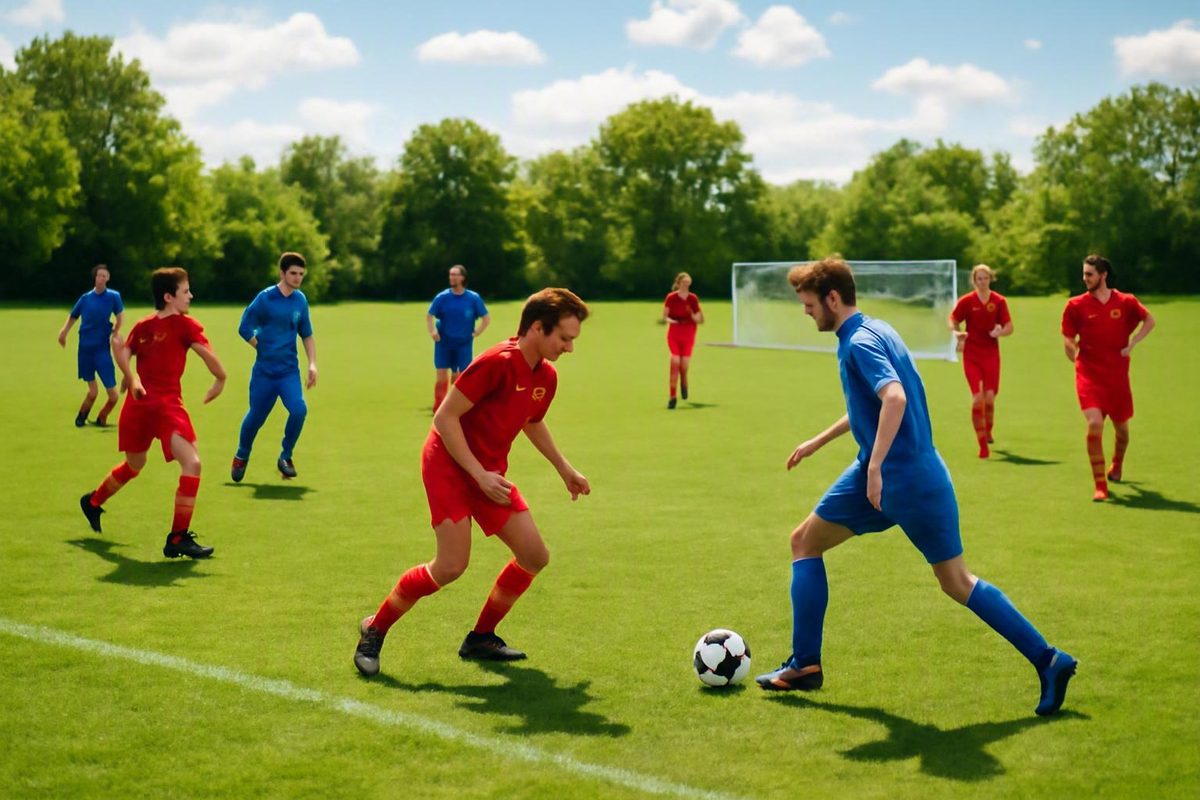
The format sets the active-player total: 4v4 has 8 combined, 7v7 has 14, 9v9 has 18 and 11v11 has 22 at full strength.
The quick answer: 22 players in standard soccer
A standard full-strength 11v11 soccer match has 22 players on the field, with 11 on each team.
The calculation is simple:
11 players per team × 2 teams = 22 players
That total counts the active players, not everyone involved in running the match. Substitutes, coaches, referees, assistant referees, and other officials are not part of the 22-player figure.
It is more precise to call 22 the full-strength maximum rather than a number guaranteed throughout every match. The Laws of the Game allow each team a maximum of 11 players, one of whom must be the goalkeeper. A team may have fewer because of a sending-off or another permitted circumstance. IFAB Law 3 establishes the 11-player maximum, the goalkeeper requirement, and the general seven-player minimum.
| Players per team | Both teams combined | Goalkeeper included? | Officials included? |
|---|---|---|---|
| 11 | 22 | Yes—one per team | No |
So, if someone asks, “How many people are on the field in soccer?” the best short answer is:
Standard soccer has 22 players at full strength—11 per side, including both goalkeepers.
The word people can create confusion. A referee may also be on the field, while assistant referees commonly work along the touchlines. Because officiating arrangements vary, there is no single universal total for every person physically participating in or around every soccer match.
Who makes up each team’s 11 players?
A full-strength standard team consists of:
1 goalkeeper + 10 outfield players = 11 players
The goalkeeper counts as one of the 11. The goalkeeper is not an additional twelfth player.
The other 10 are broadly described as outfield players and are usually grouped as:
- Defenders, who generally operate closer to their own goal
- Midfielders, who connect defensive and attacking play
- Forwards, who generally play closer to the opposing goal
These categories describe roles, not extra player slots. A team does not have to use one fixed distribution of defenders, midfielders, and forwards.
For example, a 4-4-2 formation places four defenders, four midfielders, and two forwards in front of the goalkeeper. A 4-3-3 instead uses four defenders, three midfielders, and three forwards. Both arrangements still contain one goalkeeper and 10 outfield players. This standard lineup and formation arithmetic are summarized in APFC’s position guide.
Goalkeeper:        1
Outfield players: 10
--------------------
Team total:       11
Formations can change during a match without changing the team’s permitted player count. A coach might move a defender into midfield, ask a forward to drop deeper, or switch systems entirely. Those are tactical changes, not additions to the lineup.
The notation 11v11 means 11 players on one team versus 11 players on the other team. It does not mean 11 players across both teams.
Team A: 11 players
Team B: 11 players
Total:  22 players
The same reading applies to small-sided formats: 9v9 means nine players per team, while 7v7 means seven per team.
Players, substitutes, rosters, and officials are different counts
The standard total of 22 refers only to players actively participating on the field. It does not describe the number registered to the club, named for the match, sitting on the bench, or officiating the game.
This distinction is especially important in youth soccer. A registration page might advertise a roster of 12, 14, or more children even though the competition uses 4v4, 7v7, or 9v9. The larger roster provides substitutes and accommodates absences; it does not mean every rostered child may play simultaneously.
Terminology box
Starting lineup: The players selected to begin the match. In full-strength 11v11 soccer, that means 11 starters per team.
Active players: The players currently participating on the field. The number can change during the match.
Substitute: An eligible player who is not currently active but may replace an active player under the applicable substitution procedure.
Matchday squad: The players available for a particular match, generally including the starters and named substitutes.
Roster: The larger group registered to a team or program. A season roster may differ from the matchday squad.
Match official: A referee or another appointed official who administers the match. Officials are not team players.
An ordinary substitution is a replacement, not an addition:
1 active player leaves
1 substitute enters
Net change: 0
If a team has 11 active players and completes an ordinary substitution, it still has 11 active players. The number of substitutes who may be named or used is a separate matter determined by the competition rules; it does not change the maximum number allowed on the field. U.S. Soccer’s Law 3 explanation distinguishes the maximum active-player count from competition-specific substitution allowances.
Consider a youth 7v7 team with 10 children on its roster. Seven may play at full strength while the others are available as substitutes. Rotating those children does not turn the match into 8v8, 9v9, or 10v10.
Officials are also separate from the player count. A match may use a referee and additional officials, but the number and location of those officials depend on the competition. That is why “22 players” is more dependable than trying to give one fixed answer for everyone physically on or beside the field.
The useful separation is:
- On-field player count: Set by the game format
- Bench count: Based on the named substitutes and competition rules
- Roster count: Set by the team or league’s registration rules
- Official count: Set by the competition’s officiating arrangements
Why a match may have fewer than 22 players
Eleven is the maximum number of players per team in standard soccer. Consequently, 22 is the full-strength maximum, not a fixed total throughout every match.
The clearest example is a red card. A player sent off after kickoff cannot be replaced, so one dismissal from a full-strength match normally changes the count from 22 to 21:
Before the red card: 11 + 11 = 22 players
After the red card:  10 + 11 = 21 players
A later ordinary substitution by the shorthanded team replaces one of its remaining players; it does not restore the team to 11.
Under the standard Laws, a match generally may not start or continue if either team has fewer than seven players. IFAB identifies exceptions when applying that threshold for specified temporary-dismissal and time-limited off-field protocols. Consequences such as forfeiture remain subject to the relevant competition regulations. IFAB Law 3 states the red-card replacement rule, seven-player threshold, protocol exceptions, and role of competition regulations.
| Team A | Team B | Combined active players | General rule concept |
|---|---|---|---|
| 11 | 11 | 22 | Both teams at full strength |
| 10 | 11 | 21 | Possible after one sending-off |
| 9 | 11 | 20 | One team is further shorthanded |
| 7 | 7 | 14 | General minimum for both teams |
| Fewer than 7 | Any number | Varies | Match generally may not start or continue |
This table does not mean every league must let a team begin whenever seven players are available. Seven is the general threshold under the standard Laws; the competition handbook determines how the rule applies locally.
The visible count can also fluctuate temporarily. An authorized absence for injury treatment or another permitted reason may leave a team briefly appearing shorthanded even though no player has been sent off and the team’s maximum remains 11.
Parents should distinguish among three situations:
- A planned small-sided match: The game was organized as 7v7 or 9v9.
- A shorthanded 11v11 team: The format remains 11v11, but one team currently has fewer than 11 active players.
- A temporary absence: A player has briefly left the field and may be permitted to return.
A scheduled 7v7 match is not an 11v11 game missing four players from each side. It is a distinct format organized for seven players per team.
How many players are in 4v4, 7v7, 9v9, and futsal?
In format notation, the number on each side of the v is the player count for one team. To find the combined full-strength total, multiply that number by two.
| Format | Players per team | Full-strength combined total | Goalkeeper |
|---|---|---|---|
| 4v4 | 4 | 8 | Depends on the program |
| 7v7 | 7 | 14 | Included when the format uses one |
| 9v9 | 9 | 18 | Commonly included |
| 11v11 | 11 | 22 | Included and required under standard rules |
Read each label this way:
- 4v4: Four players for Team A and four for Team B, making eight
- 7v7: Seven per team, making 14
- 9v9: Nine per team, making 18
- 11v11: Eleven per team, making 22
When a format uses a goalkeeper, that player normally counts within the stated number. A 7v7 lineup with a goalkeeper therefore has one goalkeeper and six outfield players—not seven outfield players plus a goalkeeper.
Some very young programs play without goalkeepers. In such a program, 4v4 still means four players per team; all four are field players.
Futsal commonly uses five players per team, including the goalkeeper, producing 10 active players at full strength. Alicante Football Academy’s format comparison identifies futsal as a five-player-per-team game.
5 players per team × 2 teams = 10 players
Futsal should not be used as a generic name for every indoor soccer competition. Indoor leagues may adopt different player counts, roster rules, and substitution procedures. The specific league rules—not the word indoor—determine the active-player count.
Small-sided games are also not incomplete standard games. A scheduled 9v9 match is designed for nine players per team and is governed by the rules adopted for that format and competition.
Youth soccer player counts by age
Youth soccer does not have one player count for every age. Programs may move children through 4v4, 7v7, 9v9, and eventually 11v11, but the ages assigned to those formats can vary.
As a useful U.S. reference, an August 2018 U.S. Soccer coaching-education article associates 4v4 with U6–U8, 7v7 with U9–U10, 9v9 with U11–U12, and 11v11 with U13 and older players. It is a grassroots framework, not a guarantee that every current local league uses the same progression. U.S. Soccer describes these age-related grassroots formats in its coaching materials.
| Reference age group | Format | Players per team | Full-strength total |
|---|---|---|---|
| U6–U8 | 4v4 | 4 | 8 |
| U9–U10 | 7v7 | 7 | 14 |
| U11–U12 | 9v9 | 9 | 18 |
| U13 and older | 11v11 | 11 | 22 |
The U means “under.” A label such as U10 identifies an under-age division according to the organization’s eligibility date and registration rules. It does not necessarily mean every participant is currently nine years old.
Local leagues, parks departments, tournaments, and state associations may assign formats differently. Goalkeeper policies can vary even when two divisions use the same player count.
For example, an undated local Parks and Recreation format chart—whose extract does not identify the jurisdiction—lists:
- 4v4 without goalkeepers for U6–U8
- 7v7 without a goalkeeper for U9
- 7v7 with a goalkeeper for U10
- 9v9 with a goalkeeper for U11–U12
- 11v11 with a goalkeeper for the listed older groups
The chart demonstrates that two age groups can both use 7v7 while applying different goalkeeper rules. Because the document’s jurisdiction and effective season are not identified in the available extract, it should be treated only as an example of local variation, not as current nationwide guidance. The local Parks and Recreation chart lists its age formats, roster sizes, and goalkeeper policies.
New Jersey Youth Soccer provides a separate jurisdiction-specific example. Its Fall 2023 modifications address 4v4, 7v7, 9v9, and 11v11 play. The youngest listed 4v4 division does not permit goalkeepers, while its 11v11 provision uses 10 outfield players and one goalkeeper. Those provisions apply to the competitions covered by that policy; they are not universal national rules. New Jersey Youth Soccer’s Fall 2023 policy sets out its format-specific player and goalkeeper provisions.
For parents, the practical interpretation is:
- If a schedule says 4v4, expect eight active players at full strength.
- If it says 7v7, expect 14.
- If it says 9v9, expect 18.
- If it says 11v11, expect 22.
- For a very young division, check whether goalkeepers are used.
- Do not infer the format from age alone.
A recreational league, tournament, school program, festival, or indoor competition may use different rules even though the child’s age has not changed.
What parents should verify before registration or game day
For a particular child’s game, the league’s current rules are more useful than a generic answer about standard soccer. Before registration—or at least before the first match—verify:
- Division or age group: Which division will the child enter?
- Format notation: Is it 4v4, 7v7, 9v9, 11v11, or another format?
- Maximum active players: How many may each team field?
- Minimum required players: How many are needed to start or continue?
- Goalkeeper rules: Is a goalkeeper used, and does that player count within the format number?
- Roster limit: How many children may register to the team?
- Matchday limit: May every rostered child be named for every game?
- Substitution policy: When and how may substitutes enter?
- Shorthanded play: May a team begin below the format maximum?
- Tournament differences: Does an event use different rules from the regular season?
Start with the league’s current registration page and competition handbook. Coach information, division rules, tournament documents, and state-association policies can provide details that a general soccer explainer cannot.
Pay particular attention to the difference between roster size and on-field size. If a 7v7 team has 11 registered players, that does not authorize all 11 to play simultaneously. Seven is the full-strength active count; the others may be substitutes or unavailable for that match.
If a young division is advertised only as “small-sided,” ask:
- How many children play per team at one time?
- Does that number include a goalkeeper?
- Does the division use goalkeepers at all?
- What happens if a team has too few players?
- How are substitutions handled?
- Do tournament rules differ?
Labels such as indoor, academy, developmental, and festival do not establish the active-player count. The actual format notation and current competition rules do.
For standard full-sided soccer, the practical answer remains 22 players at full strength: 11 per team, including one goalkeeper on each side. For a child’s game, the league’s named format and current rules—not age alone—provide the definitive local answer.
Use this decision rule when reading a schedule:
11v11 = 22 active players at full strength
9v9   = 18 active players at full strength
7v7   = 14 active players at full strength
4v4   = 8 active players at full strength
These totals follow directly from the format maximums used in youth policies covering 4v4 through 11v11. New Jersey Youth Soccer’s format table provides one official state-level example of those per-team counts.
Frequently asked questions
Does the goalkeeper count as one of the 11 soccer players?
Yes. In standard 11v11 soccer, each team’s lineup consists of one goalkeeper and 10 outfield players. The goalkeeper is not a twelfth player, so two full-strength teams have 22 active players combined. Cheltenham Sports summarizes the standard 11-player lineup as one goalkeeper and 10 outfield players.
Are referees included in the 22 people on a soccer field?
No. The total of 22 counts active players only. Referees and other match officials are additional to that figure. Because officiating crews and working positions vary by competition, there is no dependable universal total for every person physically involved.
What happens to the player count after a red card?
A player sent off after kickoff cannot be replaced. If both teams began with 11, one red card normally reduces the active total from 22 to 21. A later ordinary substitution replaces one of the shorthanded team’s remaining players and does not erase the numerical disadvantage.
What is the minimum number of players a soccer team can have?
Under the standard Laws, a match generally may not start or continue if either team has fewer than seven players.
How many players are on the field in youth soccer?
It depends on the format. At full strength, 4v4 has eight players combined, 7v7 has 14, 9v9 has 18, and 11v11 has 22. A common U.S. progression associates those formats with U6–U8, U9–U10, U11–U12, and U13 or older, respectively, but local leagues may use different age assignments and goalkeeper rules.