
What Actually Matters Before You Step Onto a Jiu-Jitsu Mat
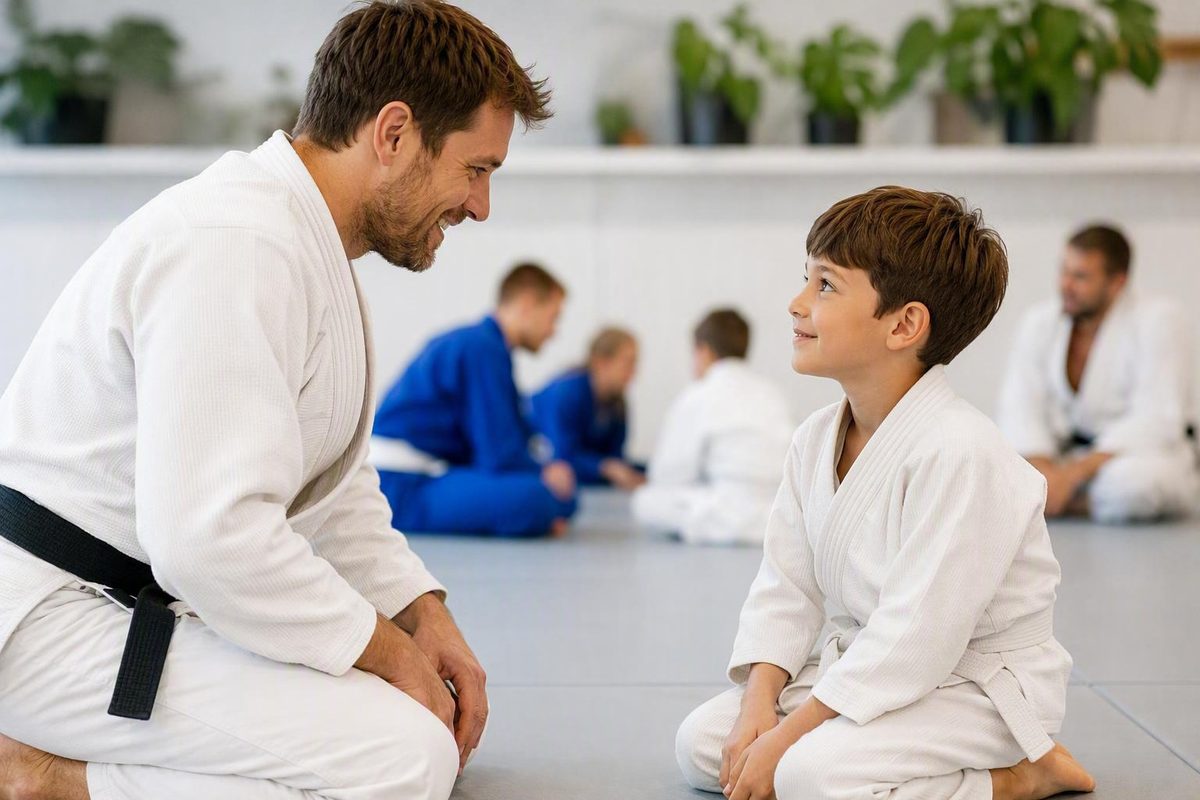
Before you show up, ask whether class is gi or no-gi, what you may wear, if loaner gis are available, when to arrive and if first-timers spar.
Your first Brazilian jiu-jitsu class is not a test of fitness, toughness, or technical knowledge. You do not need to memorize submissions, study the belt system, or practice complicated movements at home.
Useful preparation is much simpler: confirm the academy’s rules, wear clean and suitable clothing, understand how to stop an exchange, and communicate relevant limits before training begins.
Before-class checklist:
- Confirm whether the beginner session is gi or no-gi.
- Ask what you may wear and whether the academy supplies a loaner gi.
- Prepare freshly washed, fitted training clothing.
- Trim and smooth your fingernails and toenails.
- Pack water, sandals or slides, and the confirmed uniform.
- Confirm the arrival time and plan to be early according to the academy’s instructions.
- Privately tell the coach about relevant injuries, health concerns, accessibility needs, or movement limitations.
- Learn how to tap physically and verbally.
That is enough preparation to begin.
Learn the safety rules, not a catalog of techniques
A beginner is not expected to arrive knowing submissions, escapes, guard positions, belt knots, or warm-up movements. Academy-authored first-class guides commonly present technical knowledge as something taught in class, not an entry requirement. One such beginner guide emphasizes learning, controlled practice, and early tapping.
The useful things to learn before your first BJJ class are procedural:
- How to stop an exchange by tapping.
- How to ask a partner to reduce speed or resistance.
- What clothing and hygiene expectations apply.
- When to contact the academy instead of simply arriving.
- Who to approach if you are confused or uncomfortable.
Set a modest goal for the session: leave safely, remember one useful lesson, and collect enough information to decide whether you want to return. You do not need to win a drill, avoid every tap, or retain every detail.
BJJ asks your body to move in unfamiliar ways while another person changes your balance, blocks your movement, or applies pressure. You may feel clumsy. Instructions that seemed clear during the demonstration may disappear from memory once drilling starts. You might become tired, confuse left and right, or tap repeatedly during live practice. Academy guides describe these as possible first-day experiences rather than proof that someone is unsuited to BJJ.
Do not try to eliminate all uncertainty by teaching yourself a catalog of techniques from videos. Without the class context, you will not know which rules, progression, or safety expectations the instructor uses. If the academy supplies an orientation video or beginner document, review that. Let the instructor teach the actual movements.
Several academy guides also say that newcomers do not need to reach a particular fitness level before an introductory session. That is academy guidance—not individualized medical clearance. A class may still be physically demanding, and a general statement about beginners cannot establish whether contact training is appropriate for a particular person.
If you have an existing injury, chronic condition, disability, pregnancy, sensory concern, or another relevant limitation, contact the academy before participating. Explain what you need without feeling obliged to disclose private details to the entire class. For example:
“I have a limitation affecting my knee and cannot kneel comfortably. Can the class be modified, and which activities would the coach ask me to avoid?”
The coach can explain the class format and any modifications the academy offers. If you are uncertain whether participation is appropriate, obtain that guidance before training.
Ask the academy five questions before you arrive
Many first-day questions have no universal answer because each academy sets its own schedule, uniform policy, customs, and approach to live practice. Send this copyable message:
“Is the beginner session gi or no-gi, what may I wear, do you provide a loaner gi, when should I arrive, and do first-timers spar?”
Add two more questions if the website is unclear:
- Is this session intended for complete beginners?
- Do I need to book, create an account, or complete paperwork in advance?
Some academy guides recommend arriving approximately 10–15 minutes early for introductions, paperwork, or a facility tour; ARMA, for example, asks trial students to arrive 10–15 minutes before class. Treat that as an example rather than an industry standard. If your academy asks you to arrive earlier or attend a separate orientation, follow its instructions.
First-visit paperwork may request a waiver, emergency contact information, and information about injuries or limitations. Read the forms carefully and ask the academy about anything you do not understand. The supplied academy sources establish that such paperwork may be used, but they do not establish its legal effect.
Other details that can vary include:
- whether students bow when entering or leaving the mat;
- what title, if any, students use for the instructor;
- whether the coach assigns partners;
- whether beginners rotate partners;
- whether students help clean the mats;
- whether the first session includes rolling;
- whether live practice is omitted, restricted, delayed, or offered under local procedures;
- which gi colors, patches, or brands are accepted; and
- where shoes, bags, and used clothing should be placed.
Do not assume that a policy described by one gym applies elsewhere. One academy may lend every trial student a gi; another may have no loaners. One may permit a fitted shirt and athletic shorts during a trial gi class; another may require an approved uniform.
For a child or teenager, ask additional due-diligence questions:
- How are newcomers paired for drills and live practice?
- How do coaches teach physical and verbal tapping?
- What should happen immediately when a child taps?
- How does a student request a break or ask to observe?
- May parents watch the trial class?
- Who should the student approach if a partner is too rough?
- How can a child report discomfort privately?
- How should families report an injury, hygiene concern, or unsafe conduct?
These are questions, not promises about how every youth program operates. Listen for concrete answers. “We explain tapping before partner work and intervene if a tap is ignored” conveys more useful information than “Everyone here is safe.”
Before enrolling, also ask what the trial includes, when charges begin, and what equipment or branded clothing will become mandatory. Request the contract and cancellation terms before committing. Do not assume the trial class represents the program’s full cost or long-term equipment requirements.
Know whether you are attending gi or no-gi
Gi BJJ uses a jacket, pants, and belt. The uniform is also a gripping surface: depending on the technique and applicable rules, practitioners may control sleeves, collars, or pants.
No-gi BJJ uses fitted grappling clothing, commonly a rash guard with pocketless shorts, leggings, or compression apparel. Without gi fabric to hold, practitioners rely more on body positioning and controls such as underhooks, overhooks, head position, and pressure. Warrior Fitness Center’s gi and no-gi overview explains these basic clothing and gripping differences.
Gi is often described by practitioners as more grip-oriented and methodical, while no-gi is often described as involving quicker transitions and more scrambles. These are broad tendencies, not fixed rules. Pace depends on the instructor, lesson, partners, rules, and type of practice.
You do not need to identify the perfect format before attending. Either can be a valid first class. More practical considerations include:
- which beginner session fits your schedule;
- which format interests you;
- what the academy teaches in its introductory curriculum;
- whether you are willing to attend that class consistently; and
- whether its clothing requirements are manageable.
The two formats share concepts such as positional control, escapes, timing, guard retention, pressure, and submissions. Some grips and techniques are format-specific, however. A collar-based technique requires gi fabric, while some no-gi control sequences are organized around direct control of the body.
Be skeptical of claims that gi automatically creates better fundamentals or that no-gi is inherently superior for self-defense, MMA, or fitness. The supplied sources present those ideas as practitioner or academy opinions, not universal conclusions.
Most importantly, do not buy a gi before speaking to the academy. Ask whether one is required for the trial, whether a loaner is available, and which colors, branding, patches, and sizing systems are accepted. Loaner policies genuinely differ: some academies advertise a trial gi, while others explicitly say they do not provide one.
If the trial is no-gi, an academy-approved fitted athletic shirt and pocketless shorts may be sufficient. Confirm that before arriving.
Wear safe clothing and pack only the essentials
For a no-gi class—or a trial in which ordinary athletic clothing is approved—the minimal outfit is:
- a clean, fitted athletic shirt or rash guard; and
- clean, pocketless athletic shorts or leggings.
“Fitted” does not mean painfully tight. It means the fabric stays reasonably close to the body rather than hanging loosely during ground movement.
Academy clothing guides commonly discourage loose fabric, pockets, zippers, buttons, and hard components because they can interfere with close partner training. The Jiu Jitsu Company, for example, advises beginners to choose snug athletic clothing and avoid shorts with pockets, zippers, or hard materials.
Unless the academy says otherwise, avoid training clothing with:
- pockets;
- zippers;
- buckles;
- exposed buttons;
- belt loops;
- hard decorations; or
- metal components.
Academy guides also commonly instruct students to remove jewelry and accessories before training. This may include:
- rings;
- necklaces;
- watches and fitness trackers;
- bracelets;
- earrings and other removable piercings; and
- hair accessories with hard or sharp parts.
If an item cannot be removed, ask the academy privately before class. Do not improvise a covering and assume it will be accepted.
Pack these required or broadly useful items:
- water;
- freshly washed training clothing;
- the uniform the academy confirmed; and
- sandals, slides, or flip-flops for off-mat areas.
Situational additions include:
- a small towel;
- a change of clothes;
- soft hair ties;
- a bag for separating used clothing; and
- personal items specifically requested by the academy.
Shoes commonly stay off BJJ mats. Sandals or slides are useful because they are easy to put on when visiting bathrooms or walking through other off-mat areas. Verify the facility’s exact rules rather than assuming every academy manages footwear in the same way.
The supplied evidence does not establish that specialized protective equipment is medically necessary for every first-time student or that it guarantees protection from injury. Ask what the academy requires for the introductory session.
The minimal-cost principle is simple: buy nothing specialized until you know the school’s rules. Do not purchase a gi, branded rash guard, belt, protective item, or dedicated gear bag merely because it appears on a generic checklist. One message to the academy can prevent a poor purchase.
Complete the hygiene check before stepping on the mat
BJJ involves sustained close contact with partners and shared training surfaces. Academy preparation guides therefore place significant emphasis on arriving reasonably fresh, wearing freshly washed clothing, trimming nails, and securing long hair.
Complete this practical check before leaving home:
- Fingernails trimmed and smooth.
- Toenails trimmed and smooth.
- Long hair secured with soft ties.
- Jewelry removed.
- Body reasonably fresh.
- Gi, rash guard, shorts, leggings, and underlayers freshly washed.
- Skin checked for cuts, wounds, or unfamiliar areas.
- Current illness considered before deciding whether to attend.
Use freshly washed training clothing for each session rather than drying used gear and returning it to the training bag. This is a widely stated academy hygiene expectation, including in LAJJ’s guidance on clean clothing, cuts, illness, and possible skin infections.
Academy guides commonly advise students not to train while sick or when they have an open wound, suspected skin infection, or suspicious rash. These are participation guidelines from training providers, not diagnosis or medical-clearance standards.
Some academy guides suggest covering minor cuts, but covering an area does not by itself establish that close-contact training is appropriate. This article cannot identify a skin condition or determine whether a wound, illness, or rash is safe for contact training.
If you are uncertain about a wound, skin problem, or illness, contact the academy before arriving and obtain appropriate professional medical guidance. Avoid sending identifiable medical photographs unless you understand and accept how the recipient will handle them.
Separate broadly repeated hygiene guidance from local customs. Some schools request a shower immediately before class; others focus on arriving reasonably fresh. Rules concerning fragrance, makeup, gum, socks, and mat cleaning also differ. Helping clean the mats may be expected at one academy and handled entirely by staff at another.
For a youth class, parents can ask how loaner uniforms and shared equipment are cleaned and where used gear is placed. You do not need to conduct a formal inspection, but visibly dirty shared clothing or equipment is a reasonable reason to pause and ask the program for an explanation.
Understand tapping and practice clear communication
A tap tells your partner to stop the exchange.
Academy guides describe two primary methods:
Do not rely on a subtle gesture.
Academy safety guidance tells students to tap before pain or panic escalates rather than testing how far an exchange can continue. It also treats a physical or verbal tap as the instruction to release immediately; Kioto BJJ’s first-class tapping explanation describes the tap as the signal that ends the action.
It is the normal procedure for ending an exchange when you cannot continue, feel unsafe, or do not understand what is happening.
Communication begins before movement, not only after something goes wrong. Tell your drilling partner that you are new. Mention relevant limitations and ask to start slowly.
Useful scripts include:
“This is my first class—can we drill slowly?”
“Could we use less resistance?”
“I have a limitation on this side. Can we ask the coach to adjust the movement?”
“I need a break. What is the procedure here?”
“I would prefer to observe sparring today. Is that possible?”
“I’m not comfortable with that movement. Can we ask the coach for an alternative?”
You can request a break, observation, reduced resistance, a different partner, or permission to sit out a round. Do not assume every academy has the same formal policy or handles those requests identically. Ask before class how breaks and live-practice participation are managed, particularly in youth programs.
If a partner ignores a tap or continues uncontrolled movement after being asked to stop, disengage as soon as you can and alert the instructor. Do not respond by applying more force or trying to win back the exchange.
Parents should ask the coach:
- how children are taught to tap;
- whether verbal and physical taps receive the same response;
- what coaches do when a tap occurs;
- how a child requests a break; and
- whom a child should tell if a partner causes discomfort.
A child should not have to decide alone whether an ignored tap is serious enough to mention. The reporting route should be clear before live practice begins.
Expect a lesson, partner practice, and possibly sparring
There is no universal timetable for a first BJJ class. Academy examples differ in how much time they devote to warm-ups, instruction, drilling, and live practice. Think in terms of an illustrative sequence:
- Check-in, paperwork, or a short orientation.
- A warm-up.
- Instructor demonstration.
- Partner drilling.
- Possibly controlled live or positional practice.
- Questions, announcements, or a cooldown.
Warm-ups may include hip escapes—often called shrimping—bridges, forward or backward rolls, and technical stand-ups. These movements can feel unnatural at first. You are not expected to master them beforehand. Watch the instructor, move at a manageable pace, and ask for help if a movement conflicts with a limitation or creates a concern.
During the lesson, the instructor will generally demonstrate a movement or sequence. Students then practice it with a partner. This is called drilling. Partners take turns, and the exercise may begin with little or limited resistance so both people can learn the steps.
Live practice has several names and formats:
- Positional sparring begins from a specified position or uses a limited objective.
- Controlled practice is a general description, not a guarantee that every academy or partner manages intensity in exactly the same way.
First-day sparring policies are inconsistent. Some academies permit rolling immediately. Others delay it, restrict newcomers to positional practice, provide an observation option, or omit live practice from the trial. White Belt Club’s beginner preparation guide likewise notes that some gyms allow first-day sparring while others delay it.
Do not assume you will be paired with an experienced student. Some academies make that their practice; others may pair two beginners or rotate the class. Ask how newcomers are matched and supervised. Belt rank alone is not a guarantee of controlled behavior.
Compact first-day glossary:
| Term | Plain-language meaning |
|---|---|
| Gi | Jacket, pants, and belt used as clothing and a gripping surface |
| No-gi | BJJ practiced in fitted athletic clothing without gi-style fabric grips |
| Guard | A position in which the person underneath uses the legs and body to control or manage the person above |
| Mount | A top position in which one person is positioned over the other person’s torso |
| Drilling | Taking turns practicing a demonstrated movement |
| Rolling | Live sparring |
| Positional sparring | Live practice beginning from a set position or limited objective |
| Shrimping | A hip-escape movement used to create space or change position |
| Bridge | Driving through the feet and hips to lift or shift the body |
| Technical stand-up | A structured method of rising while maintaining balance and protective positioning |
You do not need to memorize this vocabulary. If the instructor says “start in guard,” tell your partner, “I’m new—can you show me where to begin?”
Train cooperatively, then evaluate whether the program fits
During demonstrations, stop talking and position yourself where you can see. Listen to the full explanation before attempting the movement. Ask concise questions when something remains unclear.
During drills:
- Tell your partner that it is your first class.
- Begin slowly and move with control.
- Breathe steadily rather than holding your breath.
- Apply only the resistance the drill calls for.
- Avoid abrupt or uncontrolled force.
- Prioritize cooperation and technique over speed, strength, or winning.
- Pause and ask the instructor if neither partner understands the movement.
Bowing, instructor titles, partner rotation, end-of-class handshakes, and helping clean the mats are local customs. Follow the orientation you receive rather than copying rituals seen online. Respect does not require pretending to understand an unexplained rule; it is appropriate to ask.
After class:
- Shower.
- Separate used gear from clean belongings.
- Wash all training clothing promptly.
- Hydrate according to your needs.
- Write down one lesson or question.
- Contact the instructor if an issue arose that was not resolved in class.
There is no need for a universal electrolyte plan, meal schedule, soreness remedy, recovery interval, or weekly training frequency. Those choices depend on the person, the session, and any relevant individualized guidance.
The first class is also an opportunity to evaluate the program. A student or parent can ask:
- Were clothing and hygiene rules explained clearly?
- Were physical and verbal taps honored immediately?
- Did the coach accept questions and relevant limitations?
- Was beginner sparring explained before it began?
- Did partners move with reasonable control?
- Did the student know whom to approach for help?
- Were concerns handled concretely rather than dismissed?
- Were future uniform and enrollment requirements transparent?
Dirty shared gear, ignored taps, uncontrolled conduct, or pressure to participate despite a stated injury or limitation are reasons to stop and raise concerns. This checklist is not an independently validated gym-rating system. It is a practical way to compare a program’s conduct with what it tells prospective students.
A successful first class is not one in which the beginner defeats someone, remembers every movement, or never needs a break. It is one in which the student stays within clear boundaries, learns something useful, and can make an informed decision about returning.
Frequently Asked Questions
Should I learn BJJ techniques before my first class?
No. You do not need to memorize submissions, escapes, positions, warm-ups, or belt knots. The instructor should introduce the relevant material and explain how the academy expects it to be practiced.
Spend your preparation time confirming the dress code, trimming your nails, preparing clean gear, learning how to tap, and deciding what limitations you need to communicate. If the academy sends an orientation document, review that instead of assembling an unrelated home curriculum.
Do I need to be fit before starting BJJ?
Academy guides commonly say a particular fitness level is not a prerequisite for an introductory class. Gracie Barra Greensboro, for example, says prior fitness and technical knowledge are not required at its academy.
That academy statement is not medical clearance for every person. Ask about the class demands and available modifications, and seek individualized professional guidance if you are uncertain whether participation is appropriate.
Do I need to buy a gi for my first BJJ class?
Not necessarily, but the academy decides. Some schools supply loaners, some permit athletic clothing for a trial, and some require an approved gi.
Before buying, ask whether the session is gi or no-gi, whether a loaner is available, and whether the academy requires particular colors, patches, brands, or sizing. Wait for those answers before spending money.
Will I have to spar or roll during my first class?
Possibly. First-day sparring may be omitted, delayed, restricted to positional practice, handled through an observation option, or included in the session.
Ask: “Do first-timers spar, and how do you handle requests to observe the live portion?” Do not assume that participation rules or partner assignments are the same at every academy.
How do I tap in BJJ, and when should I do it?
Firmly and repeatedly tap your partner or the mat. If that is difficult or the situation feels urgent, clearly say “tap” or “stop.”
Follow the academy convention of tapping before pain or panic escalates, and release immediately when someone else taps. If a tap is ignored, disengage as soon as possible and tell the instructor.
Before class
- Verify gi or no-gi, accepted clothing, loaners, arrival time, and sparring policy.
- Wear clean, fitted, snag-free clothing.
- Trim nails, secure hair, remove jewelry, and check your skin.
- Pack water, sandals, and the confirmed uniform.
- Disclose relevant limitations and ask about modifications.
On the mat
- Tap early and release immediately when someone else taps.
- Tell partners you are new.
- Request slower movement or less resistance.
- Move cooperatively rather than trying to win.
- Stop and alert the instructor if a tap is ignored or conduct becomes uncontrolled.
After class
- Shower and separate used gear from clean belongings.
- Wash every item of training clothing promptly.
- Hydrate according to your needs.
- Record one lesson or question.
- Decide whether the instruction, boundaries, hygiene, and program environment felt like a suitable fit.
The first class is not a test of toughness or technical knowledge. Verify the academy’s rules, wear clean and appropriate clothing, learn to tap, communicate your limits, move cooperatively, and clean up afterward. That is what actually matters.