
How Parents Can Help Kids Tie a Karate Belt Right the First Time
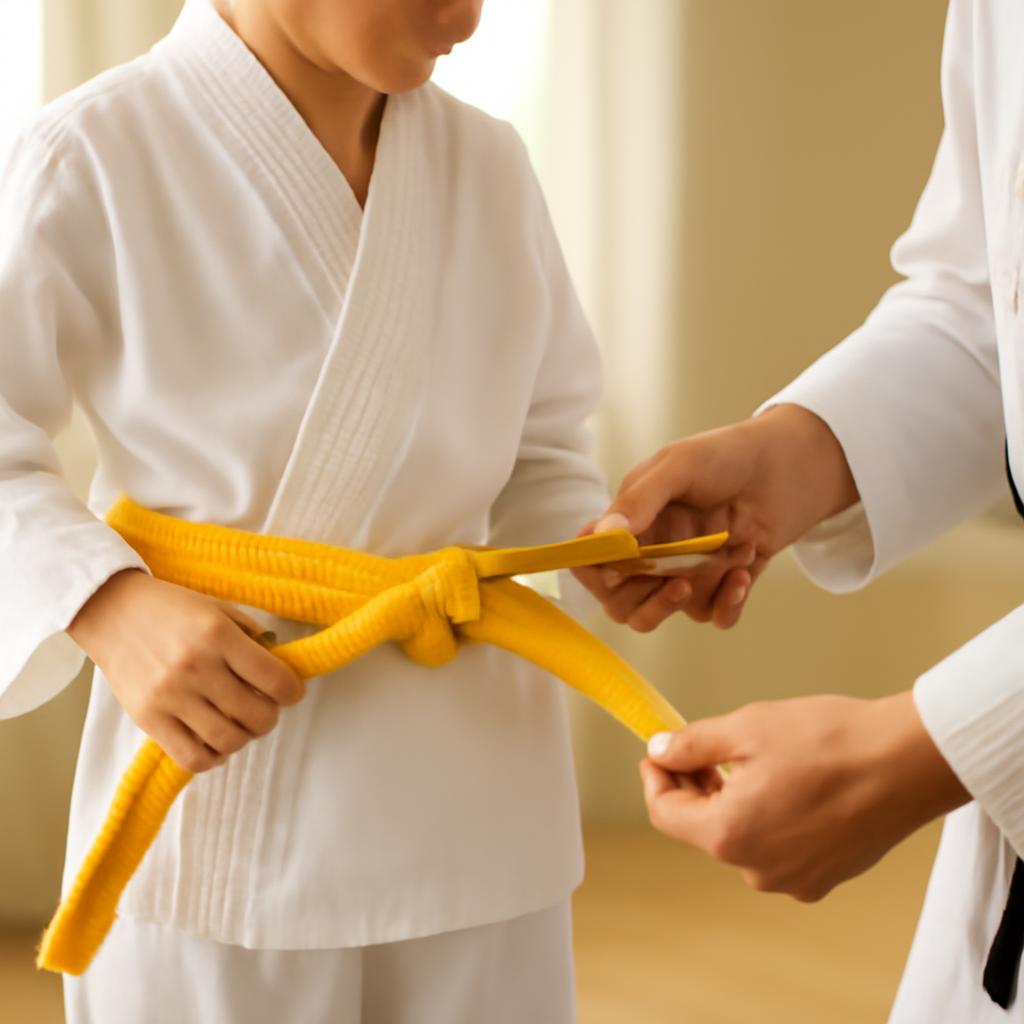
Start at the middle, wrap evenly, tuck under the waist layers and finish with a flat front knot. See fixes for twists, uneven ends and belts that loosen.
If your child is new to karate, the belt can become a surprisingly stressful part of getting ready for class. A loose knot can come undone during warmups. Uneven ends can make the belt look crooked. And when class is about to start, parents are often the ones trying to fix everything quickly.
Instead, start with the beginner-friendly sequence that shows up across multiple karate guides: place the belt at the waist below the navel, wrap it evenly, remove slack, and finish with a flat knot in front with similar-length ends. Then, if your dojo teaches a specific variation, use that version instead KarateMart’s beginner belt guide, Kataaro’s step-by-step belt guide, Jesse Enkamp’s explanation of karate belt variations.
That framing matters for parents. Karate schools do not all present the belt the same way, but they usually want the same outcome: a neat, secure tie that stays put and matches local etiquette.
Related: 4th Grade Reading List: 50+ Recommended Books by Genre from Schools and Libraries.
Why Tying a Karate Belt Matters for Youth Training
A karate belt is not just decorative. It helps keep the uniform closed and is supposed to stay secure during movement, kicking, drills, and partner work. Beginner and instructor-oriented guides alike describe a badly tied belt as a source of distraction, interruption, and avoidable training problems if it comes loose during class Shotokan Karate Online’s belt guide, KarateMart’s beginner belt guide. For a child who is already trying to remember where to stand, when to bow, and what the instructor is asking for, that matters.
A neat belt also carries an etiquette element. Several guides connect a tidy, flat knot with discipline, respect for the uniform, and a more uniform look in class Kataaro’s step-by-step belt guide, Shotokan Karate Online’s belt guide. Jesse Enkamp goes further and presents belt tying as part of karate mindset and tradition, while also acknowledging that dojo etiquette should come first if a school teaches its own method Jesse Enkamp’s explanation of karate belt variations.
For kids, the practical effect is simpler than the symbolism: when the belt looks right and stays in place, one more beginner problem disappears.
Belts also signal rank, but the details vary by organization. GKR Karate describes white as the beginner belt and black as the advanced end of its sequence, with other colors in between GKR Karate’s explanation of belt grades. Shotokan Karate Online and KarateMart similarly describe belts as rank markers while noting that color progressions can vary by school or style Shotokan Karate Online’s belt guide, KarateMart’s beginner belt guide. So parents should treat belt colors as local ranking systems, not as universal proof that every karate program works the same way.
The useful parent takeaway is straightforward: learning to tie the belt well can reduce interruptions, help a child feel prepared, and make the first months of class smoother.
Standard Step-by-Step: The Square Knot Method
If you want one beginner method to start with, use the common flat-front method often described as a square-knot approach. The wording changes from guide to guide, but the same basic sequence keeps reappearing: start at the middle or a fixed front reference point, wrap evenly, tuck one end under the waist layers, then finish with a flat knot in front KarateMart’s beginner belt guide, Kataaro’s step-by-step belt guide.
Here is a clear text-only version for beginners.
-
Find the center of the belt. Fold the belt in half to locate the midpoint. Several guides place that center point below the belly button or navel KarateMart’s beginner belt guide, Jesse Enkamp’s explanation of karate belt variations. A Shotokan guide notes that some students begin about 1 to 2 inches to the right of the belly button to help the finished knot sit neatly in front Shotokan Karate Online’s belt guide.
-
Wrap both ends around the waist evenly. Bring the belt around the back and back to the front while keeping it flat against the gi KarateMart’s beginner belt guide, Kataaro’s step-by-step belt guide. If the belt twists during the wrap, the front will usually look messy even if the final knot is technically tied correctly.
-
Cross the ends in front. Once both ends are back in front of the body, cross one over the other to make an X KarateMart’s beginner belt guide, Kataaro’s step-by-step belt guide. Before you continue, check whether the hanging ends still look roughly even.
-
Tuck the lower end under the wrapped layers and tighten. Beginner guides consistently show the lower end going up under the belt layers around the waist, followed by a firm pull to remove slack KarateMart’s beginner belt guide, Kataaro’s step-by-step belt guide.
-
Cross the ends again and finish the flat front knot. After the tuck, cross the ends once more and loop one through so the knot lies flat in front KarateMart’s beginner belt guide, Kataaro’s step-by-step belt guide. If the knot stands upright, looks rolled, or feels bulky, the final crossing usually needs to be redone in a flatter orientation.
-
Pull outward and adjust the ends. A finished beginner tie should sit flat, feel snug, and leave ends of similar length KarateMart’s beginner belt guide, Kataaro’s step-by-step belt guide. Kataaro suggests about 12 inches of visible tail for karate and taekwondo as a practical target rather than a universal rule Kataaro’s step-by-step belt guide.
A good finished knot usually passes four simple checks:
- Centered enough that it does not look obviously skewed
- Flat enough that the layers are not twisted
- Snug enough to stay put through class
- Even enough that neither tail is dramatically longer than the other KarateMart’s beginner belt guide, Kataaro’s step-by-step belt guide
If your child’s dojo teaches a back-cross method, an off-center start, or another presentation detail, that does not mean the common beginner method is “wrong.” It means karate has real local variation, and the instructor’s standard should decide the final version Jesse Enkamp’s explanation of karate belt variations.
Tying for Kids: Parent-Assisted Technique
Tying a karate belt on yourself is one skill. Tying it on a child who is wiggling in the lobby is another.
GKR Karate specifically publishes a separate demonstration for a parent tying a karate belt for a child, which is a good reminder that parent-assisted tying is a normal beginner need, not an unusual one GKR Karate’s parent-focused belt-tying page.
For parents, two start methods appear in the evidence. One is the midpoint method: hold the center below the child’s navel, then wrap both ends evenly KarateMart’s beginner belt guide. The other, shown by Kataaro, begins with the label end laid across the abdomen on the child’s left side while the other end wraps around the waist Kataaro’s step-by-step belt guide. If your dojo has already shown you a house method, use that one.
A reliable parent-assisted sequence looks like this:
-
Straighten the gi first. Make sure the jacket sits correctly and is not bunched or twisted at the waist. A neatly tied belt over a twisted gi will still look crooked.
-
Choose your front reference point and keep a hand on it. If you are using the midpoint method, hold the center below the navel. If you are using the label-end method, hold that end at the child’s left abdomen KarateMart’s beginner belt guide, Kataaro’s step-by-step belt guide.
-
Wrap flat and taut. Bring the free end around the waist without letting the belt roll. Kataaro explicitly advises keeping the belt taut against the body so friction helps it stay in place Kataaro’s step-by-step belt guide. If your school teaches a double-wrap or another layered variation, keep the passes stacked neatly rather than overlapping loosely EvolveAll’s Hollywood-knot explanation.
-
Have the child stand tall for the cross-and-tuck steps. Kids often bend forward to watch what you are doing. A simple “stand tall and freeze” cue helps.
-
Tighten in stages. Remove slack after the tuck under the waist layers, then tighten again after the final knot Kataaro’s step-by-step belt guide.
-
Teach self-tying by mirroring. Once your child is ready, stand facing them and let them copy your motions. GKR’s separate videos for tying a belt on a child and tying your own belt suggest that these are often learned as two related but distinct beginner skills GKR Karate’s parent-focused belt-tying page.
Belt choice matters here too. Kataaro notes that softer, narrower belts tend to stay tied better and that belt sizing is not standardized across the industry Kataaro’s step-by-step belt guide. If the belt consistently finishes with tails much longer than the roughly 12-inch guideline Kataaro gives for karate and taekwondo, belt length may be part of the problem rather than technique alone Kataaro’s step-by-step belt guide.
The parent goal is not ceremonial perfection. It is a secure, neat tie that lets the child walk into class without needing constant repairs.
Common Mistakes and How to Fix Them
Most beginner problems trace back to the same few mechanics: the belt did not start evenly, it twisted during the wrap, or the knot never got fully tightened. Those are the recurring mistakes in beginner karate guides KarateMart’s beginner belt guide, Shotokan Karate Online’s belt guide.
Uneven ends If one tail is much longer than the other, the real problem usually happened at the beginning, not the end. The midpoint may have been off, or one side may have picked up more slack during the wrap KarateMart’s beginner belt guide. Fix: Start over, confirm the center or front reference point, and keep even tension before the first tuck.
Twisted belt layers A twist around the back usually turns into a bulky, sloppy-looking front. Beginner guides call this one of the most common errors KarateMart’s beginner belt guide. Fix: Flatten the belt during the wrap instead of trying to smooth everything after both ends return to the front.
Loose knot that comes undone Multiple guides say to keep the wrap taut and pull snug after the tuck under the waist layers Kataaro’s step-by-step belt guide, KarateMart’s beginner belt guide. New belts can make this worse. Kataaro says new belts may come untied until they are broken in, and Shotokan Karate Online notes that material can affect how well the knot holds, especially early on Kataaro’s step-by-step belt guide, Shotokan Karate Online’s belt guide. Fix: Tighten after each stage, not only at the end, and expect a short break-in period with a new belt.
Label or stripe on the “wrong” side This confuses beginners because the answer is not universal. Kataaro starts with the label end across the abdomen on the left Kataaro’s step-by-step belt guide. A Shotokan guide says the label should face forward on the right side when finished Shotokan Karate Online’s belt guide. A taekwondo school page says stripes should end on the right for its own students San Diego Sidekicks’ taekwondo belt etiquette page. Fix: Treat label and stripe placement as local etiquette. Ask your instructor what your school expects.
Bulky or vertical knot If the knot sticks up or looks rolled instead of flat, the last crossing likely was not finished cleanly in front. Fix: Redo the final crossing and pull the ends outward so the knot settles horizontally. This matches the flat-front finish shown in beginner karate belt guides KarateMart’s beginner belt guide, Kataaro’s step-by-step belt guide.
The reassuring part for parents is that a messy belt usually points to a fixable setup error, not to anything deeper about the child’s ability.
Karate vs. Other Martial Arts: Key Differences
Parents often assume all martial arts belts tie the same way. They do not, but the overlap is real enough that general beginner tutorials can still be useful.
For karate, the beginner pattern most often shown in the evidence is an even wrap around the waist followed by a flat knot in front with similar-length ends KarateMart’s beginner belt guide, Shotokan Karate Online’s belt guide. KarateMart also notes that karate and taekwondo commonly use a very similar method, even though schools may differ on presentation details KarateMart’s beginner belt guide.
Taekwondo can therefore look very familiar to karate parents, but “similar” does not mean identical. Some schools care about where a stripe finishes, and some teach their own preferred finish or etiquette rule San Diego Sidekicks’ taekwondo belt etiquette page. So if your child crosses between arts, assume the core idea may transfer while the presentation details may not.
Broader martial-arts guides also show that wrap style and tail length can differ by discipline. Kataaro presents one belt-tying method for karate, taekwondo, jujitsu, and judo, while also suggesting about 12 inches of visible tail for karate and taekwondo and shorter visible ends for BJJ and judo Kataaro’s step-by-step belt guide.
There are also differences within karate itself. Jesse Enkamp describes a traditional Japanese approach that crosses the belt behind the back to form an X before finishing in front Jesse Enkamp’s explanation of karate belt variations. Other beginner guides skip the back X and focus on a simpler front finish KarateMart’s beginner belt guide, Kataaro’s step-by-step belt guide. EvolveAll teaches a distinct “Hollywood” knot and openly says schools vary EvolveAll’s Hollywood-knot explanation.
So the useful parent answer is not “all belts tie the same” or “every art has a totally different knot.” It is this:
- Karate and taekwondo: often use closely related beginner methods
- Judo and jiu-jitsu contexts: may present different tail lengths or wrap styles depending on belt length and school practice Kataaro’s step-by-step belt guide
- Karate itself: includes real school-to-school variation, including back-X methods Jesse Enkamp’s explanation of karate belt variations
- All arts: the instructor’s method should override internet consensus when there is a conflict Jesse Enkamp’s explanation of karate belt variations, EvolveAll’s Hollywood-knot explanation
Choosing the Right Belt for Youth Karate
Sometimes the problem is not the knot. It is the belt itself.
The first rule is to buy by length, not by rank color or a generic assumption like “all youth white belts are the same.” Kataaro explicitly says there is no industry-wide standard for belt sizing and recommends choosing by measurement rather than treating size as universal Kataaro’s step-by-step belt guide. That matters for children because two beginners of the same age may need very different belt lengths.
A practical fit target is a tied belt that leaves moderate, even tails in front. Kataaro suggests roughly 12 inches of visible tail for karate and taekwondo Kataaro’s step-by-step belt guide. That is best treated as a guideline, not a strict rulebook requirement.
Material and stiffness can matter too, but this is practical guidance rather than hard testing. Kataaro says narrower, softer belts tend to stay tied better Kataaro’s step-by-step belt guide. Shotokan Karate Online notes that newer belts, including silkier ones, may loosen more at first and may improve as they are used Shotokan Karate Online’s belt guide. For parents, the useful inference is modest: if a belt is very stiff or slippery, it may be harder for a beginner to keep tied consistently.
A simple youth-belt checklist looks like this:
-
Correct length for the child’s waist and the school’s wrap style
-
Ends that finish at a manageable length once tied Kataaro’s step-by-step belt guide, Shotokan Karate Online’s belt guide
If your child keeps fighting the same belt every class, do not assume it is only a practice problem. Sizing and stiffness may be contributing too.
Dojo Etiquette and Symbolic Meaning
Parents often want to know whether belt tying has deeper meaning or whether it is mainly about presentation.
The evidence supports a careful middle answer. Some karate teachers do present the act of tying the belt as symbolic, but those meanings are not universal facts across all karate. Jesse Enkamp gives the clearest example: he interprets balancing the belt from the middle as a reminder of balance, placing it below the navel as a reminder of moral responsibility, and the back X in some Japanese methods as part of a traditional mindset framework Jesse Enkamp’s explanation of karate belt variations. That is a meaningful traditional interpretation, but it should be understood as one teacher’s explanation of a traditional approach rather than a rule binding every dojo.
Other guides stay closer to the practical side. Kataaro emphasizes a neat, secure knot as part of discipline and a professional appearance Kataaro’s step-by-step belt guide. Shotokan Karate Online connects proper tying with dedication, respect, and avoiding disruptions during training Shotokan Karate Online’s belt guide.
For parents, the practical etiquette rules are simpler than the symbolism:
- Follow the school’s taught method if it has one
-
Keep the belt flat and tied neatly
-
Treat presentation as respect for class, not as a source of panic Kataaro’s step-by-step belt guide, Jesse Enkamp’s explanation of karate belt variations
It also helps to keep the tone healthy. Even Enkamp, who takes the traditional side seriously, says the point is not perfection but striving for it Jesse Enkamp’s explanation of karate belt variations. That is a useful message for kids. The belt tie matters, but it is not a test of personal worth.
Practice Tips and Troubleshooting Chart
Belt tying becomes easier through repetition. Beginner guides explicitly note that practice makes the process automatic KarateMart’s beginner belt guide.
A mirror can help because kids can compare the two tails and see whether the knot sits level. Video can help too. GKR Karate publishes separate demonstrations for a parent tying on a child and a student tying on themselves, and Jesse Enkamp provides a video version of his traditional method GKR Karate’s parent-focused belt-tying page, Jesse Enkamp’s explanation of karate belt variations.
Here is a simple troubleshooting chart to use before class:
| Symptom | Likely cause | Quick fix |
|---|---|---|
| Belt comes untied in class | Slack left in the first tuck or final knot | Re-tie and pull firmly after the tuck and again after the finished knot Kataaro’s step-by-step belt guide |
| Ends are uneven | Midpoint or starting reference point was off | Reset the center before wrapping; do not try to fix it only at the end KarateMart’s beginner belt guide |
| Belt looks twisted | Layers rolled during the wrap around the back | Flatten the belt as you wrap instead of after the fact KarateMart’s beginner belt guide |
| Knot is bulky or sticks up | Final crossing did not settle flat | Undo the last step and re-cross the ends so the knot lies horizontally KarateMart’s beginner belt guide, Kataaro’s step-by-step belt guide |
| Label or stripe is on the wrong side | You used a different school’s presentation rule | Ask the instructor which side the school expects Shotokan Karate Online’s belt guide, San Diego Sidekicks’ taekwondo belt etiquette page |
| Tails are extremely long on a small child | Belt length is not a good fit | Try a shorter belt rather than endlessly reworking the knot Kataaro’s step-by-step belt guide |
One last niche detail: Kataaro also shows a simpler display tie for presenting a uniform rather than wearing it in training Kataaro’s step-by-step belt guide. For class, though, a secure training tie matters more than showroom neatness.
Once belt tying stops being a scramble, parents can focus on the parts of youth karate that matter more: whether the child can get dressed consistently, whether the instructor has clearly explained the dojo’s house method, and when the student is expected to start tying the belt independently.
Do all karate dojos tie belts the same way?
No. Most beginner guides agree on the same core sequence: start at the middle or another fixed front reference point, wrap evenly, tuck under the waist layers, and finish with a flat knot in front. But schools differ on details such as whether to start exactly centered, slightly off-center, or with a back-X wrap KarateMart’s beginner belt guide, Jesse Enkamp’s explanation of karate belt variations, Shotokan Karate Online’s belt guide. The common method is the best place to start, but your instructor’s version should win if the dojo teaches something specific.
Why does my new karate belt keep coming undone?
Usually because the belt is still stiff, the wrap was not tightened enough before the final knot, or the layers were not lying flat. Kataaro notes that new belts may come untied until they are broken in, and Shotokan Karate Online also says newer or slicker-feeling belts can loosen more at first Kataaro’s step-by-step belt guide, Shotokan Karate Online’s belt guide. Tighten after the first tuck, then again after the final knot.
Is the karate belt method the same as taekwondo?
Often similar, but not always identical. Beginner karate guides say karate and taekwondo commonly use a similar basic tying method KarateMart’s beginner belt guide. But taekwondo schools may care about stripe placement or teach their own presentation details San Diego Sidekicks’ taekwondo belt etiquette page. Think of them as closely related beginner methods with school-specific etiquette layered on top.
Where should the belt label face?
That depends on the method and the school. Kataaro starts with the label end across the abdomen on the left Kataaro’s step-by-step belt guide. Shotokan Karate Online says the label should face forward on the right side when finished Shotokan Karate Online’s belt guide. If your dojo cares about label or stripe orientation, treat it as local etiquette and ask for the exact preference.