
Splash Pads Explained: Zero-Depth Water Fun Without the Pool Risks
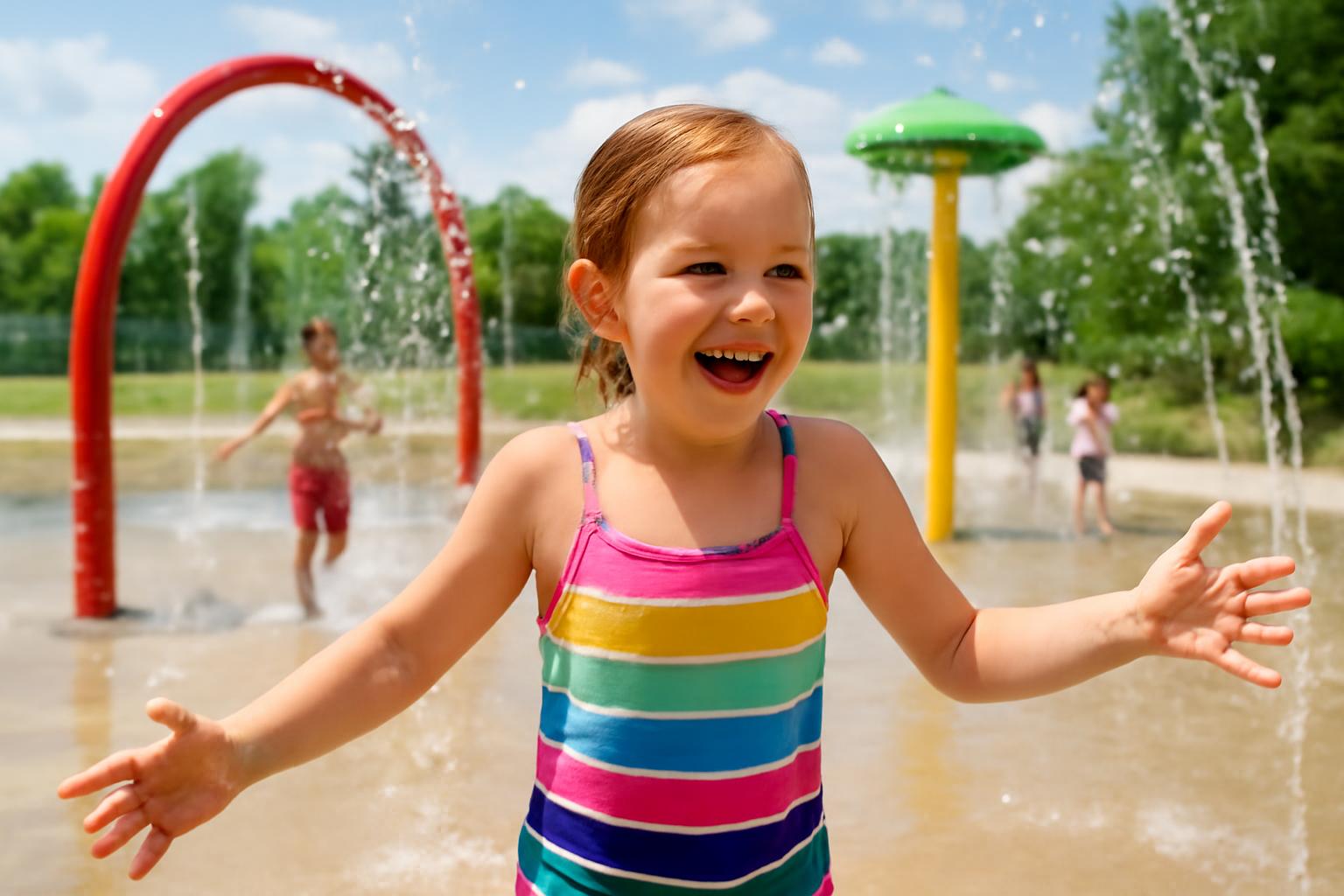
Water sprays across a deck rather than forming a pool. Some systems drain after one pass. Others collect, filter, disinfect and spray it again.
For parents, a splash pad can look like the easiest kind of summer water outing: no deep end, no swim test, no floaties to inflate, and no pool schedule to manage.
That basic impression is mostly right. A splash pad is designed so standing water does not collect in the play area, which helps reduce drowning risk compared with places built for immersion or swimming. But that is a narrower safety advantage than many families assume. A splash pad can still involve slips, collisions, heat exposure, and water-quality problems if the system is poorly maintained or the child is not supervised closely enough (CDC).
So if you are asking what a splash pad is, how it works, whether it is a better option than a pool for a toddler, or whether the water is actually clean, the useful answer is this: it is a zero-depth water-play area that lowers one major hazard without making water play risk-free.
That distinction matters, especially for parents looking for a low-barrier outing on hot days, between camps, or during the long stretch when kids want something active but are not headed to formal lessons or team practice. Splash pads can be a smart fit. They just work best when you understand what they are actually designed to do, and what they are not.
Defining a Splash Pad
A splash pad is a flat recreation area where water sprays, jets, mists, or pours onto users and then drains away instead of collecting in a swimmable basin. The phrase “zero-depth” is often used because the design centers on water play on a surface, not immersion in standing water.
You will also hear nearby terms such as spray ground, spray pad, spray park, spray pool, wet deck, and interactive fountain. Families often use those labels interchangeably, and many facilities do too. Life Floor, a company focused on aquatic surfacing, describes splash pads broadly as flat, defined play areas with water-play features that do not permit much water to accumulate, which is a practical way to understand the category even when local naming varies (Life Floor).
The most important part of the definition is not the brand name or the local label. It is the layout. A splash pad is built so the water keeps moving and the deck drains. That is the core difference from a pool or even a classic wading area: the child is on a wet surface interacting with sprays, not entering a body of water meant for submersion.
Public-health language lines up with that basic idea. The CDC describes splash pads as venues that spray or jet water on users and are usually designed so standing water does not collect in the play area. That one design choice is what makes the category distinct in a meaningful safety sense: the venue is meant for contact with moving water, not for swimming in stored water.
For parents, the simplest working definition is also the most useful one: a splash pad is a drainable, zero-depth water-play space where kids run, step, stand, and play through sprays instead of getting into a pool.
That is why splash pads can feel easier with toddlers and preschoolers. They just move onto a wet deck and start interacting with the water features already in front of them.
How Splash Pads Work: Core Features
At the surface level, a splash pad usually looks simple: water appears from the ground or from above, kids run through it, and the area stays wet. Underneath that simple experience is a fairly deliberate setup of plumbing, drainage, timing, and surfacing.
Commercial design descriptions commonly mention several recurring feature types: flush or near-flush ground nozzles, arch sprays, semicircular shower loops, mushroom or tree-style showers, and interactive nozzles that can sometimes be aimed or activated by users.
The water is immediate. A child can dart into a spray, retreat, circle back, and reengage without ever committing to entering a pool. For highly active kids, it feels more like a playground with water added than like a swimming session.
The water itself usually follows one of two paths. In a once-through setup, water sprays out and then drains away. In a recirculating setup, sprayed water is collected, filtered, disinfected, and pumped back through the features. From a parent’s perspective, the difference may not be visible from the deck, but it matters a great deal for sanitation, operations, and whether the facility behaves more like a managed aquatic system than a giant sprinkler.
The deck matters almost as much as the plumbing. Splash pads are typically built with surfaces meant to stay navigable when wet, often with texture and slight slope so water moves toward drains instead of spreading into puddles. That does not mean falls cannot happen. It means the site is supposed to be designed for wet foot traffic rather than for lounging, sitting, or swimming.
A well-functioning splash pad usually gives parents three cues at once:
- Water appears intentionally from specific play features rather than randomly pooling on the ground.
- Water drains quickly so the play surface stays zero-depth in practice, not just in theory.
- The surface is made for wet movement, even though it can still become slick when children run hard or the area gets crowded.
In short, splash pads work by combining controlled water delivery with fast drainage and a surface meant to handle constant wet use. That is what makes them feel less like a pool and more like a water playground.
Splash Pad vs. Pool: Key Differences
The biggest difference is the one parents notice immediately: a pool is built for entering standing water, while a splash pad is built for interacting with water on a deck.
That distinction changes what children do there. In a pool, kids float, wade, kick, practice breath control, or swim. On a splash pad, they run through jets, stand under pours, dodge sprays, and cool off in short bursts. Even when the fun level looks similar from a distance, the activity is different.
It also changes the risk profile. Because splash pads are usually designed so standing water does not collect, they reduce the kind of drowning risk associated with immersion environments. But “reduced drowning risk” is not the same as “no safety concerns.” Children’s Health notes that water play still carries risks including slips and falls, dehydration, infection, and, in small amounts of water, even drowning if a child’s face and nose are covered (Children’s Health).
They remove the need to manage a deep end, a shallow end, stair entry, or sudden immersion. They do not remove the need for an adult to stay engaged.
The tradeoff is just as important. A splash pad is not a substitute for learning to swim. If your goal is confidence around water without the stress of submersion, a splash pad may be the better outing. If your goal is floating, kicking, treading, or building real water competence, you still need lessons or pool time.
Maintenance is different too, though not always in the simplistic way marketing suggests. Some splash pads are easier to staff because there is no swimming basin to guard. But water treatment, surface condition, drain performance, and crowd management still matter.
For families deciding between the two, the practical comparison is usually this:
- Choose a pool when the purpose is swimming, lessons, or longer in-water time.
- Choose a splash pad when the purpose is fast cooling, low-barrier play, or a simpler outing for younger kids.
- Expect supervision in both places, just for different reasons.
A good question is not “Which one is safe?” but “What kind of supervision, skill-building, and risk am I actually managing today?” That frame leads to better decisions than treating all water recreation as one category.
Splash Pad vs. Spray Park Differences
This is the part that gets messy fast, because the terms are not used consistently everywhere.
In everyday family use, “splash pad” and “spray park” are often treated as the same thing. In commercial and design language, though, a distinction is often made by size, age range, and complexity.
Empex Watertoys describes splash pads as generally smaller installations aimed at younger children, often up to about age 12, with features that spray or pour water on users and no standing water on the pad. The same source describes spray parks as larger, broader facilities for all ages, often with separate zones for toddlers and older children and a wider mix of static, kinetic, and user-powered features (Empex Watertoys).
In practice, that often means a neighborhood splash pad may be a compact plaza with ground jets, a few arches, and an overhead spray or two. A spray park may feel more like a destination, with multiple play zones, taller structures, more elaborate equipment, and a stronger effort to separate younger children from bigger, faster kids.
For parents, the label matters less than the setup. A small child may be perfectly comfortable on a basic splash pad and overwhelmed by a huge spray park full of older children sprinting between features. On the other hand, siblings with a wide age spread may enjoy a larger spray park more because there is usually more variety.
The safest takeaway is simple: use the name as a clue, not a guarantee. If a place is called a splash pad, expect a simpler zero-depth spray area. If it is called a spray park, expect something larger and more varied. But always look at the actual features, the crowd, and the layout rather than assuming the sign tells you everything you need to know.
Safety Benefits of Splash Pads
The main safety benefit of a splash pad is clear and real: it is designed without a standing body of water in the play area. That lowers the risk that a child will slip beneath the surface or be unexpectedly submerged in the way they could in a pool, wading pool, or other immersion setting.
That flatter design also tends to make entry and exit easier for young children. There are no steps down into water, no drop-offs, and no depth changes to judge. For a toddler who is still uneasy on wet feet or who freezes at the edge of a pool, that can make the experience much easier to start.
In a pool, a supervising adult has to keep track of submersion, body position, crowd movement, and whether a child is moving normally in the water. On a splash pad, you are usually watching movement on a surface.
Some manufacturers also market splash pads as accessibility-friendly because flat, zero-depth layouts can be easier to approach than a traditional basin and ladder setup. That should be treated as a site-specific feature rather than an automatic promise, but it is one reason families sometimes find splash pads easier to use with strollers, mobility devices, or children who are uncomfortable with pool entry.
Still, the right safety mindset is “lower risk in one major way,” not “generally safe no matter what.” Wet surfaces can still be slippery. Excited children can still collide. And a crowded splash pad can be surprisingly hard to supervise because kids move quickly, unpredictably, and often in groups.
Children’s Health also stresses constant adult supervision during water play, especially for children ages 2 to 4, and recommends regular hydration and sun-protection breaks. That guidance matters just as much at a splash pad as it does around a pool because the absence of a deep end can create a false sense of ease (Children’s Health).
So yes, splash pads offer a genuine safety advantage when the comparison point is immersion. No, that advantage does not turn them into supervision-free play spaces.
Health Risks and Pathogen Concerns
The most common parent misunderstanding about splash pads is also the most important one to correct: a zero-depth design does not automatically mean clean water.
The CDC says splash pads are not always regulated as aquatic venues and are not always required to disinfect water with germ-killing chemicals. Some use once-through water that drains away after one pass. Others recirculate sprayed water through an underground tank, filter, and disinfection system before spraying it again. In either case, germs, dirt, poop, pee, and debris can wash off bodies, shoes, and the play surface into the system or runoff path (CDC).
That operational difference matters because a splash pad can look visually reassuring even when sanitation is weak. There is no cloudy pool to warn you. There may be no lifeguard stand, no lane lines, and no obvious sign that the facility is functioning like an aquatic system behind the scenes. Parents may read “no standing water” as “nothing to contaminate,” when the real question is how the sprayed water is sourced, treated, and managed.
The CDC highlights how serious the consequences can be when treatment or operation fails. A splash pad–associated Cryptosporidium outbreak in New York in 2005 infected more than 2,300 people, and from 2020 through 2023 three young children died after exposure to Naegleria fowleri linked to splash pads in Texas and Arkansas. In those Naegleria investigations, officials found operational and disinfection problems, and the CDC notes there is no evidence of spread in properly disinfected splash pads. The agency also warns that Cryptosporidium can survive for more than seven days even in adequately chlorinated or brominated water (CDC).
For parents, the right takeaway is not panic. It is respect for the fact that water quality depends on maintenance and behavior, not just on the absence of depth.
That is why hygiene advice around splash pads sounds stricter than many families expect. Kids should not drink the water. They should not sit on jets. Children with diarrhea should stay out of splash pads entirely. Diapered children need frequent bathroom or diaper checks, and swim diapers do not keep poop or pee from entering the water system. Those recommendations can feel excessive until you remember that the water may be recirculating through equipment you cannot see.
Shoes and surfaces matter too. The CDC points out that germs and debris can wash off both bodies and splash pad surfaces. So the exposure picture is bigger than “Is the water blue?” A clean-looking deck can still be part of a contamination problem if the system is poorly disinfected or if heavy use outpaces maintenance.
Parents usually cannot inspect the pump room, but they can notice a few practical signs. Does the facility seem attended to, or neglected? Is the area draining normally, or are dirty puddles lingering? Are there visible rules about diarrhea, diapering, and no drinking? Does the site look like a place the operator actually expects families to use responsibly?
None of those checks guarantees safety. They simply help you avoid treating every splash pad as equal. A well-run splash pad and a poorly run splash pad may look similar to a child. They should not look identical to a parent.
Public vs. Residential Splash Pads
But splash pads are not only public. There is also a residential market for backyard versions, ranging from simple surface-spray products to more involved systems that resemble small-scale aquatic installations.
One residential seller, My Splash Pad, markets DIY backyard kits ranging from 8 to 18 nozzles and describes both freshwater-to-drain and recirculating setups, along with add-ons such as chlorinators, UV equipment, and interchangeable nozzles (My Splash Pad).
DIY recirculating builds exist as well. One Instructables project uses plastic crates as a reservoir, a PVC frame to hold spray nozzles, and a 200-gallon-per-hour bilge pump to recirculate water back to the pad, essentially creating a miniature backyard version of the concept (Instructables).
That does not mean a home splash pad is automatically simple. In fact, once a residential setup starts storing and recirculating water, the questions become more serious, not less.
Parents thinking about a backyard installation should ask:
- Is this just a hose-fed play surface, or is it a true recirculating system?
- If it recirculates, how is the water filtered and disinfected?
- Where does the water go when the system is off?
- How is runoff kept from turning into slick or dirty standing water?
- Is the surface actually suitable for wet running and stopping?
- Are pumps, plumbing, and electrical components protected from child access?
That last point is easy to underestimate. A hose-connected splash toy is one kind of backyard water play. A recirculating splash pad is another. The second is much closer to a small aquatic system, with sanitation and equipment questions that deserve the same level of seriousness a parent would bring to any other home water feature.
In other words, “backyard splash pad” can mean anything from a very simple spray setup to a much more technical installation. The closer it gets to collecting, pumping, and reusing water, the more important upkeep and sanitation become.
Parent Tips for Splash Pad Visits
For most families, the best splash pad strategy is not complicated: stay close, keep the visit short enough to stay pleasant, and do not let the zero-depth design lull you into passive supervision.
Children’s Health recommends adult supervision at all times during water play and suggests hydration breaks about every 20 to 30 minutes, along with sun protection and, when appropriate, water shoes to help with footing on hot or slick surfaces (Children’s Health).
The hygiene side matters just as much. The CDC advises showering before using a splash pad, avoiding the water if you have diarrhea, not swallowing the water, and not sitting on jets. Those rules may sound fussy, but they are exactly the habits that help limit contamination in shared-water environments.
Before your child starts playing, it helps to do a fast parent scan rather than walking straight in. Ask yourself:
- Does the area look reasonably clean?
- Is water draining normally, or are there dirty puddles staying put?
- Is the pad so crowded that you will struggle to keep visual contact?
- Are younger children getting bowled over by bigger kids?
- Is the surface hot enough that bare feet may be uncomfortable?
- Do you already know where the restroom or diaper-changing option is?
Simple house rules also help, especially for toddlers and preschoolers. The most useful ones are usually short and concrete:
- Water is for play, not for drinking.
- No sitting on the jets.
- Slow down near other kids.
- Come back when called the first time.
If your child is newly walking, sensory-sensitive, or prone to sprinting without looking, the first few minutes are worth treating as a trial run. Stand close. See how they handle the surface. Notice whether they are startled by stronger sprays or drawn toward crowded features where collisions are more likely.
And if something feels off, leave. Parents do not need proof of a water-treatment failure to decide that a facility looks poorly run, too crowded, too hot, or just wrong for their child that day.
Do splash pads require lifeguards?
Often, no. Many splash pads are designed to operate without lifeguards because they do not include a swimming basin or standing water meant for immersion, and commercial operators commonly present that as one of the format’s practical advantages (Adventure Playground Systems).
But that does not mean adult supervision is optional. Staffing policies vary by operator, and the absence of a lifeguard does not change the basic need to watch toddlers, monitor crowding, and step in quickly when kids start slipping, colliding, or overheating.
Is splash pad water safe to swallow?
No. Parents should treat splash pad water as water children should not drink or intentionally swallow. Children’s Health specifically advises families not to drink splash pad water because germs can spread in the water or on surrounding surfaces, especially if cleaning and maintenance are not ideal (Children’s Health).
That advice applies even when the water looks clear. Clear water is not the same thing as safe drinking water, and in recirculating systems the water may have already picked up contamination from other users or the deck.
What ages are splash pads best for?
In commercial distinctions, splash pads are often described as smaller facilities aimed at younger children, frequently up to about age 12, while larger spray parks are more likely to be designed for a broader age range with separate areas for different ages (Empex Watertoys).
In real life, though, the better question is less about age alone and more about the actual facility. A quiet neighborhood splash pad may be ideal for a cautious 3-year-old. A giant spray park full of older kids may not be. The label matters less than the pace, size, and crowd.
How is splash pad water treated?
It depends on the site. Some splash pads use once-through water that sprays out and then drains away. Others recirculate water by collecting it in a tank, filtering it, disinfecting it, and pumping it back through the nozzles.
For parents, the practical point is that “it isn’t a pool” does not tell you enough about sanitation. A splash pad may still operate like an aquatic system behind the scenes, and the health questions are about treatment quality, maintenance, and user hygiene rather than about depth alone.
Are there splash pad options for home backyards?
Yes. Backyard options range from simple spray products to more involved residential kits and DIY recirculating builds. Residential sellers market dedicated home kits with multiple nozzles and optional treatment-related equipment, while DIY builders have created recirculating setups with pumps, reservoirs, and PVC spray frames (My Splash Pad).
The closer a home setup gets to storing and reusing water, the more carefully parents should think about filtration, disinfection, drainage, and equipment safety. At that point, the project is no longer just a lawn toy. It is a small water system.
A splash pad, then, is best understood as a zero-depth water playground: easier for small kids to use than a pool, usually lower-risk from a submersion standpoint, but only as good as the supervision, sanitation, and common sense around it. For parents, that is the real answer to what a splash pad is: not a risk-free shortcut, but a genuinely useful water-play option when you go in with clear expectations.