
10U Softball Pitching Distance and Rules Guide
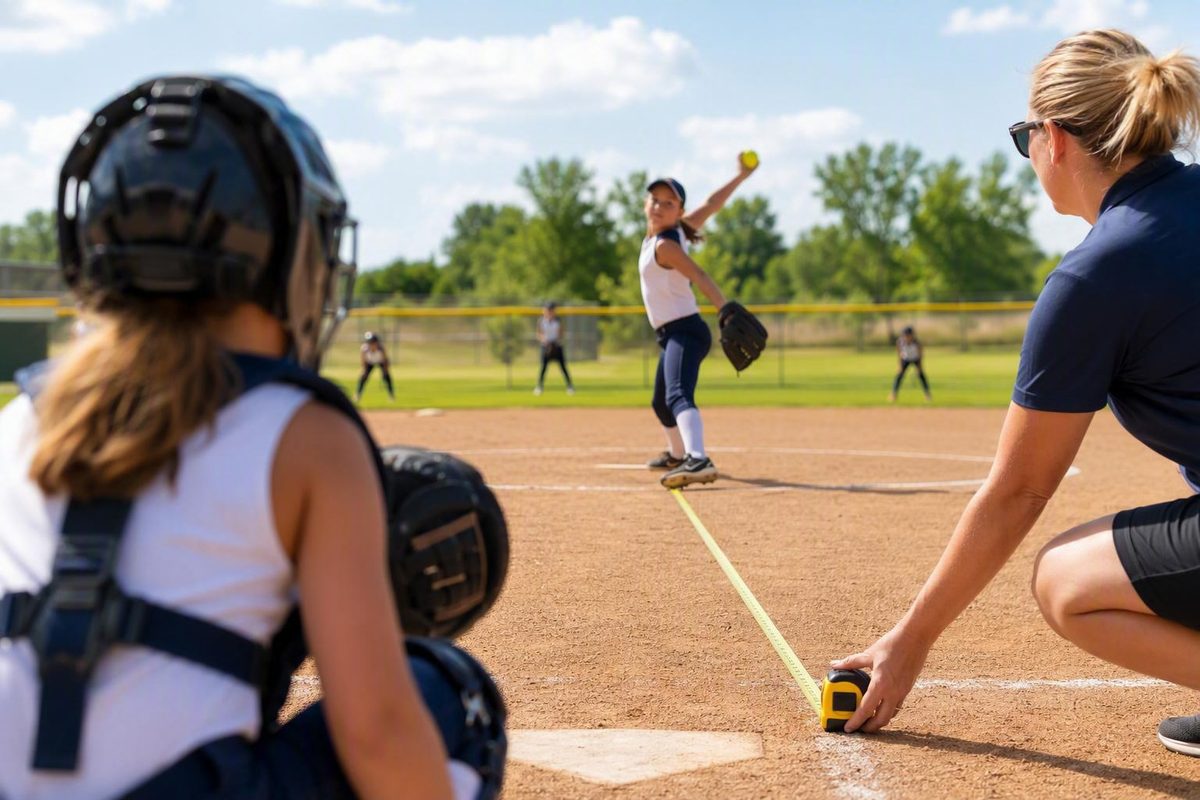
Fastpitch is listed at 35 feet, slow pitch at 40. The game's own sheet may add pitching limits, ball and equipment rules.
10U Softball Pitching Distance and Rules Guide
Overview
The standard 10U fastpitch softball pitching distance is 35 feet, measured from the pitching plate to home plate. The 2025 USA Softball Rule Book lists 35 feet for its 10U fastpitch divisions, and Little League softball tournament rules set the same 35-foot distance for the 8- to 10-Year-Old Division. The deciding factor for any specific game, however, is the rule sheet that actually governs it.
That caveat matters because 10U games are played under many different documents: a national rulebook, a local rec league’s exceptions, or a tournament’s own sheet. Most of the local 10U rule sheets in the evidence for this guide confirm 35 feet, but they modify other details such as pitching limits and equipment. Before first pitch, confirm three things: the distance your rule sheet specifies, whether the field is actually marked at that distance, and which local modifications apply. The rest of this guide walks through each step.
10U fastpitch specs: distance, ball size, bases, and circle
For a quick field-side reference, the core 10U fastpitch numbers are consistent across the national and local sources reviewed here: a 35-foot pitching distance, 60-foot base paths, and an 11-inch ball. The USA Softball rulebook table lists 60-foot bases and a 35-foot pitching distance for both its girls’ and boys’ 10U fastpitch divisions, with a minimum fence of 175 feet and maximum of 225 feet.
| Spec | 10U fastpitch value | Source context |
|---|---|---|
| Pitching distance | 35 feet | USA Softball 10U fastpitch; Little League 8–10 division; multiple local 10U rule sheets |
| Base paths | 60 feet | USA Softball 10U fastpitch table; local league sheets |
| Ball size | 11 inches (some leagues specify an 11” RIF-10 ball) | Fastpitcher age table; local rule sheets |
| Pitcher’s circle | 8-foot radius around the pitching rubber (as specified in one league’s sheet) | MBSL 10U rules |
| Fence range | 175–225 feet (min–max) | USA Softball 10U fastpitch table |
| Next division up | 12U at 40 feet; 14U girls at 43 feet | USA Softball table; Fastpitcher |
Ball size is part of the same scaling logic as distance. Fastpitcher’s age chart lists 10U at 35 feet with an 11-inch softball, moving to a 12-inch ball at older ages, and Big League Shirts notes that 10U uses 11-inch balls at 35 feet to support control and safety, with players moving to 12-inch balls between 12U and 14U. Some local leagues go further and specify a softer 11-inch RIF-10 ball, as one local 10U rule sheet does. Treat the table above as the baseline, then check your own rule sheet for the exact ball and circle specifications it names.
How to measure the 10U pitching distance correctly
The measurement runs from home plate to the pitching plate — the flat rubber slab the pitcher works from, commonly called the pitching rubber. The MBSL 10U rules state it plainly: “pitching rubber to the back of home plate is 35 feet.” CoverSports’ field-dimension guide uses the same reference point in describing the adult distance, measuring from the back tip of home plate, and notes that youth leagues typically shorten the distance to 35–40 feet depending on age group.
On a real field, a quick verification takes only a tape measure and a minute:
- Find the back tip of home plate — the pointed corner facing the catcher and backstop.
- Run a tape measure in a straight line from that tip to the pitching rubber.
- Confirm the reading matches the distance on your controlling rule sheet — 35 feet for the 10U fastpitch setups documented here — and check the rubber is centered on the line between home plate and second base rather than skewed to one side.
This check matters most on shared or temporary fields. Many diamonds host multiple divisions and may have two or three rubbers installed, or holes where portable rubbers drop in, so the rubber closest to home plate is not automatically the right one. One league sheet requires that “the distance between bases and the pitching plate shall comply with USA Softball requirements,” with bases at 60 feet and pitching at 35 feet (10U game rules) — language you can only satisfy by measuring, not assuming. Measure before warmups so any problem surfaces while there is still time to fix it.
What to do if the rubber is set at 40 feet
If your tape shows 40 feet before a 10U fastpitch game, stop and verify rather than playing on. A 40-foot rubber is a plausible mistake on a shared field because 12U fastpitch uses 40 feet in both the USA Softball table and Little League’s 9–11/Majors divisions, so someone may simply have set up for the wrong division.
Work through it in order. First, check the controlling rule sheet for the game — league rules or the tournament packet — to confirm what distance it actually requires. Second, raise it with the umpire and the league or tournament authority before first pitch; they decide how the field is corrected. Third, fix the setup where possible: on fields with a portable rubber or a second installed rubber at 35 feet, the correction is usually quick. Documenting the issue with the site director also helps the next team that draws the same field.
Which 10U rules can vary by league or tournament
There is no single universal 10U rule sheet. National rulebooks set the baseline — USA Softball and Little League both put 10U fastpitch pitching at 35 feet — but local leagues and tournaments routinely adopt a national rulebook and then layer their own exceptions on top. The MBSL 10U rules open with exactly that structure: “All games played under USA Softball rulebook with the following exceptions,” then list field, equipment, and pitching modifications.
The variation shows up clearly in the local sheets reviewed for this guide, even though all of them keep the 35-foot distance:
- Pitching limits: one league caps pitchers at 2 innings per game (MBSL), another allows a maximum of 4 innings with no more than 3 consecutive (10U game rules), and a third uses 3 innings in the first half of the season and 4 in the second, with the cap waived in the championship game (RULES FOR 10U).
- Equipment: one sheet mandates an 11-inch RIF-10 ball and facemasks for all infielders (2017 10U rules).
- Lineup rules: one league requires that all available players bat (RULES FOR 10U).
These are examples of how far local sheets can drift from one another, not a complete catalog of every sanctioning body’s rules — USSSA, NSA, PONY, and other organizations publish their own rulebooks that are not covered by the evidence here. The practical takeaway is the same either way: read the specific sheet that governs your game each season, because last year’s sheet, another league’s sheet, and the national baseline may all differ in the details that decide games.
Fastpitch vs slowpitch at 10U
The 35-foot answer applies to 10U fastpitch, and the distinction is not academic. The USA Softball rulebook table lists 10U fastpitch at 35 feet but 10U slow pitch (G10-U) at 40 feet — a 5-foot difference within the same age group and rulebook. Because the query “10U softball” is often used loosely, confirm which game type your rule sheet covers before you measure or mark anything. Most competitive youth softball coverage assumes fastpitch, and every local 10U sheet cited in this guide is a fastpitch document, but a slowpitch league following the USA Softball table would legitimately set its rubber at 40 feet.
When local, tournament, and national rules disagree
When documents conflict, work from the most specific to the most general: the event’s own rules first, then the local league’s published modifications, then the national rulebook they reference as the baseline. That ordering reflects how the local sheets themselves are written — MBSL, for example, explicitly adopts the USA Softball rulebook and then lists its exceptions, which means the exceptions control wherever they speak and the national book fills the gaps.
For a weekend tournament, that means the tournament packet outranks your home league’s sheet for that event, even if the two disagree on pitching caps or lineup rules. When you genuinely cannot tell which document controls — say, a tournament packet that is silent on pitching distance while the host field is marked for another division — ask the umpire or the event director before the game rather than debating it after a protest. This is a practical reading order, not a legal hierarchy; the event or league authority always has the final word on which rules apply to its games.
Pitching rules beyond distance
A correctly measured 35 feet does not make a game legal by itself; the same rule sheets that fix the distance also regulate how much and how pitchers work. These rules vary more than the distance does, so they deserve their own pregame check.
The local sheets in evidence show the range of what to look for. On workload, caps run from 2 innings per game (MBSL) to 4 innings with a 3-consecutive-inning limit, where a single pitch to a batter counts as an inning pitched (10U game rules). On removal and return, MBSL removes a pitcher who hits three batters in one inning and allows one return to the pitching position if she has innings remaining. Beyond the pitcher herself, one sheet applies the infield fly rule, runs the dropped third strike per ASA rules, limits defenses to no more than six players in front of the base paths, and keeps outfielders in the grass or at least 10 feet behind the bases until the ball is hit (2017 10U rules).
None of these is universal — they are documented examples from specific leagues. Use them as a scan list for your own sheet: workload caps, removal triggers, return rules, ball type, defensive positioning, and which standard softball rules (infield fly, dropped third strike) are on or off at 10U.
Pregame setup checklist for a 10U softball game
Everything above compresses into a short routine a coach, team admin, or field volunteer can run in the ten minutes before warmups. The goal is to catch distance errors, wrong equipment, and rule surprises while they are still fixable.
- Confirm the controlling rule sheet. Identify whether today’s game runs under league rules, a tournament packet, or a national rulebook with local exceptions, and have that document on hand.
- Measure the pitching distance. Tape from the back tip of home plate to the pitching rubber and confirm 35 feet for 10U fastpitch, per the USA Softball baseline and your local sheet.
- Check the base paths. Confirm 60-foot base distances, the figure listed in the USA Softball 10U fastpitch table and local sheets.
- Verify the game ball. Confirm an 11-inch ball, and check whether your league specifies an RIF-10 ball as some sheets do.
- Look at the pitcher’s circle. Where your league defines it — MBSL specifies an 8-foot radius around the rubber — confirm it is marked and centered.
- Note the pitching caps and equipment rules. Write your league’s innings limits, removal rules, and any facemask requirements on the lineup card so in-game decisions are automatic.
- Flag conflicts before first pitch. Raise any mismatch between the field and the rule sheet with the umpire or event authority immediately.
Run the same checklist on the road, at tournaments, and on borrowed fields — that is exactly where the setup is most likely to be wrong.
Preparing a 10U pitcher for the 12U distance
The jump from 10U to 12U moves the rubber from 35 to 40 feet — a 5-foot increase confirmed by Fastpitcher’s age chart and the USA Softball 12U fastpitch listing, with a further move to 43 feet at 13U and up. The distance change is paired with an equipment change: Big League Shirts notes that players move from the 11-inch to the 12-inch ball between 12U and 14U, and frames the 10U setup — 11-inch balls at 35 feet — as deliberately scaled to support control and safety.
That framing is the right lens for the transition: division rules scale the game to the athlete, so preparation should scale too. A reasonable approach for a pitcher in her final 10U season is gradual, coach-guided exposure — mixing in some practice throws from longer distances while keeping most work at the game distance she still competes from, and increasing the longer-distance share as the move to 12U approaches. Sudden, full-time jumps to 40 feet ask a young arm to change release, drive, and timing all at once.
The evidence here does not support specific workload numbers, training timelines, or medical thresholds, so treat those decisions as individual ones. Talk with the player’s pitching coach about pacing, watch for fatigue and mechanical breakdown as signals to pull back, and let league recommendations guide how early the longer distance enters practice. The rule change is fixed; the preparation should fit the pitcher.