
How Big Is a Hockey Goal, and Which Measurements Matter?
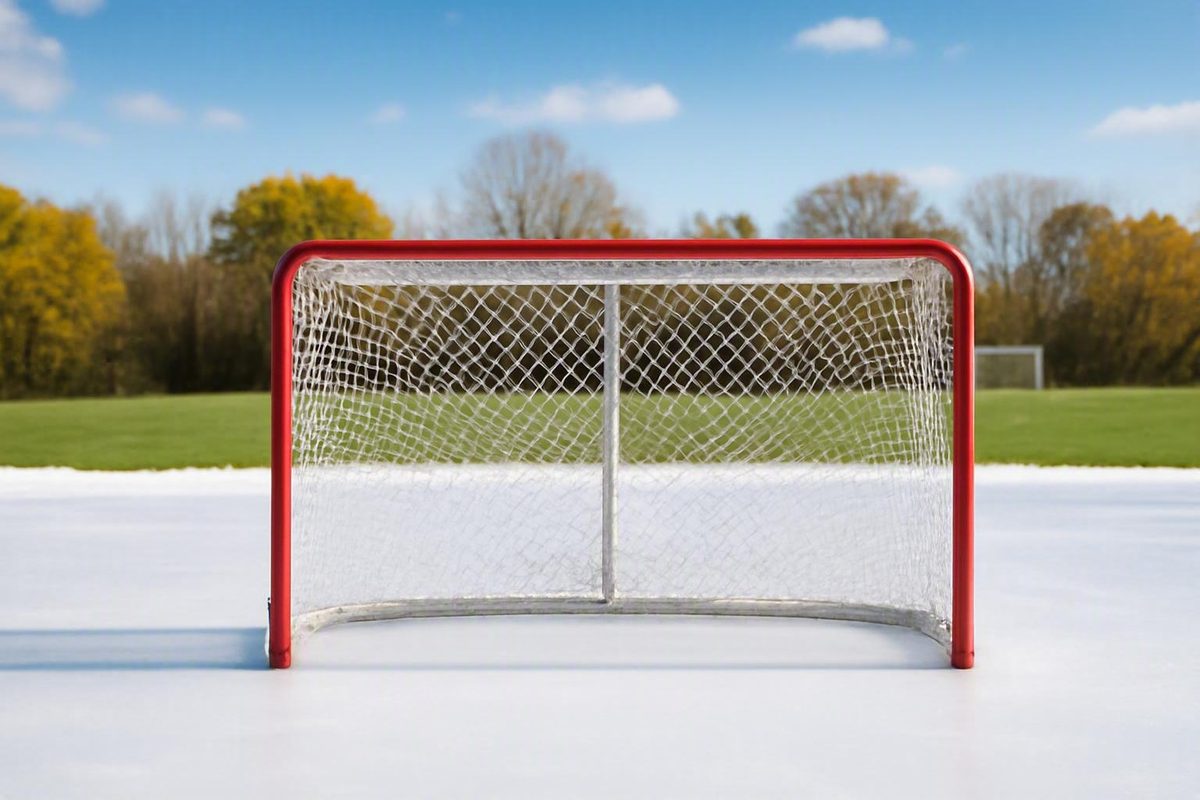
Ice hockey's commonly reported opening is 6 × 4 ft, while field hockey's is about 12 × 7 ft. Neither figure describes the complete exterior footprint.
For ice hockey, the commonly reported answer is 6 feet wide by 4 feet high, or 72 × 48 inches. That is the clear front opening—not the goal’s total exterior width, rear-frame depth, net projection, or storage footprint. The exact conversion is 182.88 × 121.92 centimeters; catalog figures such as 180 × 120 cm are rounded approximations. FloHockey reports the 72 × 48-inch opening.
Depth must be labeled separately. An NHL-style commercial frame is commonly listed as 22 inches deep at the top and 40 inches at the base, but not every goal with a 6 × 4-foot opening has that configuration.
The sport matters too. Field hockey uses a much larger opening—approximately 12 feet wide by 7 feet high—while youth and cross-ice ice hockey goals may be smaller. Because the available evidence is largely commercial or third-party material rather than current governing-body rulebooks, the figures below should be treated as commonly reported dimensions and product specifications. If eligibility or facility approval matters, verify the applicable current rules before buying or using a goal.
Hockey goal dimensions at a glance
| Sport or format | Opening width | Opening height | Top depth and measurement type | Base or bottom depth and measurement type | Status of the figure |
|---|---|---|---|---|---|
| Ice hockey, commonly reported full-size opening | 6 ft / 72 in / 182.88 cm | 4 ft / 48 in / 121.92 cm | Not established by opening size alone | Not established by opening size alone | Commonly reported clear-opening dimensions; a third-party dimensional reference lists the same opening measurements. View its ice hockey goal dimensions. |
| NHL-style commercial ice hockey frame | 6 ft / 72 in | 4 ft / 48 in | 22 in / 55.88 cm, top frame depth | 40 in / 101.6 cm, base frame depth | Commonly listed seller configuration, not a verified universal rule for every 6 × 4-ft goal. Review the frame specifications. |
| Youth or cross-ice ice hockey | Varies | Varies | Varies | Varies | Commercial examples rather than one universal age-based standard; confirm the local format and program rules. |
| Field hockey | 3.66 m / about 12 ft | 2.14 m / about 7 ft | Minimum 0.9 m top net depth | Minimum 1.2 m bottom net depth | Retailer guide’s description of FIH specifications, not independently checked here against a current FIH rulebook. See the field hockey measurement guide. |
The key distinction is between the goalmouth and the complete assembly. Width and height tell you the size of the opening. They do not necessarily tell you whether the frame will fit through a doorway, how far it extends behind the goal line, how much floor space it occupies, or whether a named league or facility permits it.
Exact metric conversions are mathematical rather than separate equipment standards:
- 72 inches × 2.54 = 182.88 cm
- 48 inches × 2.54 = 121.92 cm
- 22 inches × 2.54 = 55.88 cm
- 40 inches × 2.54 = 101.6 cm
A catalog may round these to 180, 120, 56, or 100 cm. When comparing products, use the original unit supplied by the manufacturer or rule and check whether the metric figure is exact or rounded.
What 6 feet by 4 feet actually measures
The familiar 6 × 4-foot ice hockey dimension describes the clear front opening. The reported 6-foot width is measured between the inside edges of the two front posts. The posts rise 4 feet above the ice and are connected by a crossbar, according to a specialty retailer citing an older NHL rulebook. See its explanation of the measurement points.
The opening measurement does not describe:
- the outside-to-outside width of the front posts;
- the widest point of the rear frame;
- the diameter of the tubing;
- the distance the rigid frame projects behind the opening;
- loose or tensioned net projection;
- attached backstops, wheels, supports, or other accessories;
- folded or disassembled transport dimensions; or
- the maximum floor or ice area occupied by the assembled product.
When measuring an existing goal, place the tape inside the goalmouth. Do not wrap it around the posts or measure from the outside edge of one post to the outside edge of the other. For height, measure vertically at the front opening from the playing surface to the underside of the crossbar area.
FRONT VIEW

                 clear opening width
           ←────────── 72 in ──────────→
        ┌─────────────────────────────────┐  crossbar/tubing
        │                                 │
        │                                 │
        │          clear opening          │  ↑
        │                                 │  │ 48 in
        │                                 │  ↓
        └                                 ┘
        ↑                                 ↑
     front post                        front post
     inside face                      inside face

 outside edge ←── overall exterior width ──→ outside edge
Tubing diameter is a construction measurement. It is neither part of the clear opening nor a reliable shortcut for calculating the goal’s overall width. Simply adding two tubing diameters to 72 inches can still produce the wrong exterior figure because bends, rear supports, lacing bars, and other components may determine the widest point.
One third-party dimensional reference lists an 88-inch overall width while separately listing a 72-inch opening. The 88-inch measurement is useful as an example of the difference between opening and exterior width, but it is a reference-page figure—not a verified requirement for every league or product. Compare the listed opening and overall width.
The recommended notation order is:
Width × height × depth
That order is useful only when the measurement points are also stated. Better descriptions include:
- 72 W × 48 H × 40 D inches, with D measured at the base
- 72 W × 48 H × 22 D inches, with D measured at the top
- 72-inch clear opening; maximum exterior width measured separately
- Maximum assembled dimensions: width × height × depth
Without those labels, a description such as “72 × 48 × 40” may be interpreted differently by a retailer, rink operator, coach, or parent planning storage.
SIDE VIEW

        front opening
             │
             │←──── top frame depth ────→
├───────────────────────────\
│ \
│ rear frame
│ \
             └───────────────────────────────┘
             ←──────── base depth ─────────→

      Netting or accessories may project beyond the rigid frame.
      The total footprint is the deepest point of the full assembly.
Why hockey goal depth figures differ
“How deep is a hockey goal?” can refer to at least four different measurements:
- Top depth: The horizontal distance behind the front frame near the crossbar.
- Base depth: The front-to-back distance at floor or ice level.
- Deepest net projection: The farthest point reached by the netting behind the opening.
- Total product footprint: The maximum assembled depth of the frame, net, supports, wheels, backstop, or other attached components.
These measurements are not interchangeable. A sloped rear frame can be shallow near the top and much deeper at the base. A stabilizer or backstop can make the complete assembly deeper than the goal frame itself.
For an NHL-style commercial frame, a common listing is 22 inches at the top and 40 inches at the base, equal to 55.88 cm and 101.6 cm. The same seller also lists alternative configurations with 28-, 34-, and 44-inch base depths, demonstrating that a shared 72 × 48-inch opening does not produce one universal frame depth. These are seller specifications rather than confirmation of current league compliance. Review the listed frame configurations.
Other retail listings broaden the range. Models with a 72 × 48-inch face are listed at 28, 30, 32, and 33 inches deep, depending on the product. One listing also distinguishes the goal’s dimensions from the much larger dimensions of an attached backstop assembly. Compare the retailer’s listed sizes.
Taken together, the supplied commercial examples include depths of 28, 30, 32, 33, 34, 40, and 44 inches. That does not mean every seller uses the same reference point. Some may report base depth, others may use a general product depth, and a listing may not identify whether the net or an accessory extends farther.
The bounded conclusion is:
A 6 × 4-foot opening does not by itself prove that a goal has a 40-inch base depth, a 22-inch top depth, or any particular total footprint.
Before purchasing, transporting, or allocating storage space, request a dimensional drawing and ask:
- Is the stated depth measured at the top or at the base?
- Is it the depth of the rigid frame, the net, or the entire assembly?
- Where is the front reference point—at the front, center, or rear of the posts?
- Does the measurement include supports, anchors, wheels, lacing bars, or a backstop?
- What are the maximum assembled exterior dimensions?
- Are separate folded or disassembled transport dimensions available?
- Does the drawing show the product exactly as sold, including or excluding netting?
Do not classify an alternative depth as compliant or noncompliant from a retail listing alone. If eligibility matters, compare the actual product drawing with the current rule used by the named league, association, tournament, school, or facility.
Field hockey goals are substantially larger
A field hockey goal should not be confused with an ice hockey goal. The reported field hockey opening is almost twice as wide and considerably taller:
APPROXIMATE FRONT-OPENING COMPARISON

ICE HOCKEY                     FIELD HOCKEY
6 ft wide × 4 ft high          about 12 ft wide × 7 ft high

┌──────────────┐               ┌────────────────────────────┐
│              │               │                            │
│              │               │                            │
│              │               │                            │
└──────────────┘               │                            │
                               └────────────────────────────┘
A commercial field hockey guide describing FIH specifications reports an inside opening of 3.66 meters wide by 2.14 meters high, approximately 12 × 7 feet. It says the dimensions are measured inside the posts and exclude the posts and crossbar. The guide was not independently checked here against a current FIH rulebook. Read the guide’s measurement and construction details.
The same guide describes the associated construction as follows:
- white, rectangular posts and crossbar;
- posts and crossbar stated as 2 inches wide and 2–3 inches deep;
- backboards along the back and sides measuring 0.46 meter, or 18 inches, high;
- backboards positioned so they do not narrow the goalmouth;
- minimum net depth of 1.2 meters at the bottom;
- minimum net depth of 0.9 meter at the top;
- maximum mesh openings of 45 mm; and
- net attachment intervals no greater than 150 mm.
Those are attributed specifications from a retailer guide, not independently verified current rules. A school, club, tournament organizer, or facility should consult the governing rules it actually uses before treating every frame, backboard, mesh, or attachment detail as mandatory.
The opening dimensions also do not represent the complete installation envelope. Planning for a field hockey goal may require separate measurements for:
- the rear frame;
- side and back boards;
- top and bottom net projection;
- the stabilization or anchoring arrangement;
- maximum assembled width and depth; and
- clearance behind and around the equipment.
Because the table’s ice hockey depths describe a commercial frame while the field hockey figures describe minimum net depths reported by a guide, they should not be treated as directly equivalent measurements.
Youth and cross-ice goals do not have one universal size
The available evidence does not establish one mandatory goal size for every child of a given age. Youth equipment can vary by league, association, facility, tournament, and playing format. Programs serving the same age group may use different goals for full-ice, half-ice, cross-ice, station-based practice, or games with and without goalies.
Commercial examples show the range:
| Marketed format | Opening | Listed base depth | Seller’s described use |
|---|---|---|---|
| Larger cross-ice goal | 4 ft 6 in × 3 ft | 24 in | 8U play with goalies |
| Cross-ice goal | 4 × 3 ft | 24 in | 8U play with goalies |
| Mini goal | 3 × 2 ft | 20 in | 6U play without goalies |
These are seller-listed products, not universal youth-hockey rules. See the cross-ice and mini-goal specifications.
Another commercial guide associates 3 × 2-foot goals with ages 4–6 and 4 × 3-foot or 4-foot-6-inch × 3-foot goals with cross-ice play at ages 6–8. That guide also acknowledges that there is no universal transition point, so those age bands are examples rather than requirements.
Goal selection may depend on:
- whether the playing format is full-ice, half-ice, or cross-ice;
- whether the game uses a goalie;
- the number of players sharing the playing area;
- the facility’s available equipment;
- the local association’s development model;
- tournament-specific modifications; and
- whether the equipment is intended for games, organized practice, or informal shooting.
Parents can ask four direct questions:
- What playing format does this group use—full-ice, half-ice, or cross-ice?
- What is the clear width and height of the actual goal opening?
- Does the format use goalies?
- Which current league rule, facility requirement, or local modification determines the equipment?
Keep playing format and equipment dimensions separate. “Cross-ice” describes how the ice is used; it does not, by itself, identify one mandatory goal opening. A cross-ice program might use reduced-size goals, but the actual width, height, and depth still need to be confirmed.
Do not assume that all 6U programs use 3 × 2-foot goals, that every 8U program uses 4 × 3-foot goals, or that every player moves to a full-size opening at the same age.
A retailer makes similarly nonbinding suggestions for youth field hockey: 6 × 4 feet for U8, 8 × 6 feet for U10, 10 × 6 feet for U12, and 12 × 7 feet for U14 and above. These are commercial recommendations rather than standardized youth regulations. Local clubs may use different targets, mini goals, or marked goal lines.
Opening size, construction, and intended use are separate decisions
Two goals can share a 72 × 48-inch opening while differing substantially in:
- top and base depth;
- maximum exterior width;
- front and rear tubing diameter;
- rear-frame shape;
- net material and attachment method;
- portability or folding design;
- anchoring or stabilization method;
- resistance to movement;
- intended playing surface;
- intended puck or ball; and
- whether the listing includes the net.
Retail examples with 6 × 4-foot openings list depths from 28 to 33 inches, and the stated post sizes vary by model. That demonstrates why a “regulation size” label may describe only the face of the goal rather than the entire frame. Compare opening, depth, and post specifications.
Tubing measurements vary too. One NHL-style seller lists a 2 3/8-inch outside diameter for its front tubing, while third-party references describe tubing as roughly 2 inches. Neither measurement should be converted into a universal requirement without checking the current rules that apply to the intended use.
Product scope also matters. A listing may cover only the frame, with netting available as a separate option. Conversely, another product may include a net, backstop, or other components that substantially enlarge its assembled footprint.
Parents should not infer puck suitability, durability, safety, or league approval from the opening dimensions alone. A 6 × 4-foot face answers one dimensional question; it does not establish how the product was designed, tested, installed, or approved.
Use the following as a preliminary evaluation checklist, not as a substitute for the manufacturer’s instructions, facility requirements, or applicable safety rules:
- Playing surface: Will the goal be used on ice, pavement, sport court, a gym floor, turf, or grass?
- Object used: Will players use an ice hockey puck, lightweight practice puck, street-hockey ball, or field hockey ball?
- Players: What are their ages, experience levels, and expected style of play?
- Supervision: Who is responsible for setup, inspection, and use?
- Stabilization: What system does the manufacturer, program, or facility specify for that surface?
- Frame condition: Are posts, welds, joints, and rear supports intact?
- Net condition: Are there holes, loose cords, exposed fasteners, or detached sections?
- Clearance: Is there sufficient space behind and around the complete assembly?
- Program rules: Does the named league, tournament, school, or facility permit that exact equipment?
- Product scope: Is the listing for a frame, a frame and net, or a larger assembly with a backstop?
If safety or eligibility depends on the answer, ask the responsible facility or program to confirm the requirement in writing. Dimensions help establish fit, but they do not replace equipment inspection, installation instructions, or organizational approval.
How to check a goal before registration, purchase, or storage
1. Measure the clear opening width
Place the tape between the inside faces of the two front posts. Keep it level and measure the unobstructed goalmouth. Do not measure outside to outside.
Record:
Clear opening width: ___
2. Measure the clear opening height
Measure vertically at the front opening from the playing surface to the underside of the crossbar area. If the goal sits on an uneven surface, check more than one point and note the surface condition.
Record:
Clear opening height: ___
3. Measure top depth
From a clearly identified point on the front frame, measure horizontally to the farthest rigid point near the top. If netting projects farther than the frame, record that separately.
Record:
Top frame depth: ___ Maximum top net projection: ___
4. Measure base depth
At floor or ice level, measure from the stated front reference point to the farthest rear point of the base. Note whether the measurement includes projecting supports or hardware.
Record:
Base frame depth: ___
5. Measure the maximum exterior dimensions
Find the widest, tallest, and deepest points of the complete assembled product. These measurements may be greater than the nominal opening or frame depth.
Record:
Maximum assembled exterior dimensions: width × height × depth
Use those exterior dimensions—not just the nominal opening—to assess:
- doorway and hallway clearance;
- vehicle cargo space;
- elevator dimensions;
- storage-room floor area;
- rear clearance in a practice space;
- ceiling and shelving clearance; and
- whether disassembly is required for transport.
Removable nets, folding frames, and frame-only products can have different handling requirements. Do not assume a folding goal will fit a vehicle or storage area without obtaining its folded dimensions.
When contacting a program, ask:
“Which hockey code and playing format does this group use: full-ice, half-ice, or cross-ice? Does the program use full-size or reduced-size goals? What are the clear opening width and height, the top and base depths, and the maximum exterior dimensions? Do those requirements come from a current league rule, a facility policy, or a local program modification?”
For a purchase, ask the seller:
“Does ‘6 × 4 feet’ describe the inside opening or the outside frame? What are the top depth, base depth, maximum assembled width, and transport dimensions? Does the listing include the net and any backstop, and can you provide a dimensional drawing?”
A seller’s “regulation size” label is not, by itself, evidence that a particular league or rink permits the product. When dimensions affect game eligibility or safety, check the named league’s current rulebook or ask the program director and facility operator for their written requirements.
The practical distinction is simple: 6 × 4 feet is the commonly reported ice hockey opening, while approximately 12 × 7 feet is the reported field hockey opening. Neither figure describes the complete exterior footprint. For youth play, purchasing, transport, or storage, verify the format, local rules, top and base depth, and maximum assembled dimensions rather than relying on the opening or a “regulation-size” label alone.
Frequently asked questions
What are the dimensions of a full-size ice hockey goal opening?
The commonly reported clear opening is 6 feet wide by 4 feet high, or 72 × 48 inches. The exact mathematical conversion is 182.88 × 121.92 cm, although commercial pages often round that to 180 × 120 cm. FloHockey reports the imperial opening dimensions.
Those figures describe the opening only. They do not establish the overall width, depth, tubing size, or complete footprint, and they have not been independently confirmed here against every current governing-body rulebook.
Is a hockey goal 6 feet wide from the inside or outside of the posts?
The reported 6-foot width is measured between the inside edges of the two front posts, not outside to outside. See the retailer’s measurement explanation.
For transport or storage, measure the maximum exterior width separately because rear supports or other frame components may determine the widest point.
How deep is an NHL-style hockey goal?
A commonly listed NHL-style configuration is 22 inches deep at the top and 40 inches at the base, equal to 55.88 cm and 101.6 cm. A commercial hockey-goal guide reports the same top and base figures. Review its NHL-style depth summary.
Do not assume every 6 × 4-foot goal has those depths. Product listings may use “depth” to mean base depth, net projection, or overall product depth.
What size goals are commonly used for 6U and 8U cross-ice hockey?
Commercial examples include a 3 × 2-foot goal with a 20-inch base depth marketed for 6U play without goalies, plus 4 × 3-foot and 4-foot-6-inch × 3-foot goals with 24-inch base depths marketed for 8U cross-ice play with goalies. See the seller’s youth-goal examples.
These are product examples, not universal age-group rules. Confirm the local playing format, whether goalies are used, and the actual equipment requirements.
How large is a field hockey goal compared with an ice hockey goal?
A field hockey opening is reported as 3.66 meters wide by 2.14 meters high, approximately 12 × 7 feet, while the commonly reported ice hockey opening is 6 × 4 feet. A commercial guide likewise describes field hockey goals as 12 × 7 feet. See its sport-size comparison.
Field hockey’s opening is therefore about twice as wide and approximately 3 feet taller. Both sports require additional rear space for the frame, net, and associated components.