
How to Choose Knee Supports That Actually Fit a Young Catcher’s Gear
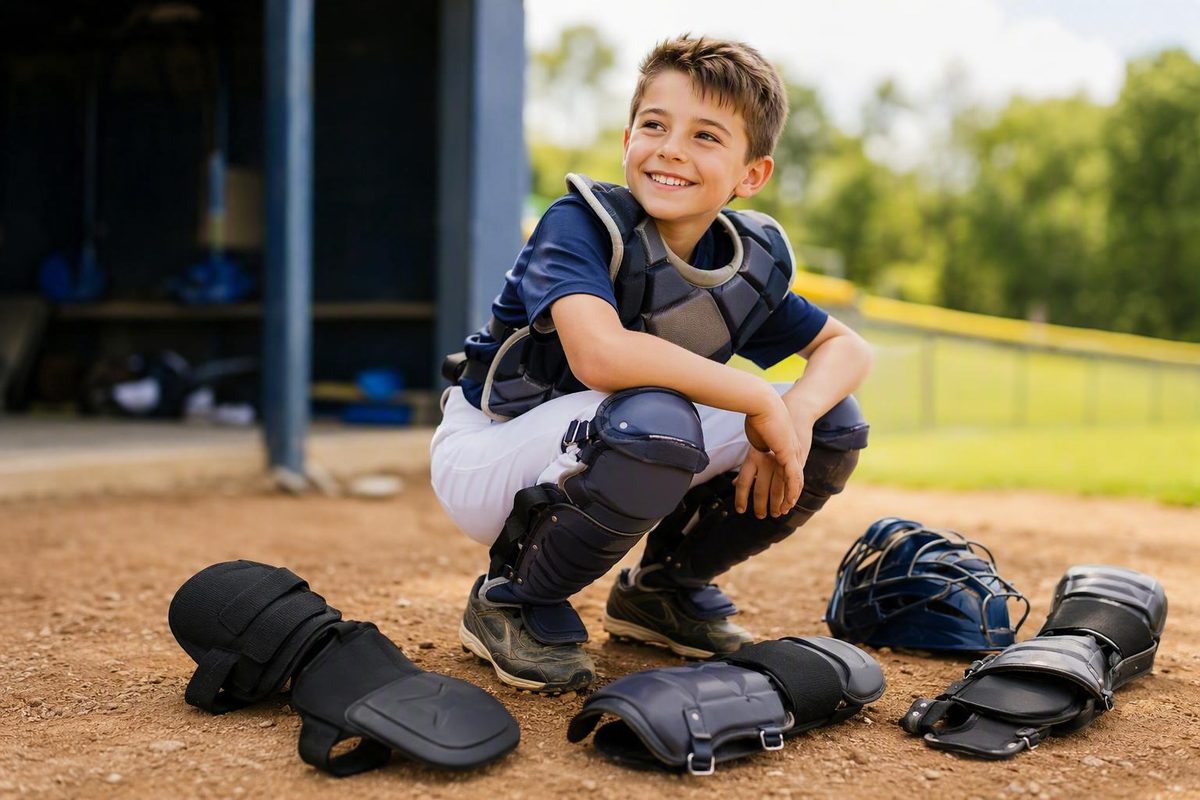
Buy only if they match the measured guards, have a workable attachment route, stay secure through normal catching movements and can be returned if fit is wrong.
Baseball catcher knee savers are simple accessories with inconsistent sizing and attachment systems. Some are labeled youth or adult, some use player-height cutoffs, and others are sold as one size. None of those labels alone establishes whether a pair will fit a particular catcher’s leg guards.
The reliable approach is to start with the equipment already in the gear bag. Measure the guards, identify their straps and harness, compare the available mounting space with the knee-saver manufacturer’s instructions, and then test the completed setup through normal catching movements.
The manufacturer pages, retailer listings, and coaching material reviewed for this guide market knee savers primarily for support or comfort. They do not provide independent clinical or biomechanical evidence establishing injury prevention, cartilage protection, or long-term knee-health benefits. This is therefore a specifications-and-fit guide—not a medical guide.
What catcher knee savers are—and what they are not
Catcher knee savers are padded wedges or blocks mounted behind the lower legs on catcher leg guards. When the catcher settles into a crouch, the backs of the legs can rest against the pads instead of remaining unsupported.
Retailers and manufacturers use several names for broadly similar products:
- knee savers;
- knee supports;
- knee relievers;
- knee wedges;
- knee blocks; and
- Knee S’Ports.
The terminology does not guarantee identical dimensions, foam, attachment hardware, or fit. Two products described as youth knee supports may use different sizing rules and work with different leg-guard systems.
Knee savers are add-on supports, not substitutes for a catcher’s standard protective equipment. Their position behind the calf also gives them a different function from the hard shell and padding on the front of a leg guard.
Manufacturers and retailers commonly describe these accessories as improving comfort or reducing fatigue, pressure, strain, or stress. Those descriptions are commercial claims. The reviewed product pages do not present independent comparative testing showing that the products produce those outcomes across youth catchers.
More specifically, the reviewed materials do not establish that baseball catcher knee savers:
- prevent acute or overuse injuries;
- protect cartilage from damage;
- eliminate stress on the knee joint;
- correct catching mechanics;
- make an injured knee safe to play on; or
- extend a catcher’s career.
That does not mean an individual catcher cannot find them comfortable. It means that a report of comfort should not be converted into a medical promise.
Knee savers also do not determine whether a catcher works hard. Coach Xan Barksdale argues that effort and work ethic belong to the player rather than the equipment. That is a coaching opinion, but it makes a useful distinction: debates about whether knee savers make players “lazy” concern training culture, not measurable product fit or performance.
Use four practical standards when evaluating a pair:
- Fit: The pads match the catcher’s leg guards and sit in a useful position behind the legs.
- Attachment: The straps or hardware hold the pads securely without improvised routing.
- Movement: The catcher can receive, rise, block, throw, and run without observable interference.
- Realistic expectations: The pads are being considered as optional support equipment, not as proven injury prevention or treatment.
Start with the leg guards, not the product label
Before shopping, place the catcher’s leg guards on a table and record what is actually there. Product names such as youth, adult, universal, or one size are only starting points.
Use this pre-purchase workflow:
- Identify the leg-guard brand and model. Look for a label inside the guard, on the knee cap, or along the harness. Do not assume every model from one brand uses the same strap layout.
- Measure the guard length. Follow the knee-saver manufacturer’s measurement method when one is published. Record the result rather than estimating from the catcher’s age.
- Count and locate the leg straps. Note how many straps there are and where they cross behind the calf and lower leg.
- Identify the harness. Determine whether the guards use separate conventional straps, an integrated harness, or a proprietary system.
- Inspect the mounting area. Look at the space behind the calf and above the ankle. Consider whether a wedge can sit there without overlapping hinges, buckles, padding, or guard edges.
- Compare the equipment with current instructions. Check the exact knee-saver model, not merely the manufacturer’s broader product category.
- Confirm what hardware is included. A listing may show straps in a photograph without clearly stating whether they come with the pads.
A one-size claim does not establish universal compatibility.
All-Star illustrates why model-level checking matters. Its KS3 Knee S’Ports are listed as incompatible with MVP-Pro leg guards. The manufacturer also says the pads cannot attach directly to a DeltaFlex harness; installation with that harness requires the included extra-long elastic straps.
Other products take different approaches. FORCE3 says its pads connect to shin guards without additional straps. An Easton-titled retailer listing says its pads attach to the shin guards’ leg straps.
Clocean also relies on the catcher’s existing leg-guard straps. Its package is described as including two vertical straps and four stainless-steel D-rings, but not the leg-guard straps themselves. Those details appear in the Clocean product listing.
If a listing is vague, ask the seller or manufacturer:
- Does this model fit my exact brand and model of leg guard?
- What guard measurement defines the recommended size?
- Which existing straps are used for installation?
- Does the product work with an integrated harness?
- Are extension straps, buckles, loops, or D-rings required?
- Is all required hardware included?
- Are any guard models specifically excluded?
- Are installation instructions available before purchase?
- Can the pads be returned after a careful indoor fit check?
- Does routing the straps or removing packaging affect return eligibility?
Compatibility information is incomplete for many products. Resolve uncertainty before removing tags, discarding packaging, or using the pads in a practice or game.
Youth, adult, or one size: how sizing systems differ
Youth and adult labels are not standardized across brands. One manufacturer may define size by leg-guard length, while another seller may use the catcher’s height or age.
All-Star provides a clear model-specific example: youth is listed for leg guards measuring 14.5 inches or less, while adult is for guards longer than 14.5 inches. That rule applies to the specified All-Star product and should not be transferred to another brand unless the second manufacturer confirms it. See the All-Star sizing and compatibility information.
Retailer listings show how much sizing systems can vary. Champion Sports listings use a height division of 5 feet 7 inches and under for youth and 5 feet 8 inches and over for adult. Martin Sports separately describes a youth model for players under 5 feet 6 inches. Those differing cutoffs appear in the same retailer category for catcher knee savers.
Clocean combines age and height, marketing its youth version for players ages 9–12 who are 5 feet 7 inches or shorter. FORCE3 takes another approach by advertising one size.
Children of the same age can wear different leg-guard sizes, have different calf positions, and use guards with different strap spacing. Their preferred receiving stances may also differ. Age describes none of those variables precisely.
Use this order of priority:
- Follow the product’s own measured leg-guard threshold when one is published.
- Check explicit compatibility and harness restrictions.
- Compare the pad’s dimensions with the available mounting space.
- Use manufacturer-specific height guidance if no guard measurement is available.
- Treat age as a rough shopping category, not a fit guarantee.
Dimensions are particularly useful when evaluating a one-size product. FORCE3 lists its pads as 7.25 inches high, 2 inches wide, and 5 inches long. Before ordering, compare that footprint with the open space behind the catcher’s calf and the locations of usable straps. The same listing describes a pair with a total listed weight of 0.23 pounds. These are product specifications, not proof of universal compatibility; see the FORCE3 product page.
Never transfer one brand’s rule to another. All-Star’s leg-guard threshold does not define Easton, Clocean, Champion Sports, or FORCE3 sizing. Likewise, a Champion Sports height cutoff does not determine which All-Star size to buy.
If a product provides neither measurements nor a meaningful compatibility chart, favor a seller with clear return terms. A careful trial fit may be the only dependable way to resolve the uncertainty.
Comparison of commonly listed catcher knee savers
The specifications below reflect the supplied pages reviewed on August 10, 2026. Prices, sales, stock, ratings, colors, warranties, shipping, and return terms can change, so verify them again immediately before purchase.
| Model | Captured price | Sizing method | Attachment method | Included hardware | Listed materials or dimensions | Colors | Warranty | Known compatibility limits |
|---|---|---|---|---|---|---|---|---|
| FORCE3 Pro Catchers Knee Savers | $18.98 sale | One size; sold as a pair | Manufacturer says they connect without additional straps | No separate attachment straps stated as necessary | 7.25 × 2 × 5 inches; listed weight 0.23 lb | Black, gray, red, royal, navy | One year against manufacturer defects | No model-specific exclusions listed; one-size language is not proof of universal fit (manufacturer listing) |
| All-Star Catcher Knee S’Ports | $34.99 | Youth for guards 14.5 inches or shorter; adult for guards over 14.5 inches | Guard-dependent; special routing required with DeltaFlex | Extra-long elastic straps included for DeltaFlex installation | Materials and dimensions not supplied in the reviewed information | Black, navy, royal, scarlet, graphite | Not stated | Not compatible with MVP-Pro leg guards; cannot attach directly to DeltaFlex (manufacturer listing) |
| Easton Original Knee Savers retailer listing | $34.00 | Youth and adult; defining measurements not supplied | Attaches to shin-guard leg straps | Not stated | 210-denier nylon cover; crosslink polyethylene foam; expanded polyurethane backing | Black | Not stated | No exclusions supplied; title says Easton while the displayed brand link says Markwort (retailer listing) |
| Clocean Catcher Knee Savers | $27.99 youth | Youth and adult; youth marketed for ages 9–12 and height of 5 feet 7 inches or shorter; sold as a pair | Uses the catcher’s existing leg-guard straps | Two vertical straps and four stainless-steel D-rings; leg-guard straps not included | Precise pad dimensions not supplied | Not clearly established in the reviewed information | Not stated | No specific guard exclusions supplied; existing straps must work with the loops and D-rings (marketplace listing) |
The Easton row requires special caution. The retailer’s title identifies the product as Easton, but the displayed brand link says Markwort. The page does not explain whether that reflects manufacturing, distribution, legacy branding, or a listing error. It is therefore more precise to call it the Easton-titled listing than to assert which company manufactured it.
The broader captured market showed many standard products around $18–$35. That was not a fixed market range: one specialty retailer listed an EvoShield adult model at $59.99 and a temporary Under Armour clearance price of $4.98. The retailer category page illustrates how sharply premium and temporary clearance prices can differ.
Price alone cannot identify the best option. The reviewed sources provide no independent head-to-head testing of comfort, mechanics, safety, foam durability, or long-term value. A higher price should not be interpreted as proportional proof of better performance.
Ratings deserve similar restraint. At the review date, FORCE3 displayed a rating based on five reviews, All-Star had one product-specific review, and Clocean showed 80 marketplace reviews. Those totals may help a shopper find recurring comments, but they do not establish medical benefit, durability, or comparative quality. A documented incompatibility or measurable sizing problem should outweigh a high star rating.
Youth Listings states that it does not use gear affiliate links or coach sponsorships, as explained on its About page. That disclosure reduces one potential commercial influence, but it does not turn manufacturer specifications or retailer descriptions into independent testing.
Installation and the movement check before game use
Follow the instructions for the exact knee-saver and leg-guard models. There is no universal strap route because products use different loops, D-rings, extension straps, and harness arrangements.
Coach Xan Barksdale suggests mounting knee savers on the lower two shin-guard straps, with the top of each pad near the bottom of the calf. Treat that as qualified coaching guidance rather than a universal or independently validated rule. His installation discussion does not override model-specific manufacturer instructions.
The functional goal is straightforward: the pad should support the back of the leg without visibly slipping, twisting, creating a concentrated pressure point, or obstructing the catcher’s normal position.
After installation, have the catcher put on the complete lower-body setup and work through this sequence in a controlled area:
- Assume the normal receiving stance. Check whether each pad meets the back of the leg in a useful position.
- Hold the crouch briefly. Ask about sharp pressure, pinching, hard edges, or uneven contact—not merely whether the foam feels soft.
- Rise normally. Watch for a pad catching on the guard, dropping downward, or pulling a strap out of position.
- Shift laterally in both directions. Look for twisting or contact with guard hinges and buckles.
- Perform a controlled block. Confirm that the catcher can move down and recover without the wedge obstructing the transition.
- Transfer the ball and simulate a throw. Observe the rise, footwork, and rotation.
- Jog and run. Check whether the pads bounce, migrate, or strike the catcher’s legs.
Inspect the setup again afterward. The pads should remain centered in their intended positions. Straps should not be twisted, and D-rings or pad edges should not dig into the player or interfere with movement.
If a pad slips, do not respond by tightening every strap as far as possible. Stop and recheck:
- whether the correct size was purchased;
- whether the pad is upside down or reversed;
- whether the specified straps were used;
- whether the routing matches the instructions;
- whether the pad overlaps a hinge or guard edge;
- whether required extension hardware is missing; and
- whether the model is compatible with the guards.
Do not invent a FORCE3 route from an Easton diagram, attach All-Star pads directly to an incompatible harness, or assume Clocean’s D-rings function like another brand’s loops. Similar-looking products may be designed differently.
Test the setup during a controlled practice before game use. A successful movement check can reveal observable slipping, pressure points, or restricted movement. It cannot prove medical safety or establish any change in injury risk.
Comfort claims versus injury-prevention claims
Commercial descriptions often blend four different outcomes:
- Immediate comfort: whether resting against the pad feels better during a crouch.
- Muscular fatigue: whether the catcher feels less tired during repeated or prolonged crouching.
- Joint loading: the forces and pressure experienced by structures in and around the knee.
- Injury incidence: whether catchers using the pads experience fewer injuries over time.
These outcomes are not interchangeable. A catcher can feel more comfortable without any demonstrated reduction in injury risk. A product could also affect perceived effort without protecting cartilage or treating an existing condition.
FORCE3, All-Star, Easton, Clocean, and retailers use variations of reduced stress, pressure, strain, fatigue, or improved comfort in their sales language. Repetition across listings can sound persuasive, but these are commercial descriptions—not multiple independent research groups confirming the same result. For example, the Easton-titled listing says the product eliminates knee stress, but the page provides no clinical or comparative evidence for that claim.
The product pages and coaching material reviewed for this guide do not include an independent clinical or biomechanical comparison demonstrating that knee savers:
- prevent catcher injuries;
- protect cartilage;
- eliminate joint stress;
- improve long-term knee health; or
- are safer than catching without them.
That conclusion is deliberately limited to the supplied research set. It should not be read as a claim that this article conducted a comprehensive review of all medical literature.
Customer and catcher stories should be treated as anecdotes. A review saying that a player felt better during a doubleheader may describe a genuine individual experience, but it cannot establish effectiveness or safety for youth catchers generally. Leg guards, pad position, age, workload, conditioning, previous injuries, and catching style can all differ.
Claims about professional use also require restraint. Barksdale’s coaching article reports a percentage of Major League Baseball starters using knee savers, but the page does not provide enough visible methodology, timing, or sample information to verify the figure. Even verified professional adoption would show usage—not medical effectiveness for children.
The same coaching article describes a disagreement about whether incorrect placement could increase joint stress, but it does not identify and evaluate rigorous evidence sufficient to resolve that question. Parents should therefore avoid treating confident claims in either direction as settled scientific findings.
The practical takeaway is narrower: evaluate knee savers as optional ergonomic accessories. Ask whether they improve the catcher’s immediate experience, remain securely attached, and permit normal movement. Do not buy or use them as a proven treatment or preventive medical device.
When pain changes the decision
A preference for additional padding is an equipment question. Persistent pain, an existing injury, recovery after surgery, or a rehabilitation plan is not something the reviewed product listings can address.
Do not use knee savers merely to cover up pain that returns whenever the catcher squats. Padding may change how a position feels, but the commercial and coaching sources reviewed here cannot identify why the player hurts or determine whether continued catching is appropriate.
If crouching causes persistent or worsening pain, affects ordinary movement, or raises questions because of a known injury or procedure, seek an individualized assessment from a qualified healthcare professional, sports-medicine clinician, or certified athletic trainer. This is a referral recommendation, not condition-specific medical advice.
Barksdale has offered opinions about knee savers for players with previous knee complications and has advised evaluation when squatting hurts. Those comments come from a coaching source, not an authoritative clinical guideline, and should not be treated as universal rehabilitation instructions. A previous injury does not automatically mean knee savers are required, beneficial, or appropriate.
If equipment fit may be contributing to the problem, bring the actual leg guards and proposed pads to the appointment. That allows the clinician or athletic trainer to observe:
- where the pads contact the legs;
- how the straps are routed;
- whether the guard or wedge creates an obvious pressure point;
- what happens as the player enters and exits the crouch; and
- whether symptoms differ with the equipment on and off.
The supplied evidence cannot answer condition-specific questions involving surgery, cartilage injuries, tendons, growth-related pain, rehabilitation, or return-to-play timing. Those decisions require appropriate individual assessment.
This guide can support a buying and fit decision. It cannot diagnose pain, approve participation, or prescribe rehabilitation.
Price, condition, and the final pre-purchase checklist
At the August 10, 2026 review date, many standard catcher knee savers in the supplied listings were priced around $18–$35. Temporary clearance pricing fell below that range, while one premium listing was close to $60. These figures are a dated market snapshot, not a promise of current pricing.
Compare delivered cost rather than the displayed product price alone. Shipping can make a lower-priced marketplace listing cost more than a higher-priced product with included delivery. Recheck stock, promotions, colors, ratings, return terms, and estimated shipping at checkout because all can change.
Before ordering, verify:
- [ ] the exact leg-guard brand and model;
- [ ] measured leg-guard length;
- [ ] the number and position of usable straps;
- [ ] harness type;
- [ ] the knee-saver model’s own size rule;
- [ ] pad dimensions, when supplied;
- [ ] included straps, D-rings, extensions, or other hardware;
- [ ] whether existing leg-guard straps are required;
- [ ] published compatibility restrictions;
- [ ] current delivered cost;
- [ ] return conditions for a tried-on product;
- [ ] warranty coverage; and
- [ ] access to model-specific installation instructions.
FORCE3’s one-year warranty against manufacturer defects is one documented example. Comparable warranty information was absent from most of the other reviewed listings, so ask what is covered, how long coverage lasts, and whether the buyer must pay return shipping.
Do not let a rating override a fit requirement. A product with numerous positive reviews is still the wrong purchase if it cannot attach to the catcher’s guards. Conversely, a low review count does not necessarily indicate a poor product; it simply offers limited information about performance across different users.
Once the pads are in use, inspect them periodically for observable problems:
- badly compressed, misshapen, crumbling, or deteriorating foam;
- torn or separated covers;
- damaged, bent, or corroded hardware;
- stretched, frayed, or weakened straps;
- loose stitching;
- repeated slipping despite correct installation; and
- edges or hardware that have begun creating pressure points.
The reviewed sources do not establish a universal replacement interval or a medically validated wear threshold. Follow the manufacturer’s care instructions and consider whether the pads continue to remain intact and securely positioned.
If a pad is visibly damaged or no longer stays in position, pause use and consult the manufacturer about repair, replacement hardware, or product retirement. Do not compensate for failing equipment by improvising a strap route the product was not designed to use.
Frequently asked questions
Do baseball catcher knee savers prevent knee injuries?
The manufacturer pages, retailer listings, and coaching material reviewed for this guide do not establish that knee savers prevent injuries. Their claims about reducing stress, strain, fatigue, or pressure are commercial or coaching statements rather than independent clinical findings.
A catcher may find the pads more comfortable. That experience should not be interpreted as proof of cartilage protection, medical treatment, or long-term knee-health benefits.
How do I choose between youth and adult catcher knee savers?
Use the sizing rule for the exact product. If the manufacturer publishes a leg-guard measurement, prioritize it over age or a generic youth/adult label.
Other products may rely on player height, age, or one-size language. When measurements are missing, compare pad dimensions, strap positions, harness type, and available calf space with the catcher’s actual guards. Do not transfer one brand’s threshold to another.
Where do knee savers attach to catcher leg guards?
They generally mount behind the lower legs using the leg guards’ straps, the knee savers’ loops or D-rings, or model-specific extension straps. The precise route varies.
Some coaching guidance suggests using the lower two straps and positioning the top of the pad near the bottom of the calf, but that is not a universal rule. Follow the instructions for both the knee savers and leg guards, especially when an integrated harness or proprietary attachment system is involved.
Can the same knee savers be used for baseball and softball?
Some products, including Clocean’s, are marketed for both baseball and softball. That label does not guarantee compatibility with every set of leg guards in either sport.
Fit depends on guard dimensions, strap layout, harness type, mounting space, and product instructions. Check the actual equipment rather than relying only on the sport named in the listing.
Should a young catcher use knee savers if crouching already causes pain?
Do not treat persistent pain as a shopping problem. Knee savers may alter how the crouch feels, but the reviewed product and coaching sources cannot diagnose the cause of pain or determine whether continued catching is appropriate.
Seek an individualized assessment from a qualified healthcare professional, sports-medicine clinician, or certified athletic trainer. If equipment fit may be involved, bring the leg guards and pads so their position and strap routing can be observed directly.
Bottom line: Buy only when the knee savers match the measured guards, have a workable attachment route, remain secure through normal catching movements, and can be returned if the fit is wrong. Treat them as optional comfort equipment—not proven injury prevention—and treat persistent pain as a reason for individualized professional assessment rather than another gear purchase.