
How Much Space Does Your Family Actually Need for a Batting Cage?
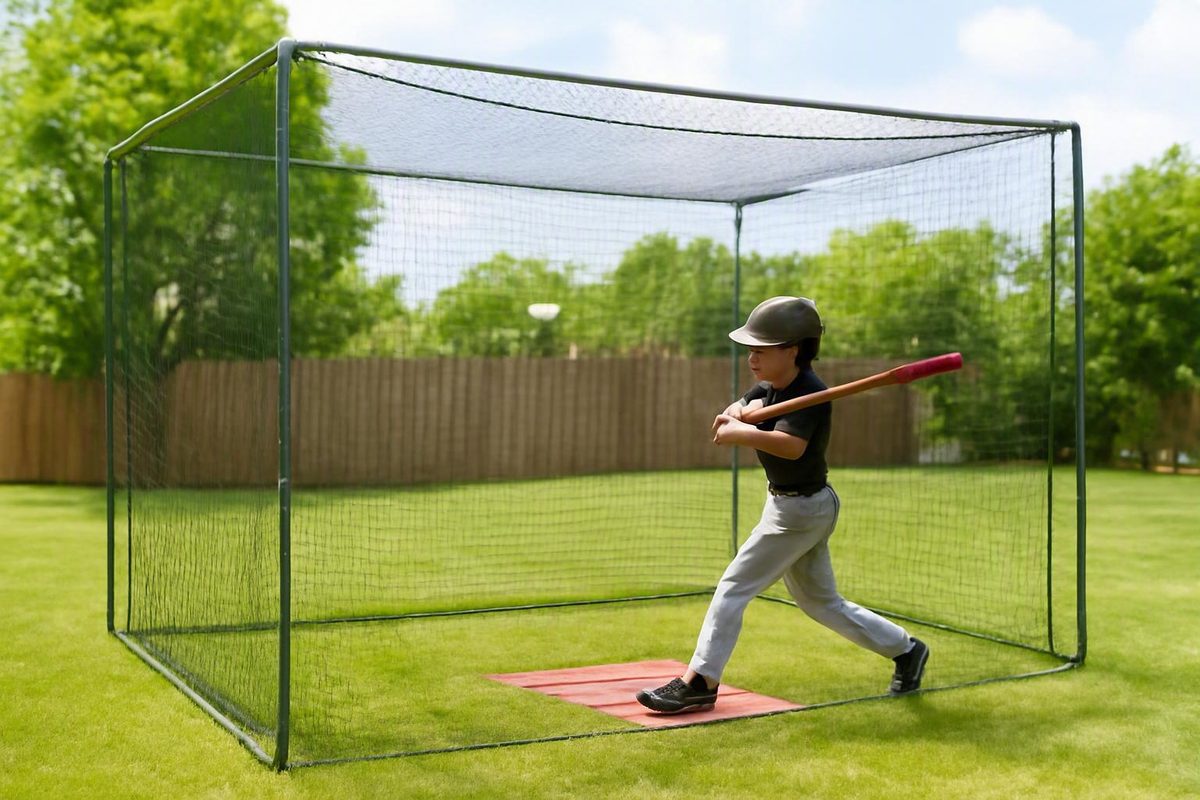
For a 35-ft cage, pitching-machine use requires a measured layout with room for the machine, feeder, operator, protective screen, batter and end zones.
A batting cage that fits on a product page may not fit in your yard, garage, or gym. Listed dimensions usually describe the net, not the complete frame, anchors, equipment area, access path, net movement, or surrounding space.
Choose a batting cage size by working outward from the practice you intend to run:
- Confirm the actual pitcher-to-plate, coach-to-plate, or machine-to-plate distance.
- Place the batter, delivery equipment, protective screens, and ball storage.
- Choose enough usable width and height for the expected players and drills.
- Add the frame, suspension system, anchors, net movement, access, and maintenance space.
- Compare that complete installed envelope with the site.
For many families, the options fall into three broad commercial categories:
- 35-foot compact cage: commonly used for tee work, soft toss, front toss, and other short-range drills.
- 55-foot mid-size cage: potentially useful for machine, youth, intermediate, and softball arrangements when the measured delivery distance and equipment fit.
- 70-foot full-size cage: the recurring commercial recommendation for full-distance baseball pitching.
These are planning categories used by vendors, not official dimensions or universal safety standards.
Batting cage dimensions at a glance
Throughout this guide, batting cage dimensions are written as:
length × width × height
A 70 × 14 × 12 ft cage is therefore 70 feet long, 14 feet wide, and 12 feet high.
Commercial guides commonly list cages approximately 35–70 feet long, 12–14 feet wide, and 10–12 feet high. A 70 × 14 × 12 ft net is frequently described as a typical full-size configuration, while 35- and 55-foot products fill compact and mid-size roles. The CoverSports sizing guide presents the following three configurations as common net sizes, but it does not establish them as governing-body requirements.
| Nominal net dimensions | Planning category | Commonly suited to |
|---|---|---|
| 35 × 12 × 12 ft | Compact drill cage | Tee work, soft toss, front toss, youth clinics, and constrained practice |
| 55 × 14 × 12 ft | Versatile mid-size cage | Many machine, youth, intermediate, and softball layouts after checking the delivery distance |
| 70 × 14 × 12 ft | Full-size cage | Full-distance baseball pitching and layouts requiring more equipment room |
Important: These are nominal net dimensions. They are not the complete frame dimensions, usable interior dimensions, required room size, or total yard footprint.
Each nominal measurement needs interpretation:
- Length determines which delivery distances and equipment layouts can fit.
- Width affects the batter’s stance, backswing, follow-through, handedness, and room for equipment or coaching.
- Height may describe the net before it is hung rather than the clearance beneath the installed net.
- Exterior space accommodates the frame, anchors, access, maintenance, and the area into which the net can move.
Most published sizing guidance comes from companies that sell or install batting cages. In this article, “common,” “typical,” and “standard” refer to commercial practice—not an independently validated safety specification. Product instructions, current league rules, structural conditions, and site requirements still need separate verification.
Choose cage length by drill and pitching distance
Age alone is a poor basis for choosing cage length. Two players of the same age may practice at different pitching distances, and one may need only a tee station while the other needs live pitching.
Start by drawing the actual practice arrangement:
- Mark home plate or the hitting mat.
- Mark the pitcher, coach, or machine’s delivery point.
- Measure between those two points.
- Add the machine, feeder, mound, screen, ball cart, and operator.
- Check how much space remains at both ends.
A cage can be longer than the delivery distance and still be too short for the complete setup. Plate placement, a machine body, a feeder, a portable mound, a protective screen, and the space between equipment and the end net all consume length.
| Intended practice | Common commercial length category | What to verify |
|---|---|---|
| Tee work | About 35–40 ft | Batter location, rear-net space, ball collection, and coaching room |
| Front toss or soft toss | About 35–40 ft | Toss position, protective screen, batter separation, and net movement |
| Machine pitching | Often 50–55 ft or longer | Exact machine-to-plate distance, machine body, feeder, operator, and protective screen |
| Shortened-distance live pitching | Often 50–55 ft | Program pitching distance, mound or mat location, and room behind both participants |
| Full-distance baseball pitching | About 70 ft | Current required distance, plate location, pitcher or machine area, screen, and end allowances |
These drill-based ranges follow the Baseball Turtles portable-cage guide, which associates 35–40 feet with tee work and front toss, at least 50 feet with machine work, and approximately 70 feet with full pitching distances. They remain commercial recommendations rather than universal requirements.
A 35-foot cage is commonly a short-range drill cage, not a general substitute for a full pitching tunnel. It can support tee work, soft toss, front toss, and contact drills. It generally should not be represented as suitable for full-distance live pitching.
Machine use in a 35-foot cage cannot be decided from cage length alone. It requires a documented machine placement that leaves room for the machine, feeder, operator, protective screen, batter, and both end zones. If the machine manufacturer does not provide a compatible layout, the cage’s nominal length is not enough to establish suitability.
A 50- to 55-foot cage occupies the middle ground. It may accommodate many shortened-distance live-pitching or machine arrangements, but “55 feet” does not establish compatibility with every baseball or softball program. A delivery distance that nearly fills the cage may leave inadequate room for a machine, mound, screen, or access.
A 70-foot cage is the recurring commercial choice for full-distance baseball practice. The extra length beyond the measured delivery distance should not automatically be treated as spare space: plate placement, the pitcher or machine, a portable mound, an L-screen, a feeder, and ball storage all use part of the tunnel.
Before buying, reproduce the layout with tape, cones, stakes, or cardboard templates. Measure between the actual delivery point and plate rather than assuming the entire advertised cage length is available for pitching.
Width and height: the dimensions families often underestimate
Length gets most of the attention, but width and usable height often determine whether a cage is practical.
A 12-foot width is a commonly listed commercial baseline, while 14 feet is the roomier recurring option. Neither dimension is automatically appropriate for every batter or equipment layout.
Width planning should include:
- the largest expected batter’s height and wingspan;
- bat length;
- stance and plate position;
- backswing and follow-through;
- both right- and left-handed use;
- any coach or operator inside the tunnel;
- an L-screen, pitching machine, tee, or ball cart;
- suspension lines or frame members; and
- inward or outward net movement.
Do not assume the plate belongs at the geometric center of the cage. Mark the intended batter’s box and compare it with the largest expected player’s swing envelope on both sides of the plate. Any swing-space test should be slow, controlled, and completed before the enclosure is used for live balls.
For a shared family cage, plan for the largest expected user, not only the child’s current size. That may be an older sibling, parent, teammate, or the same player after several seasons of growth. This does not mean every family needs a 14-foot cage; it means width should follow the expected users rather than the youngest current player.
Commercial net heights commonly fall between 10 and 12 feet, but nominal height and playable height are different measurements. Some installations leave approximately 6–12 inches of net on the floor, and one specialist installer describes about a foot of ground sag, leaving roughly 11 feet of playable height from a nominal 12-foot net (Grand Slam Safety).
Keep these measurements separate:
- Nominal net height: the listed dimension of the uninstalled net.
- Playable interior height: the clearance beneath the installed net.
- Required room height: the space needed for the net, support system, installation geometry, and overhead conditions.
In a garage, basement, gym, or barn, measure the lowest obstruction across the entire cage area. That may be a beam, light, garage-door track, opener, pipe, duct, cable tray, sprinkler component, or other utility rather than the room’s advertised ceiling height.
Available vendor evidence does not establish that every low cage changes swing mechanics or that a taller cage is always safer. The narrower conclusion is more useful: installed height affects which players, equipment, drills, and ball paths the enclosure can accommodate.
Calculate the total room or yard footprint
“Batting cage size” may refer to four different measurements:
- Hanging-net dimensions: the nominal dimensions of the net.
- Frame dimensions: the outside dimensions of its supporting structure.
- Playable interior dimensions: the usable area after sag, suspension lines, net movement, and equipment are considered.
- Total site footprint: the frame plus anchors, access, equipment, maintenance room, and surrounding site constraints.
These measurements are not interchangeable. A 70 × 14 × 12 ft net should not be expected to fit in a room measuring exactly 70 × 14 × 12 ft.
The complete footprint may include:
- frame legs, posts, or overhead supports;
- tensioning and suspension hardware;
- stakes, guy lines, weights, anchors, or footings;
- the area into which the net can move when struck;
- net material resting on the floor;
- a pitching machine, feeder, mound, or L-screen;
- a batter’s mat, turf, tee, and ball cart;
- entry and equipment-movement routes; and
- space for ball collection, inspection, and maintenance.
Vendor planning allowances vary. Some commercial guides suggest approximately 2–3 feet around a frame, while another recommends 3–5 feet beside walls, fences, or other hard surfaces. These are preliminary vendor estimates, not safety, engineering, or code requirements.
CoverSports provides the following room-size examples in its commercial guide:
| Nominal net | Vendor’s example minimum room | Vendor’s example recommended room |
|---|---|---|
| 55 × 14 × 12 ft | About 65 × 22 × 14 ft | About 70 × 24 × 16 ft |
| 70 × 14 × 12 ft | About 80 × 22 × 14 ft | About 85 × 24 × 16 ft |
The cited estimates come from the CoverSports room-planning examples. They cannot account for a particular room’s columns, doors, lights, attachment system, equipment, or exposed surfaces.
A portable-cage calculation illustrates the difference between net size and ground plan. Adding 2 feet on every side to a 50 × 12 ft cage plan produces a 54 × 16 ft ground area before anchors, storage, or additional access are considered (Baseball Turtles).
A practical worksheet is:
Required site length = nominal cage length + front-end allowance + rear-end allowance + equipment space + access or maintenance space
Required site width = nominal cage width + left-side allowance + right-side allowance + anchor or access space
Required room height = installed playable height + frame or suspension space + chosen overhead allowance
Treat equipment as a separate addition unless the supplier’s drawing clearly shows it inside the stated playable area.
A formula alone cannot determine whether a site is suitable. The site review must identify windows, unprotected lights, walls, vehicles, spectators, and other objects that a moving net or escaped ball could approach. Commercial guidance notes that balls can push netting outward and gives separate suggested distances from walls, ceilings, lights, and windows; those figures should remain product- and site-specific rather than being treated as universal clearance rules (Practice Sports).
Baseball, softball and youth-use sizing decisions
Baseball and softball cages commonly use similar commercial widths in the 12- to 14-foot range. Length is more likely to change because delivery distances, pitching styles, drills, and equipment arrangements differ.
Do not assume that every youth player needs a short cage or that every softball setup fits a 55-foot cage. “Youth” and “softball” each cover multiple programs and practice formats.
Commercial guides publish age- and sport-based pitching-distance examples, but the evidence available here does not include the corresponding current governing-body rules. Those mappings should not be used to select a cage. Obtain the applicable distance directly from the child’s current league, school, tournament, or program, then measure the entire practice arrangement.
Two children of the same age can need different cages:
- A player doing tee work and front toss may be well served by a 35- or 40-foot drill cage.
- A player practicing live pitching at the program’s complete distance may need a mid-size or full-size tunnel.
- A player using a pitching machine may need substantial room for the machine, feeder, screen, operator, and power arrangement even when the release point is closer to the batter.
For a family, school, or multi-age cage, evaluate the usable area for the oldest, tallest, or most advanced expected player and the most demanding drill the cage is genuinely expected to support.
Future-proofing does not mean automatically buying the largest system. Compare:
- expected use over the next several seasons;
- the verified delivery distances involved;
- available yard or floor area;
- width and height needed by future users;
- portability and storage needs;
- frequency of use;
- budget;
- whether the area must also hold vehicles or support other activities; and
- whether replacing or relocating the cage later is realistic.
A compact cage used frequently for suitable drills may be more practical than a full-size system that overwhelms the property. Conversely, a 55-foot cage bought without checking an approaching longer delivery distance may become limiting.
Indoor, garage and low-ceiling feasibility
An indoor room does not need to hold a full-length pitching tunnel to support useful practice. A garage may accommodate tee work, front toss, or a barrier net even when live pitching does not fit.
Use this indoor measurement checklist:
- Measure clear floor length and width.
- Measure the lowest obstruction across the proposed enclosure.
- Mark beams, columns, wall projections, and ceiling-height changes.
- Plot doors and their swing or travel paths.
- Map garage-door panels, tracks, springs, cables, and openers.
- Identify lights, windows, mirrors, pipes, ducts, and other exposed components.
- Locate outlets, electrical panels, sprinklers, and utilities.
- Record proposed attachment points without assuming their capacity.
- Include frame members, cables, pulleys, and suspension hardware.
- Account for net sag and movement.
- Position the mound, machine, feeder, L-screen, mats, and ball storage.
- Measure where a retractable net and its hardware will sit when stored.
- Preserve access needed for the room’s other functions.
Some indoor systems use wall-supported cables and sliding hardware so the net can collect at one end. Custom net dimensions are also offered for nonstandard spaces; for example, the National Sports Products indoor tunnel kit describes a wall-supported sliding system and custom sizing.
Customization solves only a dimensional problem. It does not establish that a particular wall, beam, ceiling, or attachment point is suitable. Obtain the manufacturer’s complete installation requirements and seek qualified structural review when the support condition or load path is uncertain.
A retractable system also needs a storage plan. Record the bundled net and hardware dimensions so the retracted cage does not unexpectedly occupy a doorway, wall area, or shared-use zone.
For a low-ceiling room:
- Start with the lowest measured obstruction.
- Subtract the space required by the selected support system.
- Account for the installation’s net sag.
- Determine the resulting usable height.
- Compare it with the largest user, equipment, and intended drills.
- Review exposed lights, windows, doors, and utilities as site-specific hazards.
If the resulting envelope is too small for a tunnel, consider a limited practice station. Tee work into a properly selected and installed barrier net may fit where pitching does not. A product’s “garage” or “basement” label does not replace measurements or installation requirements.
Backyard and outdoor planning
Before ordering an outdoor cage, mark the complete proposal on the ground with stakes, flags, chalk, cones, or landscape paint. Show:
- the outside of the frame;
- the hanging net;
- the area available for net movement;
- plate and the batter’s location;
- the pitcher, coach, or machine position;
- the mound, feeder, L-screen, and ball cart;
- anchors, stakes, weights, guy lines, or footings;
- the entrance and equipment route; and
- the surrounding site buffer.
Walk through the marked area as though the cage were installed. Confirm that users can enter, collect balls, move equipment, inspect the net, and reach storage without crossing into a driveway, neighboring property, or incompatible activity area.
Outdoor site review should include:
- property boundaries;
- slopes and uneven ground;
- drainage and standing-water areas;
- wind and storm exposure;
- snow or ice conditions;
- long-term weather exposure;
- the selected system’s anchoring instructions;
- nearby vehicles and parking;
- house, garage, and neighboring windows;
- walkways, gates, and spectator locations; and
- utilities above and below ground.
Portable and fixed cages can use the same nominal net dimensions while requiring different sites. A portable frame may have a larger deployed base, rolling components, weights, anchors, or storage needs. A fixed system may use posts or foundations and require a different installation review.
Do not transfer footing depth, post spacing, anchor type, or weather limits from an unrelated product. Obtain those specifications from the manufacturer of the selected frame and net.
Before construction or installation, contact the relevant local planning, building, property, utility, and homeowners association authorities as applicable. Ask what approvals, location restrictions, or documentation apply to the specific proposal rather than relying on a nationwide rule of thumb.
Standard-size nets may be easier to source and replace than custom products. That can favor a conventional dimension when two layouts work equally well, but it should not override the measured site or intended drills.
| System type | Often practical when… | Questions to answer |
|---|---|---|
| Portable | The yard is shared or the cage must move | What is the deployed footprint? How is it anchored, moved, and stored? |
| Retractable | The area must reopen for vehicles, sports, or events | Where does the net collect? What supports the suspension system? |
| Fixed | Practice is frequent and the site can remain dedicated | What installation, anchoring, weather, property, and approval requirements apply? |
The most appropriate format is one the family can deploy, use, inspect, and store without conflicting with the rest of the property.
A pre-purchase measurement and verification checklist
Use this sequence before buying a net, frame, or complete kit.
-
Define the drills. List what the cage must support now and over its expected life: tee work, soft toss, front toss, machine pitching, shortened live pitching, or full-distance pitching.
-
Confirm the applicable pitching distance. Obtain the current distance from the relevant league, school, tournament, or program. Do not rely on age alone or an uncited vendor chart.
-
Identify the largest expected player. Consider height, wingspan, bat length, handedness, and likely users over the next several seasons.
-
Place the plate and delivery point. Mark the hitting mat or plate, then measure to the actual pitcher, coach, or machine release arrangement.
-
Add delivery and protective equipment. Position the machine, feeder, portable mound, L-screen, operator area, and ball storage instead of treating them as future additions.
-
Select width and usable height. Evaluate swing space, handedness, equipment, net sag, and the lowest overhead obstruction.
-
Map the frame and net movement. Obtain the product drawing and mark frame legs, posts, cables, anchors, guy lines, and the area available for net movement.
-
Add access and maintenance room. Preserve practical routes for entry, ball collection, inspection, repair, and equipment movement.
-
Review site-specific hazards. Identify windows, lights, walls, fences, utilities, vehicles, walkways, spectators, property boundaries, and neighboring activities.
-
Compare the complete footprint with the site. Use the total installed envelope, not only the dimensions printed on the net label.
Equipment that may consume usable space includes:
- pitching machine;
- automatic or manual feeder;
- portable mound;
- L-screen;
- ball cart or bucket station;
- batting tee;
- batter’s mat;
- turf or flooring transitions; and
- equipment storage.
Before committing, request product-specific net, frame, anchor, and retracted-storage dimensions. Two frames designed for the same nominal net can have different exterior footprints, and a net labeled 70 × 14 × 12 ft does not fit a room with exactly those dimensions.
As relevant, verify the final plan with:
- the applicable league or program;
- the manufacturer;
- the installer;
- the property owner or school;
- local planning or building authorities;
- the homeowners association; and
- a qualified structural professional for supported or suspended systems.
The recurring dimensions and allowances in this guide are commercial conventions and planning estimates. They are not universal safety requirements, structural specifications, engineering criteria, or building-code provisions.
The planning process should lead to one of three outcomes:
- Choose a compact drill cage when tee work, soft toss, front toss, or another constrained drill is the intended use.
- Choose a mid-size cage only after confirming the delivery distance, equipment placement, usable height, and complete footprint.
- Choose a full-size cage when full-distance pitching is required and the site can accommodate the net, frame, equipment, movement, access, and surrounding conditions.
The right batting cage is not simply the largest net a family can buy. Start with the intended drill and verified pitching distance, size the width and usable height for the largest expected hitter, and calculate the complete installation footprint before deciding that the site works.
What is the most common full-size batting cage size?
70 × 14 × 12 ft—length × width × height—is a commonly cited commercial full-size configuration. Multiple vendor guides use it as a typical baseball cage size, but it is not an official universal standard.
The complete installation requires more space than the nominal net. Include the frame or suspension system, plate and delivery positions, equipment, net movement, access, and anchors.
Is a 35-foot batting cage long enough for a pitching machine?
The length alone cannot answer that question. A 35-foot cage works only if the machine manufacturer’s placement requirements and a complete measured layout leave room for the machine, feeder, operator, protective screen, batter, and end zones.
Without that documented layout, treat a 35-foot cage as a short-range drill option commonly used for tee work, soft toss, and front toss—not as a general pitching-machine cage.
How much room is needed for a 70 × 14 × 12 ft batting cage?
More than the nominal net dimensions. The vendor example in the footprint table above uses a substantially larger minimum and recommended room, but those figures are preliminary planning references rather than universal requirements.
The actual site must accommodate the selected frame or suspension system, equipment, net sag and movement, access, anchors, and room-specific obstructions.
Can a batting cage fit in a garage or low-ceiling room?
Possibly, depending on the intended drill and the room’s measured clear dimensions. Measure the lowest beam, light, garage-door component, pipe, duct, or utility—not merely the advertised ceiling height.
Then account for suspension hardware, net sag, the batter, equipment, doors, windows, and storage when the net is retracted. A small garage may support tee work or a barrier net even when it cannot support a pitching tunnel. Any wall- or ceiling-supported installation also requires product-specific attachment requirements and, when appropriate, qualified structural review.
Is a 55-foot cage long enough for softball?
It can be, but 55 feet is not sufficient for every softball program, drill, or machine arrangement. Commercial guides commonly market it as a mid-size softball option, but suitability depends on the program’s current pitching distance and the complete equipment layout.
Measure the delivery distance, then add the batter, pitcher or machine, feeder, mat, protective screen, end zones, and access. If those elements do not fit, the cage is too short regardless of how it is marketed.