
Youth Sports Concussions: Why a Body Jolt Can Injure the Brain Without Head Contact
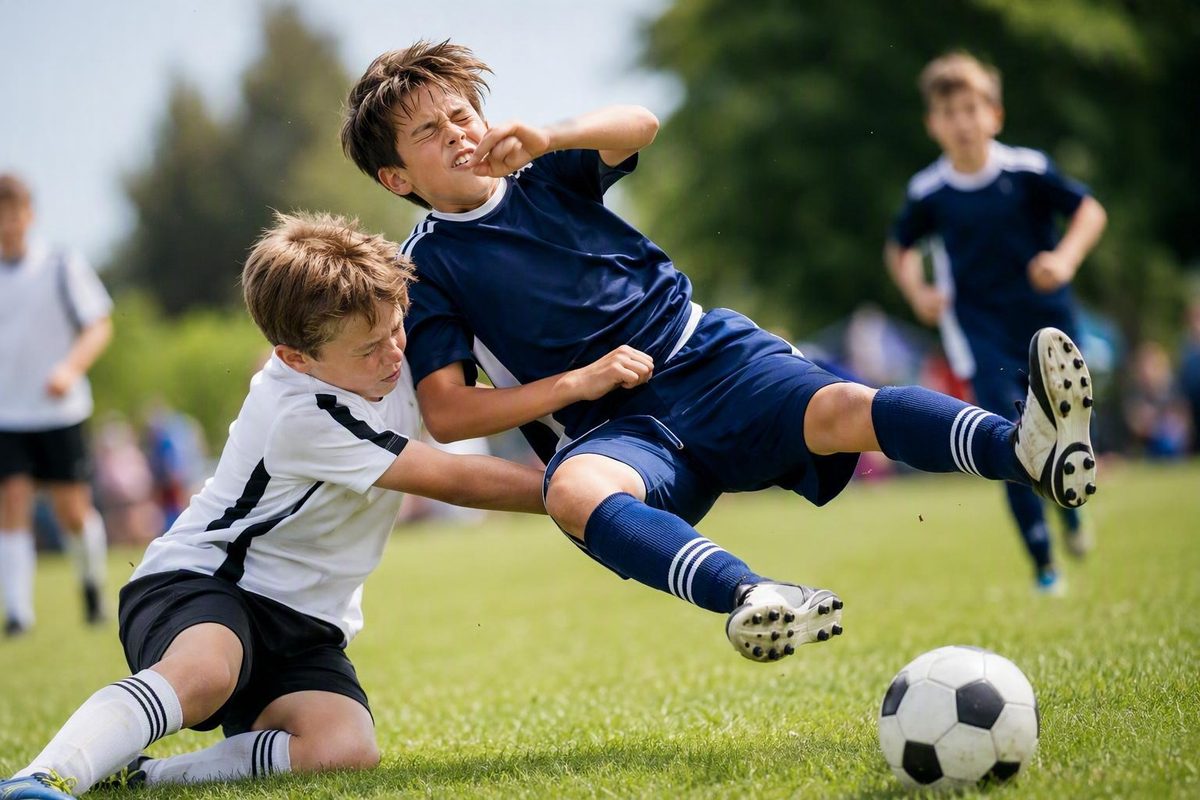
After a suspected concussion, the CDC standard is immediate removal, no same-day return and healthcare-provider clearance before returning to sports.
Yes — you can get a concussion without directly hitting your head. In sports, a hard hit to the body, a sudden stop, a fall, or a whiplash-type motion can accelerate or rotate the head enough that the brain moves inside the skull and brain function is disrupted. The CDC tells coaches and parents to suspect concussion after a bump, blow, or jolt to the head or a hit to the body, and Mayo Clinic and Cleveland Clinic likewise describe concussion as something that can follow force to the body, neck, or head. (CDC HEADS UP; Mayo Clinic; Cleveland Clinic)
That matters for parents because concussion is easy to picture too narrowly: helmet hits turf, forehead hits elbow, head hits dashboard. But the real issue is brain motion, not just scalp contact. A child who takes a substantial torso collision, lands hard on their back or side, or has a forceful neck snap in a fall or crash can have a real concussion even if no one saw the head strike anything. Symptoms may also be subtle at first or show up hours or days later, which is one reason these injuries can be missed. (CDC mild TBI symptoms; Mayo Clinic; Lurie Children’s)
For families comparing youth sports programs, the practical takeaway is simple: a league or coach should recognize concussion risk after more than just an obvious head hit. A program that only reacts when a player is knocked down by head contact is using too narrow a model of how concussion happens. (CDC HEADS UP; PMC review of adolescent sport-related concussion)
Related: 4th Grade Reading List: 50+ Recommended Books by Genre from Schools and Libraries.
What Exactly Is a Concussion?
A concussion is a mild traumatic brain injury, or mTBI, that temporarily changes how the brain works. Cleveland Clinic describes it as a brain injury that happens when the brain moves or twists inside the skull, and Lurie Children’s similarly defines concussion as a brain injury that temporarily changes brain function. (Cleveland Clinic; Lurie Children’s)
The word mild can be misleading. Barrow Neurological Institute notes that concussion is classified as mild on the trauma scale, but that does not mean the symptoms feel mild. Headache, dizziness, fogginess, sleep disruption, balance problems, and mood changes can still be significant. (Barrow Neurological Institute; CDC mild TBI symptoms)
Under normal conditions, the brain is cushioned by cerebrospinal fluid. That cushion helps absorb ordinary movement, but it has limits. When the head and body are forced to accelerate, decelerate, or rotate too quickly, the brain can still shift enough inside the skull to disrupt normal function. Cleveland Clinic, Barrow, and Mayo Clinic all describe concussion in terms of rapid brain movement rather than visible external injury alone. (Cleveland Clinic; Barrow Neurological Institute; Mayo Clinic)
That helps explain why concussion is often an “invisible” injury. A child may have no cut, bruise, or swelling and still have trouble with attention, memory, balance, mood, or sleep because concussion affects brain function. The CDC groups symptoms into physical, thinking and memory, social-emotional, and sleep categories, and pediatric guidance from Lurie Children’s and Nationwide Children’s makes the same point for kids and teens. (CDC mild TBI symptoms; Lurie Children’s; Nationwide Children’s)
Loss of consciousness is not required. Mayo Clinic says most concussions do not cause loss of consciousness, the sports-medicine review in PMC says loss of consciousness is not essential to the definition, and Nationwide Children’s says about 90% of concussed athletes do not lose consciousness. (Mayo Clinic; PMC review of adolescent sport-related concussion; Nationwide Children’s)
For parents evaluating programs, this section matters because it changes what “serious enough to worry about” looks like. If a team culture treats concussion as something that only counts when a child is knocked out or has a visible head injury, that is already a red flag. (Nationwide Children’s; CDC HEADS UP)
Yes: Concussions Without Direct Head Impact Are Possible
If your question is, “Can my child get a concussion from a body hit or fall without head contact?” the evidence-based answer is yes. The CDC says to suspect concussion if an athlete has signs or symptoms after a bump, blow, or jolt to the head or a hit to the body. Mayo Clinic says concussions are usually caused by an impact to the head or body, and Cleveland Clinic says a jolt or shake to the body, neck, or head can move the brain enough to cause concussion. (CDC HEADS UP; Mayo Clinic; Cleveland Clinic)
Sports-medicine literature says the same thing more formally. The adolescent concussion review in PMC summarizes the Zurich consensus definition this way: concussion may be caused by a direct blow to the head, face, neck, or elsewhere on the body if an impulsive force is transmitted to the head. The same review also notes that concussions in sport can result from sudden acceleration, deceleration, or rotational forces. (PMC review of adolescent sport-related concussion)
That does not mean every body blow causes a concussion. Mayo Clinic explicitly says not everyone who experiences a blow to the head or body has a concussion. The right mental model is not “every hard hit is brain injury,” but “a substantial hit to the body can be a concussion mechanism if it creates enough force to move the brain rapidly inside the skull.” (Mayo Clinic; Cleveland Clinic)
For parents, that distinction prevents two common mistakes. One is dismissing symptoms because there was no direct head strike. The other is assuming any rough play automatically means concussion. What matters is the force transmitted to the brain and the symptoms that follow. (CDC HEADS UP; Mayo Clinic)
It also changes what good sideline recognition looks like. A strong program should be prepared to act after a hard body collision, a forceful fall, or a whiplash-like mechanism — not only after a clearly seen head hit. That broader recognition standard is built into CDC guidance and the sports-concussion literature. (CDC HEADS UP; PMC review of adolescent sport-related concussion)
The Biomechanics: How Brain Motion Causes Injury Without Head Contact
The simplest picture is that the skull changes direction first, but the brain keeps moving for a fraction of a second. If that movement is fast enough, the brain can move or twist inside the skull and temporarily alter brain function. Cleveland Clinic describes concussion as the brain moving or twisting inside the skull, and Barrow says the rapid movement of the brain against the skull can trigger chemical and blood-flow changes that alter how the brain works. (Cleveland Clinic; Barrow Neurological Institute)
Whiplash is the clearest non-head-impact example. In a rear-end crash, or in a sports collision that snaps the head forward and backward, the head can accelerate and decelerate so quickly that the brain moves inside the skull even without striking an object. Barrow specifically lists whiplash from being rear-ended as an example, and Mayo Clinic and Cleveland Clinic describe the same general acceleration-deceleration mechanism. (Barrow Neurological Institute; Mayo Clinic; Cleveland Clinic)
Rotational force is also important. The adolescent sports review notes that concussions can result from acceleration, deceleration, and rotational forces, including forces generated during running, pivoting, jumping, and stopping in sports. Cleveland Clinic adds that concussions can stretch or injure nerves and blood vessels in the brain. (PMC review of adolescent sport-related concussion; Cleveland Clinic)
That is why “no head contact” is not the same as “no force reached the brain.” A child can land hard on the buttocks, back, or side and still have a rapid neck-and-head motion; a bike crash can involve sudden deceleration; and a torso-first collision can whip the head enough to jar the brain. Those kinds of mechanisms fit the motion-based explanations described by Mayo Clinic, Lurie Children’s, and Cleveland Clinic. (Mayo Clinic; Lurie Children’s; Cleveland Clinic)
For parents comparing sports, the practical lesson is that concussion risk is not confined to the obvious “head meets object” moment. It also lives in transmitted force: the hit through the chest, the awkward fall, the fast rotation, the stop-short collision. A program that understands only direct head contact will miss part of the risk picture. (CDC HEADS UP; PMC review of adolescent sport-related concussion)
Real-World Examples in Youth Sports and Beyond
In youth sports, indirect concussions can happen during the kinds of plays adults sometimes underestimate: a hard body collision, a fall that ends with the player landing on the back or hip, or a movement that violently rotates the head and neck. Lurie Children’s says concussions can result from a blow or hit to the body that causes a significant jolt to the head, and the sports-medicine review notes that sports forces can involve acceleration, deceleration, and rotation as well as contact. (Lurie Children’s; PMC review of adolescent sport-related concussion)
That means the mechanism can show up across very different activities. In contact or collision sports, the concern may be a body hit that snaps the neck. In soccer or basketball, it may be an awkward player-to-player collision followed by a hard fall. In gymnastics or cheer, it may be a missed landing or forceful rotational movement. The underlying principle stays the same: the brain is injured by transmitted force and rapid motion, not only by a direct blow to the skull. (Mayo Clinic; Lurie Children’s; PMC review of adolescent sport-related concussion)
Outside sports, the same mechanisms appear in ordinary family life. Cleveland Clinic lists falls, motor vehicle accidents, bike accidents, and sports injuries among common concussion causes, and Barrow identifies whiplash from rear-end crashes as an example of concussion without a direct head blow. (Cleveland Clinic; Barrow Neurological Institute)
Recognition is part of the problem. The adolescent concussion review describes significant underrecognition and underreporting of concussions in adolescents. It specifically notes that athletes, parents, and coaches may not understand that concussion can occur without a direct head hit, which helps explain why indirect mechanisms get minimized or mislabeled. (PMC review of adolescent sport-related concussion)
Age patterns matter too. Mayo Clinic says falls are the most common cause of concussion in very young children, while concussions are common in children and teenagers who play contact sports. So the parent lens changes by age: with younger children, you may be thinking more about playground and household falls; with older athletes, more about collisions, speed, and competitive play. (Mayo Clinic)
When parents compare youth programs, this section translates into a useful question: does the staff only talk about “head hits,” or do they recognize the actual situations in which force reaches the brain — body collisions, awkward falls, and whiplash-like motions? The latter is the safer standard. (CDC HEADS UP; PMC review of adolescent sport-related concussion)
Symptoms: What to Spot After a Body Jolt or Fall
The symptom list after a body jolt looks much like the symptom list after a direct head hit. The CDC says concussion symptoms may affect how a person feels, thinks, acts, or sleeps. (CDC mild TBI symptoms)
Physical symptoms commonly include headache, dizziness or balance problems, nausea or vomiting, fatigue, light or noise sensitivity, and vision problems. Those symptoms are listed by the CDC, Mayo Clinic, and Lurie Children’s. (CDC mild TBI symptoms; Mayo Clinic; Lurie Children’s)
Thinking and memory symptoms are often what parents describe as “not acting like themselves.” The CDC includes trouble concentrating, trouble thinking clearly, feeling slowed down, and memory problems; Nationwide Children’s lists feeling mentally foggy, difficulty concentrating, and difficulty remembering. (CDC mild TBI symptoms; Nationwide Children’s)
Mood and sleep changes can be just as important. Irritability, sadness, anxiety, being more emotional than usual, sleeping more, sleeping less, or having trouble falling asleep all appear in CDC, Mayo Clinic, and Nationwide Children’s guidance. (CDC mild TBI symptoms; Mayo Clinic; Nationwide Children’s)
Delayed symptoms are normal enough that parents should expect the possibility. The CDC says some symptoms appear right away while others may not appear for hours or days after the injury. Mayo Clinic says symptoms may occur in the hours and days after an injury, and Nationwide Children’s says symptoms can develop immediately or up to 48 hours later. (CDC mild TBI symptoms; Mayo Clinic; Nationwide Children’s)
The emergency red flags are different from routine “watch closely” symptoms. The CDC advises immediate emergency care for danger signs such as a worsening headache, repeated vomiting, seizures, one pupil larger than the other, unusual drowsiness or inability to wake up, slurred speech, increasing confusion, weakness, numbness, or loss of consciousness. (CDC mild TBI symptoms; CDC HEADS UP)
One reason sideline judgment is unreliable is symptom overlap. The CDC notes that concussion symptoms can resemble other health problems and may be overlooked by the injured person, family members, or even healthcare providers. That is one more reason not to dismiss symptoms after a meaningful jolt just because the mechanism did not look dramatic. (CDC mild TBI symptoms)
For parents, the useful rule is this: if symptoms begin after a body collision, fall, whiplash event, or other substantial jolt, treat it like a possible concussion until a clinician says otherwise. (CDC HEADS UP; Lurie Children’s)
Diagnosis and When to Get Medical Help
A concussion is diagnosed clinically, not by a single home checklist or a scan. Lurie Children’s says diagnosis involves a careful history plus a physical and neurocognitive exam, including tasks that assess memory, balance, reaction time, and attention. The adolescent sports review likewise notes that standard structural neuroimaging is typically normal in concussion. (Lurie Children’s; PMC review of adolescent sport-related concussion)
That matters because many parents expect CT or MRI to “show the concussion.” Cleveland Clinic says imaging tests cannot diagnose concussion, and Lurie Children’s explains that imaging may be used when needed to look for other injuries or complications, not to confirm every concussion itself. (Cleveland Clinic; Lurie Children’s)
For sports, the first step is not complicated: if concussion is suspected, remove the athlete from play right away. The CDC says that if an athlete has signs or symptoms after a bump, blow, or jolt to the head or a hit to the body, they should be removed from participation immediately, kept out the rest of the same day, and not return until cleared by a healthcare provider. (CDC HEADS UP)
Parents should seek medical evaluation when symptoms follow a significant collision, fall, crash, or whiplash-type event. The CDC tells athletes and families to report a hit or blow to the head or body to a healthcare provider, and Lurie Children’s emphasizes physician assessment for diagnosis. If danger signs are present, emergency care is the right next step rather than waiting for an office appointment. (CDC HEADS UP; Lurie Children’s; CDC mild TBI symptoms)
Children and adolescents deserve pediatric-specific follow-up. Mayo Clinic says children and adolescents should be evaluated by a healthcare professional trained in assessing and managing pediatric concussions. (Mayo Clinic)
For parents choosing programs, this is where policy becomes very concrete. The minimum standard should be immediate removal after suspected concussion, no same-day return, and return-to-play decisions made by a healthcare provider rather than by the coach, athlete, or family guesswork. (CDC HEADS UP)
Recovery, Return-to-Play, and Program Risks
Most young athletes recover, but recovery should not be rushed. The CDC says most people with a mild TBI or concussion feel better within a couple of weeks. At the same time, Lurie Children’s says there is no standard recovery time and that concussion severity is often judged by how long symptoms last rather than by how dramatic the original hit looked. (CDC mild TBI symptoms; Lurie Children’s)
Early recovery typically involves a period of reduced physical and cognitive strain followed by a gradual return to school and sports activity under medical guidance. Lurie Children’s describes a staged return-to-play progression from symptom-limited activity to progressively harder exercise and, eventually, full contact when appropriate. The CDC likewise says athletes should remain out of sports the day of injury and until cleared by a healthcare provider. (Lurie Children’s; CDC HEADS UP)
The major risk parents need to understand is repeat injury before recovery. The CDC warns that athletes who return too soon have a greater chance of repeat concussion and that repeat concussions can cause permanent brain changes. Nationwide Children’s adds that a second impact before full recovery can, in rare cases, cause dangerous brain swelling with severe consequences. Cleveland Clinic also notes that multiple concussions increase the risk of permanent damage. (CDC HEADS UP; Nationwide Children’s; Cleveland Clinic)
This is where program choice matters, not because parents can eliminate concussion risk, but because they can choose how seriously a program manages it. The questions worth asking are practical and evidence-based:
- If a player reports headache, dizziness, fogginess, or light sensitivity after a body hit, are they removed from play immediately? The CDC says suspected concussion after a hit to the body requires immediate removal. (CDC HEADS UP)
- Is same-day return off the table? The CDC says the athlete should stay out the same day. (CDC HEADS UP)
- Is return decided by a healthcare provider? The CDC says return-to-sports decisions are medical decisions. (CDC HEADS UP)
- Does the league use age-appropriate rules and modifications to reduce avoidable contact where possible? The adolescent sports review notes that evidence for primary prevention is limited, but rule modifications are among the stronger preventive measures discussed. (PMC review of adolescent sport-related concussion)
A parent does not need a perfect sport. What you want is a program with a credible response system: recognition beyond obvious head hits, no-pressure removal, medical clearance, and rules that do not create unnecessary collision exposure for the age group. (CDC HEADS UP; PMC review of adolescent sport-related concussion)
Prevention Tips for Parents in Youth Sports
No prevention plan can guarantee that a concussion will not happen. The adolescent sports review notes that primary prevention remains difficult, which is one reason families should be skeptical of simple promises or one-piece solutions. (PMC review of adolescent sport-related concussion)
What parents can do is lower the odds of a missed concussion and improve the response when one is suspected.
First, teach your child to report symptoms after a body hit, hard fall, or whiplash-type play — not just after a direct head hit. The CDC’s sports guidance specifically includes suspected concussion after a hit to the body. (CDC HEADS UP)
Second, favor programs with a real remove-from-play culture. A written policy is less important than whether coaches actually pull athletes when symptoms appear and keep them out the same day. That is the CDC standard. (CDC HEADS UP)
Third, ask how coaches are taught to recognize concussion. A coach who understands that concussion can follow transmitted force, not only obvious head contact, is more likely to act promptly after the kind of play parents often underestimate. The CDC and the adolescent sports review both support this broader recognition model. (CDC HEADS UP; PMC review of adolescent sport-related concussion)
Fourth, ask about age-appropriate rules and whether the league uses rule modifications intended to reduce avoidable contact exposure. The sports-medicine review points to rule modifications as one of the more supported prevention approaches in youth sport. (PMC review of adolescent sport-related concussion)
Fifth, make medical clearance non-negotiable. If a program leaves return-to-play to the athlete, the parent, or the coach, it is below the standard set by CDC guidance. (CDC HEADS UP)
A practical parent checklist looks like this:
- Recognition: Do coaches treat symptoms after a body hit as possible concussion symptoms? (CDC HEADS UP)
- Removal: Is suspected concussion an automatic same-day removal from participation? (CDC HEADS UP)
- Medical clearance: Is return decided by a healthcare provider? (CDC HEADS UP)
- Rules: Does the program use age-appropriate rules or modifications to reduce avoidable contact? (PMC review of adolescent sport-related concussion)
- Culture: Do adults take delayed symptoms seriously instead of telling players to “shake it off”? Delayed symptoms are well recognized by CDC, Mayo Clinic, and Nationwide Children’s guidance. (CDC mild TBI symptoms; Mayo Clinic; Nationwide Children’s)
The bottom line for parents is straightforward: if symptoms appear after a meaningful body jolt, treat it as a possible concussion even without head contact, and do not allow return to sports until a qualified healthcare professional says it is safe. (CDC HEADS UP; Mayo Clinic)
Is loss of consciousness needed for a concussion from a body hit?
No. Loss of consciousness is not required for a concussion, whether the force came from a direct head hit or a body hit that jarred the brain. Mayo Clinic says most concussions do not cause loss of consciousness, the adolescent sports review says loss of consciousness is not essential to the definition, and Nationwide Children’s says about 90% of concussed athletes do not lose consciousness. (Mayo Clinic; PMC review of adolescent sport-related concussion; Nationwide Children’s)
Can bumpy rides or minor falls cause concussions without head contact?
A concussion can happen without direct head contact if the force is strong enough to move the brain rapidly inside the skull, but the strongest support in this evidence set is for substantial jolts such as whiplash, crashes, sports collisions, and significant falls — not routine bumps or ordinary rides. Mayo Clinic, Cleveland Clinic, Lurie Children’s, and the adolescent sports review consistently support body impacts, falls, crashes, and transmitted force as real mechanisms. Some lower-authority explainers mention high-rotation rides as plausible examples, but that is weaker support and not a reason to assume every bumpy ride or minor fall is a concussion event. If symptoms follow any jolt or fall, get medical advice rather than guessing the force was too small to matter. (Mayo Clinic; Cleveland Clinic; Lurie Children’s; PMC review of adolescent sport-related concussion; Healthline; Mountain Land Physical Therapy)
Do symptoms differ for indirect vs direct head concussions?
Not in a clear, practical way based on the evidence here. The CDC describes concussion symptoms generally in physical, thinking and memory, emotional, and sleep categories, and consumer medical guidance on concussion without head impact describes the same broad kinds of symptoms after indirect mechanisms. For parents, the useful point is that the mechanism may differ, but the symptoms worth watching for are largely the same. (CDC mild TBI symptoms; Healthline)
What if symptoms start days after a sports collision?
Take them seriously. The CDC says some concussion symptoms appear right away while others may not appear for hours or days after the injury. Mayo Clinic says symptoms may occur in the hours and days after an injury, and Nationwide Children’s says they can appear up to 48 hours later. If symptoms begin after a collision or fall, keep the athlete out of play and arrange medical evaluation. If danger signs develop — such as worsening headache, repeated vomiting, seizures, unusual drowsiness, slurred speech, or increasing confusion — seek emergency care. (CDC mild TBI symptoms; Mayo Clinic; Nationwide Children’s; CDC HEADS UP)
How to evaluate youth programs for concussion risks?
Ask how the program handles the situations where concussion is easiest to miss: body hits, awkward falls, delayed symptoms, and pressure to return too fast. The CDC standard is immediate removal from play after suspected concussion, no same-day return, and healthcare-provider clearance before return to sports. The adolescent sports review adds that rule modifications are among the more supported prevention measures in youth sport. So the best questions are: Do coaches recognize concussion after a hit to the body? Is same-day removal automatic? Is return-to-play a medical decision? And does the league use age-appropriate rules to reduce avoidable contact exposure? (CDC HEADS UP; PMC review of adolescent sport-related concussion)