
How to Build a Youth Goalkeeper Kit That Fits
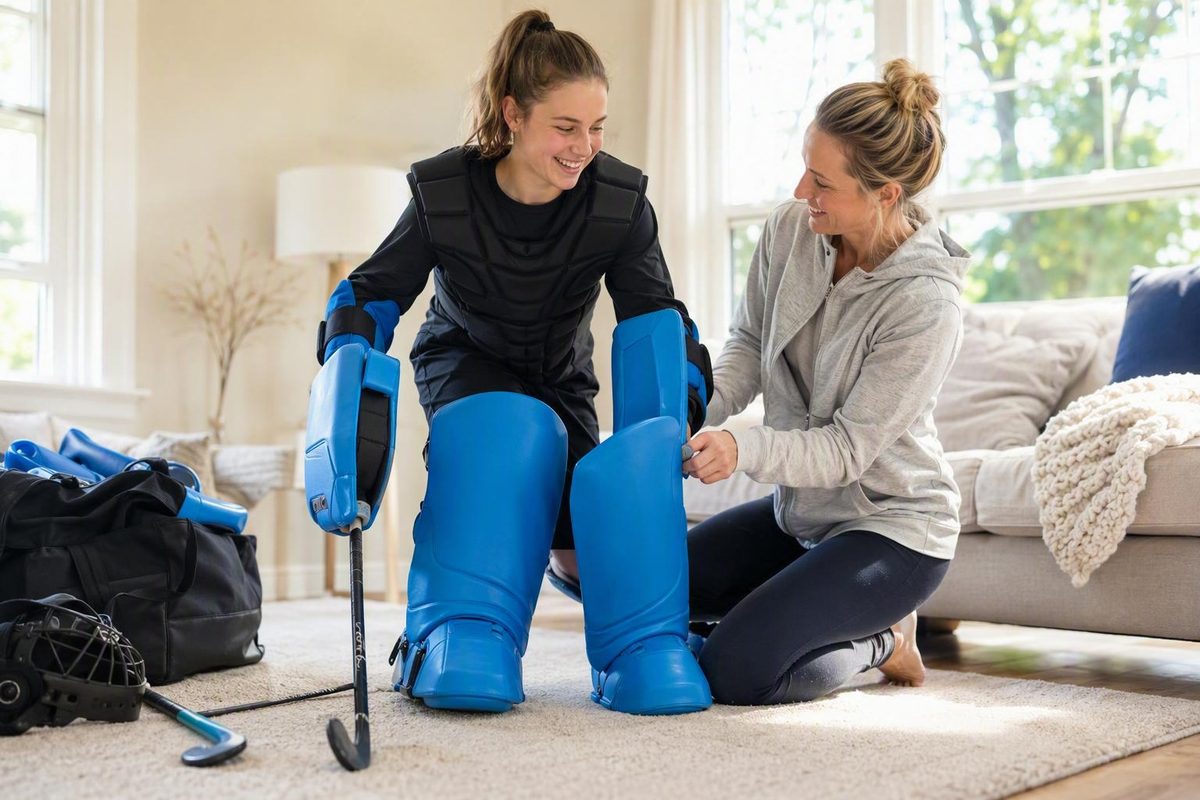
For youth goalkeepers, check helmet, torso, right- and left-hand, pelvic, leg and foot protection, then assess exact-model fit during movement.
Buying field hockey goalie gear is not simply a matter of choosing a bundle marked “youth” or paying more for an “elite” range. Families need to identify the proposed components, confirm what the player’s program requires or supplies, consult the instructions and sizing chart for each exact model, and test the assembled kit with help from a coach, equipment manager, manufacturer, or specialist fitter.
This article is a general shopping-orientation guide, not a determination that any product is safe, certified, competition-eligible, or suitable for a particular child. The available market evidence comes primarily from specialist retailers; it does not include governing-body equipment rules for every jurisdiction, independent safety testing, or manufacturer manuals for every model. Current program rules and exact-product documentation must control the final decision.
Goalkeeper should not be treated like an ordinary field position that a child can try with whatever equipment is available. Youth Listings’ guide to field hockey positions advises families to obtain properly fitted equipment and goalkeeper-specific instruction through the club or coach rather than improvising the role.
Use this buying sequence:
- Confirm the program, format, age group, and current rules.
- Find out what equipment the club supplies.
- List every component included in the proposed kit.
- Obtain the current instructions and measurements for each exact model.
- Test the assembled kit through supervised goalkeeper movements.
- Resolve missing components, fit problems, damage, or documentation questions before use.
Price and product tier can narrow the options. They cannot establish complete coverage, correct fit, compliance, or protective performance.
Start With a Head-to-Toe Goalkeeper Gear Checklist
A field player’s ordinary uniform and protective equipment are not a substitute for a goalkeeper setup. Retailer catalogs commonly organize goalkeeper products by protected body area, including head, face, throat, torso, elbow, hand, pelvic, leg, and foot categories. Sticks, clothing, bags, and accessories are generally listed separately.
That catalog organization is useful for building a shopping list. It does not establish that every listed component is mandatory under every ruleset or that a particular product provides suitable protection for an individual player.
Head and face
Treat the helmet and face protection as an individual fitting and documentation decision. Do not assume that a label such as youth, junior, under-12, or adult establishes fit. Ask for the current manufacturer chart and fitting instructions for the exact model.
A separate throat or neck protector may be needed when equivalent coverage is not otherwise provided. Total Hockey’s commercial goalkeeper guide recommends adding throat or neck protection in that situation, while also directing users to verify requirements with their league or club. The final configuration must therefore be confirmed against the equipment design and the player’s current program rules.
Torso, arms, and hands
Chest and shoulder protection is intended to provide upper-body coverage.
The right- and left-hand protectors normally have different functions. The right-hand protector commonly acts as a blocker during clearances, while the left is commonly shaped to help with catching or controlling the ball. They should not be treated as interchangeable ordinary gloves.
Pelvic and lower-body protection
Pelvic or abdominal protection should be selected with regard to the player’s anatomy, the design of the surrounding equipment, and the program’s requirements.
Do not assume that separately purchased leg guards and kickers will work together merely because their labels show the same nominal size.
Catalog-based orientation checklist
The table below is a shopping and fitting-discussion checklist based on categories and functions described by specialist retailers. “Core protection” means that the item belongs to the main protective setup described in those catalogs; it does not mean that the article has established a universal legal requirement or verified the performance of a particular product.
| Component | Body area covered | Basic role | Initial fit discussion | Classification |
|---|---|---|---|---|
| Helmet and face protection | Head and face | Provides head and facial coverage | Compare the player’s measurement with the exact model chart; discuss vision, forehead fit, and unwanted movement | Core protection |
| Throat or neck protector, where needed | Throat and neck | Adds coverage when equivalent coverage is not otherwise provided | Confirm its interaction with the helmet and chest unit under the applicable instructions and rules | Core protection when required by design or rules |
| Chest and shoulder protector | Torso and shoulders | Provides upper-body coverage | Check whether it stays positioned while the player bends and moves the arms | Core protection |
| Arm and elbow guards | Arms and elbows | Extends coverage beyond the torso unit | Bend and rotate both arms; discuss gaps or interference with adjoining pieces | Core protection |
| Right-hand protector | Right hand and wrist | Commonly functions as a blocker for clearances | Check hand placement, wrist position, stick handling, and overlap with the arm guard | Core protection |
| Left-hand protector | Left hand and wrist | Commonly supports catching or ball control | Check hand placement, movement, and the junction with the arm guard | Core protection |
| Pelvic or abdominal protection | Pelvic or abdominal area | Provides anatomy-appropriate lower-torso coverage | Confirm placement and compatibility with pants and torso protection | Core protection |
| Padded shorts, pants, or girdle system | Hips, upper legs, and lower torso, depending on design | Adds lower-body coverage and affects overlap | Crouch, step, and rotate while checking the waist and adjacent protection | Core protection where part of the selected system |
| Leg guards | Shins and lower legs | Provides lower-leg coverage | Discuss knee clearance, centering, and rotation during shuffles | Core protection |
| Kickers | Feet | Provides foot coverage and supports goalkeeper clearances | Check toe alignment, heel security, movement, and interaction with the leg guards | Core protection |
| Goalkeeper stick | Playing equipment | Used to control, pass, and clear the ball | Confirm suitable handling with both hand protectors fitted | Supporting item |
| Smock or goalkeeper jersey | Outer clothing | Clothes and identifies the goalkeeper | Ensure it works with the assembled equipment without disguising a fit problem | Supporting item |
| Suitable base clothing | Under the protection | Supports comfort under the equipment | Check for bunching or movement restriction during the fitting | Supporting item |
| Equipment bag | Entire kit | Carries and organizes the equipment | Confirm that it accommodates the full kit | Supporting item |
| Compatible replacement straps and hardware | Relevant component | Restores adjustment when an approved part is replaced | Verify exact-model compatibility and follow manufacturer instructions | Supporting item |
| Training aids | Training environment | Supports goalkeeper drills | Use as directed by the coach; do not treat as protective equipment | Supporting item |
A product called a “complete set” cannot be assumed to contain everything in this table. Specialist retailer catalogs show complete sets alongside separately sold helmets, throat guards, upper- and lower-body protection, clothing, and replacement straps. The Savage Field Hockey goalkeeper catalog, for example, separates many of those categories.
Ask the seller for a component-by-component list that identifies the model and size of every piece. If throat, pelvic, arm, hand, or lower-body protection is not expressly named, treat its inclusion as unconfirmed.
Confirm the Program’s Rules and Equipment Process Before Shopping
Before ordering, identify the child’s exact playing context:
- club or school;
- league or governing organization;
- age group;
- indoor, outdoor, tournament, training, or another format;
- current season and ruleset; and
- any local equipment modifications.
This guide does not determine what is mandatory or competition-eligible in any jurisdiction. A list used by another team, an older sibling, or a retailer cannot answer that question for the current player.
Questions to ask the club or coach
Start with the program’s equipment process:
- Does the club supply a shared goalkeeper kit?
- Must the family buy the entire setup or only selected personal items?
- Is rental available?
- Can a new goalkeeper borrow equipment for a supervised trial?
- Does the program hold fitting sessions?
- Which models and sizes does it routinely fit for children in this age group?
- Can pieces be exchanged as the player grows?
- Who adjusts shared equipment before a session?
- Who receives reports about damage or poor fit?
If the club owns the kit, ask who inspects it, records concerns, replaces components, and decides when it no longer fits the assigned player. The article cannot supply a universal club inspection or replacement protocol because none is established by the available evidence.
Ask the club or governing organization directly for current helmet documentation, equipment standards, and competition requirements. A product name, certification-related phrase in a listing, salesperson’s general assurance, or retailer badge is not proof that an exact model is eligible for the child’s current competition.
Ask for a movement-based fitting discussion
Ask whether a coach, equipment manager, manufacturer representative, or specialist fitter can observe the assembled kit while the child:
- assumes a normal ready position;
- crouches;
- shuffles in both directions;
- steps forward and backward;
- raises and rotates both arms;
- performs any controlled goalkeeper movement the qualified supervisor considers appropriate; and
- simulates clearances.
This is a discussion framework rather than a validated safety-inspection protocol. The purpose is to identify visible movement, interference, or coverage questions that require reference to the exact product instructions or qualified help.
Also ask who will teach the player how to move in the equipment. Suitable protection and position-specific instruction belong together. Do not place a child in goal with an incomplete or improvised kit simply because the team needs someone to fill the position.
Treat retailer labels as filters, not rules
Terms such as youth, junior, beginner, entry-level, performance, advanced, and elite are shopping classifications. They are not universal sizes, competition categories, or evidence of independently tested performance.
Two sellers may classify similar equipment differently. One may organize products by claimed playing level, another by age-oriented language, and another by named product family. Use these labels to browse, then make the decision from current documentation, measurements, observed fit, and program requirements.
Fit the Kit by Measurement and Movement, Not Age Alone
A specialist retailer’s general fit guidance says goalkeeper equipment should remain secure without significant gaps, lifting, rotation, or twisting while preserving movement. The same guide says chest protection should resist lifting, leg guards should end just below the knee bend without rotating, and kickers should align at the toe and secure the heel with minimal play. These are commercial fitting prompts—not substitutes for the current manufacturer instructions for an exact model. See the Total Hockey goalkeeper buying guide.
Fit must also be considered across the assembled setup.
Helmet fit
Use the manufacturer’s current head-circumference chart for the exact helmet. Do not substitute a general chart from another model or use an age label as the measurement.
During a supervised fitting, ask the responsible fitter to discuss:
- Whether the head was measured as the manufacturer directs.
- Whether the helmet is positioned as the instructions specify.
- Whether there is a visible forehead gap.
- Whether the helmet moves independently when the child gently turns the head.
- Whether the player’s view is unobstructed in the ready position.
- How the helmet interacts with any throat coverage, shoulder protection, and chest unit.
The retailer guidance cited above specifically recommends matching the helmet to head circumference and checking for forehead gaps and unwanted movement. It does not establish that a helmet passing those observations is certified, competition-compliant, or suitable for a particular child.
Chest, shoulder, arm, and hand fit
The commercial fitting guidance describes chest protection as snug and resistant to lifting during diving movements while still preserving mobility. In a supervised fitting, have the child bend and move the arms as directed, then observe the adjoining areas:
- chest to throat or neck coverage;
- chest to padded shorts or pants;
- shoulder to arm guard;
- arm guard to right-hand protector; and
- arm guard to left-hand protector.
Check stick handling only after both hand protectors are fitted. Ask whether the player can hold and reposition the stick without obvious protector rotation or an awkward wrist position. Any unresolved problem should be referred to the manufacturer, program equipment lead, or specialist fitter rather than “fixed” by guessing at an adjustment.
Pelvic and lower-body fit
Select pelvic or abdominal protection for the player’s anatomy and the intended equipment system. During the fitting, observe its position while the child crouches, steps, and rotates as instructed.
Padded shorts or pants also need to be assessed with the torso and leg protection in place. A waist size printed on one component does not show that it will overlap properly with equipment from another range or manufacturer.
Leg-guard fit
The retailer fitting guide says the top of each leg guard should finish just below the knee bend and that the guard should not rotate while the goalkeeper shuffles. With the straps adjusted under the relevant instructions, ask the player to perform repeated lateral movements under supervision.
Observe whether each guard remains centered and whether it interferes with the padded shorts or kickers. These observations can identify a question; they are not proof of protective performance.
Kicker fit
The same commercial guide says a kicker should align at the toe, secure the heel, and have minimal play without twisting. Check both feet because each side must be fitted and adjusted individually.
Observe the leg-guard-and-kicker junction while the player crouches, shuffles, steps, and simulates clearances. Questions to raise with the fitter include:
- Does an exposed area appear during movement?
- Does material bunch at the junction?
- Is either piece displaced by the other?
- Are the straps routed as the product instructions show?
- Does the combination interfere with ordinary knee or ankle movement?
One supervised full-kit fitting sequence
Use one complete sequence rather than judging every item only while the player stands still:
- Stand neutrally. Review alignment and visible coverage.
- Assume the ready position. Observe vision, balance, torso placement, and hand position.
- Crouch. Recheck the neck, waist, pelvic, knee, and ankle junctions.
- Shuffle both ways. Observe leg-guard rotation, kicker movement, and shifting lower-body equipment.
- Step forward and backward. Look for interference among the foot, leg, and torso components.
- Raise and rotate both arms. Review shoulder, elbow, wrist, and hand junctions.
- Perform only supervisor-approved goalkeeper movements. Use the surface, instruction, and level of movement selected by the coach or fitter.
- Simulate clearances. Observe stick handling, the right-hand blocker, kickers, and leg-guard position.
- Reassess after permitted adjustments. Follow the instructions for each exact component.
If the child reports pain, numbness, blocked vision, or restricted movement—or if a component repeatedly shifts or exposes a questionable area—pause the fitting and obtain qualified help. This is a conservative escalation rule, not a claim that the article can diagnose the cause or validate the equipment.
Do not publish or rely on generic body measurements as universal sizing recommendations. Every exact model may have a different chart, shape, and adjustment system.
Complete Set, Paired Pads, or Individual Components?
Field hockey goalie gear is commonly sold in three formats:
- complete goalkeeper sets;
- paired leg-guard-and-kicker sets; and
- individual components.
None is automatically the correct, most complete, or least expensive option.
Complete goalkeeper sets
A set can reduce the number of separate orders and provide a coordinated starting point.
Before buying, confirm:
- every included component;
- the size of every component;
- each exact model or range;
- whether required straps and hardware are included;
- whether throat or neck protection is omitted;
- whether pelvic or abdominal protection is omitted;
- whether the stick, smock, or clothing is included;
- whether mixed sizes or substitutions are allowed;
- return and exchange restrictions;
- warranty terms; and
- availability of compatible replacement parts.
Get these answers in writing where possible.
Paired leg guards and kickers
A paired set can simplify one important equipment junction. Retailer catalogs show leg guards and kickers sold both separately and as coordinated pairs.
Pairing still does not establish fit. The child needs to try the two components together and discuss toe alignment, heel security, movement, knee clearance, and overlap with the fitter. Products intended to work together can still be the wrong size or shape for an individual player.
Individual components
Buying separately may be practical when:
- the head, torso, hands, and legs require different sizes;
- the club already supplies part of the kit;
- one component needs replacement;
- the child has outgrown only one part;
- a bundle omits a necessary item; or
- the family needs more flexible exchange options.
Separate purchasing can preserve usable existing equipment, but it increases the number of compatibility questions. Test every neighboring junction after the final combination is assembled.
Compare total usable cost
Do not compare a bundle’s headline price with an incomplete list of separate products. Estimate the cost of producing one complete setup that fits and meets the program’s requirements.
Include:
- missing protective components;
- shipping and applicable taxes;
- return shipping or exchange fees;
- any fitting costs;
- goalkeeper stick;
- clothing or smock;
- equipment bag;
- compatible replacement straps; and
- a documented near-term size issue identified during fitting.
If one standard bundle size appears to fit the legs but not the helmet or torso, compare a mixed-size order against the set’s total price and exchange terms. A bundle saves money only when its confirmed contents, usable sizes, and equivalent individual costs support that conclusion.
What Field Hockey Goalie Gear Can Cost
All amounts below are USD retailer snapshots, not market averages or recommendations. The evidence was reviewed for this article on August 9, 2026, but the original page-capture date was not supplied. Recheck current prices, stock, shipping terms, sale status, and package contents directly with the seller before ordering.
Observed complete-set listings spanned approximately $355 to $1,890. Savage Field Hockey showed Mercian Genesis sets from $354.95 to $639.95 and Mercian Evolution sets at $1,055 and $1,149.50 in the supplied snapshot. Savage Field Hockey’s catalog also marked some displayed products as sold out, illustrating why price and availability require reconfirmation.
Anthem Sports displayed a TK4 entry-level set at $549.99, an OBO set at $914.99, and an OBO Cloud set at $1,889.95. These were retailer-specific listings rather than equivalent packages, and the supplied catalog did not establish every included component. See the Anthem Sports goalkeeper catalog.
These examples do not create safe or unsafe price bands. They also do not show that a more expensive set provides better verified protection for a particular child.
Major components can cost hundreds of dollars
In the supplied Just Field Hockey snapshot, paired OBO leg-guard-and-kicker sets were listed at $864 and $919. The same retailer displayed standalone OBO leg guards as high as $608, helmets at $586, kickers at $403, body armor at $403, and a hand-protector set at $384. Some listings were discounted, and prices and shipping terms may change. See the Just Field Hockey OBO collection.
Other supplied retailer listings reached approximately $665 for leg guards, $580 for a helmet, $435 for kickers, and $447 for chest or upper-body protection. These are cross-retailer examples from different products, not a coordinated recommended kit.
| Category | Observed listing for orientation | Snapshot source |
|---|---|---|
| Complete set | About $355–$1,890 | Savage Field Hockey and Anthem Sports |
| Paired leg guards and kickers | About $864–$919 | Just Field Hockey |
| Standalone leg guards | Up to about $665 | Longstreth |
| Helmet | Up to about $580–$586 | Anthem Sports and Just Field Hockey |
| Chest or upper-body protection | Up to about $447 | Anthem Sports |
| Kickers | Up to about $435 | Longstreth |
Do not add the category highs together as though they describe one product family or recommended setup.
Total Hockey’s commercial guide recommends prioritizing spending on the helmet, chest protection, and leg guards. That is retailer guidance, not independent safety testing. A more cautious budgeting principle is to fund the required components that fit and have the necessary documentation before paying for colors or a higher marketing tier.
Parent budget worksheet
| Budget line | Supplied or borrowed? | Expected cost | Confirmed cost | Notes |
|---|---|---|---|---|
| Helmet and face protection | Exact model and size | |||
| Throat or neck protection, if needed | Design and rule questions confirmed | |||
| Chest and shoulder protection | ||||
| Arm and elbow guards | ||||
| Right-hand protector | ||||
| Left-hand protector | ||||
| Pelvic or abdominal protection | Anatomy-appropriate design | |||
| Padded shorts, pants, or girdle | ||||
| Leg guards | ||||
| Kickers | ||||
| Missing bundle components | ||||
| Fitting, return, or exchange costs | Include return shipping | |||
| Goalkeeper stick | ||||
| Smock, jersey, and base clothing | ||||
| Equipment bag | ||||
| Compatible replacement parts | Confirm exact model | |||
| Shipping and applicable taxes | ||||
| Identified future size change | Record the fitter’s advice | |||
| Total usable cost |
The useful comparison is the total cost of a complete, correctly fitting setup—not the largest discount or lowest advertised package price.
Choose Youth Gear Without Relying on Marketing Tiers
Goalkeeper catalogs use inconsistent segmentation systems. One retailer offers Beginner, Intermediate, Advanced, and Elite filters, while others use junior, youth, under-12, entry-level, performance, or named product families. The Longstreth goalkeeper collection, for example, combines playing-level filters with protection sizes from Youth through XXL.
Those labels organize inventory. They do not share a universal definition.
Age labels are not sizing instructions
Several OBO range descriptions in the supplied retailer evidence were presented for players ages 14 and older, while other catalogs listed junior, youth, and under-12 helmets and protection.
An “ages 14 and older” description does not explain how to size a 14-year-old. A “junior” title does not prove that a product fits a younger child. Both still require:
- the current chart for the exact model;
- the child’s current measurements;
- a physical fitting;
- an assembled-kit movement review; and
- confirmation from the program.
For a player younger than 14, ask the club which models and sizes it routinely fits for children with similar proportions. Do not extrapolate from adult-oriented ranges.
Use a needs-based decision framework
Organize the choice around:
- Measurements: Does the player fall within the current chart for the exact model?
- Observed fit: Does the component stay positioned under the manufacturer’s adjustment instructions?
- Mobility: Can the player perform supervised goalkeeper movements and handle the stick?
- Frequency of use: Is the kit for a supervised trial, a shared rotation, or regular training and competition?
- Program requirements: Does the club accept the exact equipment and documentation?
- Parts support: Are compatible replacement straps and hardware available?
- Fitting support: Can the club, manufacturer, or specialist retailer help resolve problems?
- Mixed sizing: Can the order accommodate different head, torso, hand, and leg sizes?
- Return flexibility: Can unsuitable pieces be exchanged after an allowed fitting?
Words such as elite, high-performance, trusted, and top seller are marketing descriptions. They do not independently establish impact protection, durability, comfort, or value. Sparse retailer reviews are also insufficient for a dependable brand ranking.
That can make a single-size package less practical even when its age or performance label sounds appropriate.
Evaluate Borrowed, Used, and Discontinued Equipment Cautiously
Used or shared equipment should be approached through questions, documentation, and qualified assessment—not declared suitable merely because another goalkeeper wore it.
What is known about the item?
Ask:
- Who previously used it?
- Is its use and damage history known?
- How was it stored?
- Has it been altered or repaired?
- Are the original labels and exact model details readable?
- Are the manufacturer’s instructions available?
- Can compatible replacement straps or parts still be obtained?
An unknown history does not prove that an item is unusable, but it limits what the family, club, or fitter can verify.
What condition questions should be raised?
Total Hockey’s retailer guide recommends regular checks for cracked foam, damaged padding, and strap problems. Use those as prompts for a qualified inspection rather than as a complete safety protocol.
Ask the club, manufacturer, or specialist fitter to assess any visible:
- cracking or compression;
- torn or deformed padding;
- shell damage;
- missing pieces;
- failed fasteners;
- frayed or nonholding straps;
- unauthorized alteration; or
- edge or surface that interferes with adjoining equipment.
Do not recommend visibly damaged protection for use. Set it aside until an appropriate party has assessed the concern. The available evidence does not provide a validated home-inspection standard that can determine whether hidden damage exists.
Does it fit the current player?
Repeat the same measurement and full-kit movement review used for new equipment. Fit for a previous goalkeeper says nothing conclusive about fit for the current child.
Assess each component individually, then assemble the entire setup and review its adjoining areas during supervised movement. Do not infer compatibility from matching labels alone.
What about a used or discontinued helmet?
Discontinued status alone does not prove that a helmet is unsafe or prohibited. Conversely, a current or archived retailer listing cannot establish that the helmet remains suitable or eligible for competition.
Before considering use, verify with authoritative sources:
- the exact model;
- current physical condition;
- individual fit;
- applicable documentation;
- current competition eligibility;
- manufacturer instructions; and
- replacement-part availability.
A retailer’s “model being discontinued” label describes commercial status at the time of the listing. It is not a safety or compliance determination.
How does the club manage shared equipment?
Ask the club:
- how equipment is cleaned and dried;
- how it is stored;
- who inspects it;
- whether concerns are documented;
- how a kit is assigned and adjusted;
- how reported damage is recorded;
- who authorizes repairs or replacement; and
- how an item is removed from service.
The available evidence does not establish one universal sanitation process, service life, or replacement interval. The club should explain its process and provide the relevant manufacturer guidance.
Care, Inspect, and Upgrade the Kit
Total Hockey’s commercial guide recommends cleaning mud from goalkeeper equipment, allowing it to air-dry, checking straps weekly, and responding promptly to damaged foam or padding. Those are practical retailer prompts, not a universal manufacturer-approved care procedure for every material or model.
Follow the care instructions for each exact product. If those instructions are unavailable or unclear, ask the manufacturer rather than improvising a cleaning method or repair.
Inspect before the next session
Before the next use, review the kit for:
- newly visible cracks or compression;
- torn or displaced padding;
- shell damage;
- failed or slipping straps;
- missing fasteners;
- unwanted movement or rotation;
- changed overlap;
- a new fit concern;
- reduced mobility; and
- changes after a growth spurt.
This list helps identify questions; it does not certify the equipment as serviceable. Do not invent a fixed replacement calendar. Refer to the manufacturer and the applicable program authority when condition, fit, documentation, or performance is uncertain.
Upgrade by need, not appearance
Address a damaged, poorly fitting, or incompatible component before paying for cosmetic changes or moving to a higher marketing tier.
After replacing one piece, repeat the assembled-kit fitting.
Keep a simple family equipment record:
| Record field | What to note |
|---|---|
| Component | Helmet, chest protector, leg guard, and so on |
| Brand and exact model | Copy from the label or documentation |
| Size | Record the marked size |
| Purchase or club-issue date | Use the known date; do not estimate |
| Current user | Useful for shared family or club equipment |
| Observed concern | Record its location and the date noticed |
| Straps or parts replaced | Identify the part and who approved or fitted it |
| Current fit concerns | Movement, pressure, gaps, or restriction |
| Last reviewed by | Parent, coach, equipment manager, manufacturer, or fitter |
Pre-purchase and pre-practice checklist
- [ ] Player’s club, school, league, age group, format, and current ruleset identified
- [ ] Program requirements and documentation process confirmed
- [ ] Club-supplied, borrowed, rented, and family-purchased items identified
- [ ] Responsibility for inspection, adjustment, and replacement confirmed
- [ ] Bundle contents verified component by component
- [ ] Exact model and size of every component recorded
- [ ] Missing throat, pelvic, hand, arm, or lower-body items identified
- [ ] Current measurements taken as the exact manufacturer directs
- [ ] Current exact-model charts and instructions consulted
- [ ] Helmet documentation and competition eligibility checked where applicable
- [ ] Full kit assembled for a supervised fitting
- [ ] Ready-position, crouch, shuffle, stepping, arm-movement, and clearance checks completed
- [ ] Any additional goalkeeper movement selected and supervised by a qualified coach or fitter
- [ ] Neck, shoulder, wrist, waist, knee, and ankle junctions reviewed
- [ ] Pain, numbness, blocked vision, or restricted movement reported and resolved
- [ ] Persistent movement, rotation, twisting, or questionable gaps referred for help
- [ ] Visibly damaged equipment set aside for assessment
- [ ] Return, exchange, warranty, and replacement-part terms checked
- [ ] Unresolved questions taken to the coach, equipment manager, manufacturer, or specialist fitter
Frequently Asked Questions
What gear does a field hockey goalie typically wear?
A catalog-based goalkeeper checklist may include a helmet and face protection, throat or neck coverage where needed, chest and shoulder protection, arm and elbow guards, separate right- and left-hand protectors, anatomy-appropriate pelvic or abdominal protection, padded goalkeeper shorts or pants, leg guards, and kickers.
Related items include a goalkeeper stick, smock or jersey, suitable base clothing, equipment bag, and compatible replacement straps. Training aids are not substitutes for protective equipment.
The exact required configuration must be confirmed with the player’s program and current competition rules. Do not assume that every item is included in a set.
How much does a complete field hockey goalie kit cost?
In the supplied USD retailer snapshots, complete sets ranged from approximately $354.95 for a Mercian Genesis mini set at Savage Field Hockey to $1,889.95 for an OBO Cloud set at Anthem Sports. Other displayed examples included a TK4 set at $549.99, an OBO set at $914.99, Mercian Genesis sets up to $639.95, and Mercian Evolution sets above $1,000.
The evidence was reviewed on August 9, 2026, but its original capture date was not supplied. Treat every amount as orientation only and verify the current price, stock, contents, shipping, taxes, and return terms with the seller.
Is it better to buy a complete goalie set or separate pieces?
A complete set may simplify the first order. Separate pieces may be more practical when the player needs different sizes for the helmet, torso, hands, and legs, or when the club already supplies part of the kit.
Paired leg guards and kickers offer a middle option, but their fit and overlap still need to be checked. The better format is the one that produces a complete, documented, correctly fitting setup with workable exchange terms—not automatically the bundle with the lowest advertised price.
How should field hockey leg guards and kickers fit?
Total Hockey’s retailer guide says the top of a leg guard should finish just below the knee bend and that the guard should not rotate during shuffling. It says a kicker should align at the toe, secure the heel, and have minimal play without twisting.
Use those points as prompts during a supervised fitting, then follow the current manufacturer instructions for the exact models. Review the junction between the two components throughout movement and refer exposed areas, bunching, displacement, or restricted movement to the coach, manufacturer, equipment manager, or specialist fitter.
Can a youth goalkeeper use borrowed or discontinued gear?
Possibly, but neither “borrowed” nor “discontinued” determines suitability by itself. Verify the item’s history, exact model, visible condition, fit, instructions, parts availability, applicable documentation, and competition eligibility.
Repeat the entire fitting process for the current child. Set aside visibly damaged, altered, incomplete, or poorly fitting protection and obtain an appropriate assessment. A discontinued listing is not proof that equipment is unsafe, prohibited, suitable, or currently eligible.
Make the Final Decision in the Right Order
Confirm the program’s current requirements first. Then establish what the club supplies, list every component in the proposed kit, obtain the instructions and sizing chart for each exact model, and test the assembled setup through supervised goalkeeper movements.
Resolve every missing item, documentation question, fit concern, or visible condition problem before use. Price and retailer tier can narrow the field, but complete coverage, exact-model documentation, individual fit, program acceptance, and ongoing inspection should determine the purchase.