
Choose the Right Wiffle Ball Layout Before You Mark the Field
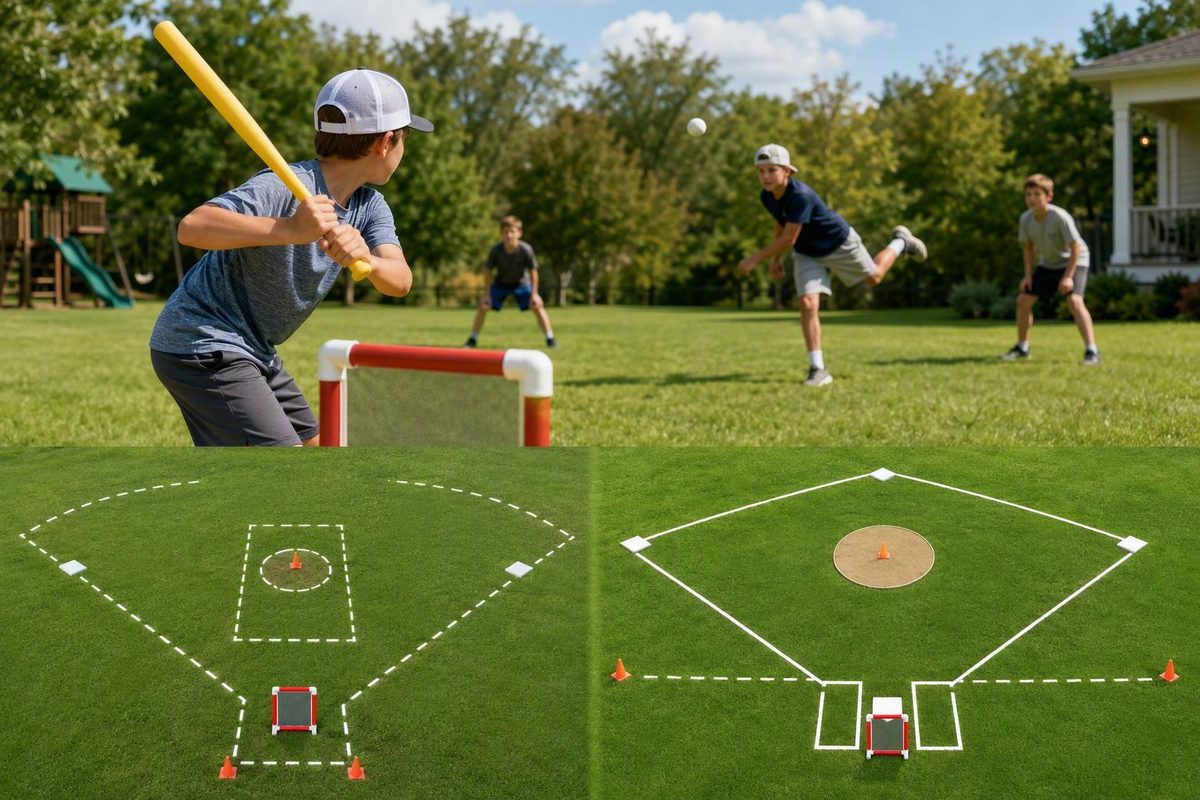
Compare the flexible scoring-zone layout with AWA’s base-running field, including marker, mound, base and no-bunt-line measurements.
The published rules compared here do not establish one universal set of Wiffle ball field dimensions. Choose the format first: use Wiffle Ball, Inc.’s flexible scoring-zone layout for a casual game with imaginary runners, or follow the current rules and field diagram for a league such as AWA when players run physical bases. Do not combine measurements from the two formats and present the result as a standard field.
Wiffle ball dimensions at a glance
For a backyard or youth-program game without base running, the optional scoring-zone layout is a practical starting point. If players will run bases or compete in an organized event, use that league’s current specifications.
| Feature | Wiffle Ball, Inc. scoring zones | AWA base-running field |
|---|---|---|
| Base running | No; runners are imaginary | Yes |
| Physical bases | Not used | First, second and third |
| Pitching distance | Not specified | League-specified range |
| Main field elements | Foul lines and scoring-zone markers | Mound, bases, foul lines, no-bunt line, target and fence |
| Best fit | Casual backyard or program play | AWA league-style competition |
The manufacturer’s suggested format assigns singles, doubles, triples and home runs according to where a ball is hit. AWA instead uses a mound, physical bases, a no-bunt line, a backstop target and an outfield fence. Because these elements support different styles of play, an AWA pitching measurement should not be inserted into the manufacturer’s zone layout and described as official for that format.
Optional scoring-zone layout from Wiffle Ball, Inc.
Wiffle Ball, Inc. explicitly treats overall field size as optional and presents its dimensions as recommendations. The game uses scoring zones and imaginary runners rather than physical bases, base paths or conventional base running.
The manufacturer’s suggested game rules provide these measurements:
| Marker or dimension | Suggested measurement | Approximate metric equivalent |
|---|---|---|
| Minimum width at home-run markers | 20 feet | 6.10 meters |
| Home to each home-run marker | About 60 feet | About 18.3 meters |
| Home to single markers | About 24 feet | About 7.3 meters |
| Singles to double markers | About 20 feet farther | About 6.1 meters farther |
| Doubles to triple markers | 20 feet farther | About 6.1 meters farther |
The source measurements in feet control; the metric figures are conversions. Following the sequential instructions places the double markers approximately 44 feet from home: about 24 feet to the singles plus about 20 feet farther. The same calculation places the triple markers approximately 64 feet from home. Those two home-to-marker distances are calculations, not independently published specifications.
That sequence does not align neatly with the separate recommendation placing each home-run marker about 60 feet from home. The apparent 64-foot triple position would extend beyond that guidance. Neither figure should therefore be treated as an exact construction point that resolves the conflict.
A clearer way to visualize the sequential marker instructions along each foul line is:
Home plate
    |
    | about 24 ft
    |
Single marker
    |
    | about 20 ft farther
    |
Double marker
    | about 44 ft from home, calculated
    |
    | another 20 ft
    |
Triple marker
      about 64 ft from home, calculated
Separate guidance: Place each home-run marker about 60 feet from home and maintain a minimum field width of 20 feet at those markers. This is not shown as the next point in the sequence because it conflicts with the calculated triple position.
Repeat the scoring markers along both foul lines. For a casual game, test the arrangement with cones or other removable markers and announce how the house rules handle the overlap before play begins.
This format does not provide physical base locations, base paths or a pitching distance. Players may select a pitching position that works for their space, but it should be described as a house rule rather than part of the manufacturer’s published layout.
AWA base-running field dimensions
AWA’s measurements apply to its league play; they are not regulation dimensions for every Wiffle ball game. Unlike the scoring-zone format, AWA uses base running, a pitching mound, three bases, foul lines, a no-bunt line, a target behind home plate and an outfield fence.
The published AWA league rules state the following:
| AWA field feature | League measurement | Metric equivalent |
|---|---|---|
| Mound to home | 36.5–38 feet | 11.13–11.58 meters |
| Home to first and third | 45 feet each | 13.72 meters |
| Second to first and third | Apparently 40 feet each | 12.19 meters |
| No-bunt line from home | 8 feet | 2.44 meters |
| Backstop target | 14 × 7 inches | About 35.6 × 17.8 centimeters |
| Foul lines | 75-degree angle; intersect 4 feet behind home | Intersection 1.22 meters behind home |
The second-base measurement requires confirmation before permanent installation. The wording appears to place second base 40 feet from both first and third, but it is not clear enough to treat that interpretation as settled field geometry. Check the current league diagram or obtain instructions from the event organizer.
AWA specifies a 14-by-7-inch target behind home plate but does not state its mounting height or a more exact position. Its rules also define a ball hit over the outfield fence as a home run without providing the fence distance. Because the published page does not give that depth or dimensions for foul territory and other site areas, these playing measurements cannot be used to calculate the total field footprint.
How to mark each field without mixing the formats
Write down the ruleset before measuring. Use removable field paint, chalk, tape, flat markers or cones while testing the layout and confirming league-specific details. Install permanent posts, fencing or mounted equipment only after those questions have been resolved.
For the optional scoring-zone field, follow the measurements in the manufacturer’s published rules:
- Establish home plate and two foul lines.
- Measure approximately 24 feet from home along each foul line and place the single markers.
- Measure approximately 20 feet beyond the singles and place the double markers.
- Measure another 20 feet beyond the doubles and place the triple markers.
- Consider separately the recommendation that home-run markers be about 60 feet from home.
- Decide and announce how the house rules will handle the conflict between that guidance and the sequential marker distances.
- If following the recommendation, check for a minimum width of 20 feet at the home-run markers.
For an AWA field, apply the dimensions from the current AWA rules and event instructions:
- Establish home plate as the reference point.
- Locate first and third base 45 feet from home.
- Set the mound at the selected distance within the 36.5–38-foot range.
- Mark the no-bunt line 8 feet from home.
- Use the current league diagram or organizer’s instructions to confirm second-base geometry.
- Confirm how to survey the 75-degree foul lines that intersect 4 feet behind home.
- Confirm the target’s exact placement and the required outfield-fence depth before installing permanent features.
Do not estimate the AWA fence distance, target height or total footprint from the other measurements. The published measurements do not establish those specifications.
Before play, check that:
- everyone is using the same ruleset;
- bases, cones and other markers are secure and visible;
- the playing area is unobstructed; and
- the organizer has verified any dimensions not stated by the selected rules.
Measurements you still need to confirm locally
Neither layout provides a universal construction specification or determines how much land every Wiffle ball field requires. Before building a permanent field or preparing for a tournament, confirm:
- outfield-fence depth;
- total site footprint;
- foul-territory dimensions;
- spectator placement;
- safety clearances;
- any age-specific scaling;
- exact AWA second-base geometry; and
- the AWA target’s exact position and mounting height.
Competition organizers should consult the current rules and field diagram for the particular league or event. Event instructions may supply details that a general rules page does not, while another organization may use a substantially different layout.
Casual players can adapt the optional scoring-zone format to the available yard, gym or program space as long as the boundaries and scoring rules are clear before play. If a zone is shortened, a marker is moved or a local pitching distance is selected, identify the change as a house rule rather than an official Wiffle ball dimension.
Choose the format before measuring: scoring zones for an imaginary-runner game or the applicable league plan for base-running competition. Keep the measurements separate, mark uncertain features temporarily, and confirm missing construction details before making the field permanent.