
How to Find the Right Way to Start Learning Violin
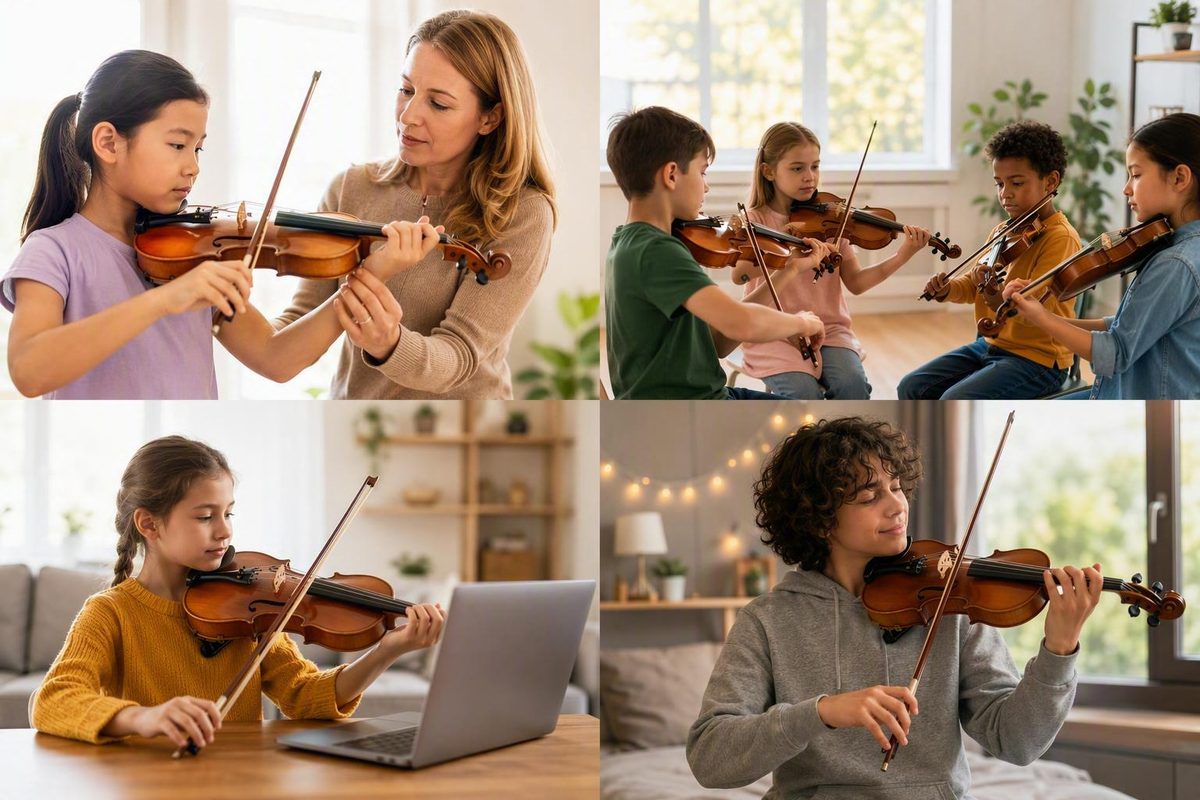
Compare private, group, live online and self-paced formats by feedback, scheduling, social interaction, technology, travel and cost structure.
Choosing violin lessons is less about finding a universally “best” program than finding a workable match for the learner. A young child who needs close guidance has different needs from an adult with an unpredictable schedule, a peer-motivated school student, or a returning player preparing for an audition.
Start with five variables:
- Age and readiness: Can the student focus briefly, follow directions, copy movements, and accept correction?
- Musical goal: Is the aim recreational playing, school orchestra, classical repertoire, fiddle, pop, jazz, performance, or audition preparation?
- Need for personal correction: Does the learner need immediate help with posture, bow path, tuning, and hand position?
- Preferred social setting: Will the student engage more readily alone with a teacher or alongside peers?
- Budget and schedule: What can the family sustain after including the instrument, materials, travel, technology, and fees?
A lower-commitment way to decide is to inspect free samples, take a trial lesson or short introductory course, and purchase a package or subscription only after confirming fit and reading the terms.
Most of the detailed service, price, and readiness information available for this comparison comes from music schools, instructors, and commercial lesson platforms describing their own offerings. Their pages are useful for checking advertised prices and features, but they do not establish that one format or provider produces better results. Prices and commercial terms cited below were reviewed against the supplied provider pages in September 2026 and should be rechecked before enrollment.
Start With the Learner, Not the Lesson Listing
Violin programs generally fall into five formats:
- In-person private lessons: One student works with one teacher in a studio, school, home, or other teaching space.
- Live online private lessons: The student and teacher interact in real time by video.
- Group classes: Several students learn together, usually on a fixed schedule and shared curriculum.
- Self-paced recorded study: The student follows videos and materials without meeting a teacher every week.
- Hybrid study: The student combines formats—for example, private lessons plus an ensemble, or recorded instruction plus periodic live feedback.
Each format provides a different kind of feedback. Private lessons allow immediate individual correction. In a group class, teacher attention is shared. Some recorded programs add delayed private video critique, while others provide no personal correction.
That distinction is more useful than asking which format is “best.” The supplied evidence does not establish that private, group, online, recorded, or hybrid instruction is superior for every learner.
| Learner | A sensible option to test first | Why it may fit | What to verify |
|---|---|---|---|
| Young beginner needing close physical and behavioral guidance | In-person private lesson | Individual pacing and close observation | Parent role, instrument sizing, lesson length |
| School-age child motivated by peers | Small group or private lessons plus an ensemble | Shared repertoire and social accountability | Class size, pacing, individual correction |
| Adult with travel or scheduling constraints | Live online private lessons | No commute and a wider geographic teacher pool | Camera setup, schedule, cancellation terms |
| Independent learner testing interest | Free materials or a short self-paced course | Low-commitment exploration | Whether lessons are sequenced and whether feedback exists |
| Returning or audition-focused player | Specialist private teacher | Goal-specific technical and repertoire feedback | Relevant teaching, performance, and audition experience |
Goals matter because “learning violin” can mean many things. One student may want to join a school orchestra; another may want classical solo repertoire, fiddle tunes, folk music, jazz, rock, pop, graded examinations, or audition preparation. A capable classical teacher may not be the right fiddle coach, while an engaging beginner teacher may not specialize in advanced orchestral excerpts.
A large lesson library is not necessarily a curriculum, and a prestigious résumé is not automatically evidence of compatibility. Before committing, ask:
- What will the student work on first?
- Is the material presented in a deliberate sequence?
- What personal feedback will the student receive?
- How will progress be reviewed?
- Does the teacher cover the learner’s preferred style or pathway?
- What happens if the student needs a different pace or format?
To find candidates, check nearby music schools, independent studios, school-orchestra referrals, community ensembles, instrument-rental shops, and online teacher platforms. Obtain two or three current written quotes and compare the same details—lesson length, frequency, feedback, included materials, extra fees, and cancellation rules—rather than comparing headline prices alone.
Starting Age and the Signs of Readiness
There is no universally accepted starting age. Provider recommendations commonly fall between approximately four and seven, but these are institutional or experience-based guidelines rather than validated developmental thresholds.
Merit School of Music says children can start private violin at age four and group violin at age six. It recommends individual instruction for four-year-olds because very young beginners need substantial attention; these thresholds are specific to Merit’s programs. See Merit’s age and program guidance.
Music & Arts generally recommends starting at age five, depending on whether the child can hold a fractional-size violin and focus through a 30-minute lesson. It also states that there is no maximum starting age. Review Music & Arts’ age guidance.
A teacher with nearly 20 years of reported beginner-teaching experience describes ages five to seven as a commonly successful range while noting that children may start earlier or later. That is professional experience, not a validated age rule. Read the teacher’s readiness and starting-age guidance.
Age should therefore prompt questions rather than settle the decision. Look for these practical signs:
- recurring interest in music or the violin;
- ability to focus for a short lesson interval;
- ability to follow a simple sequence of instructions;
- willingness to receive and try a correction;
- ability to copy or adjust a physical movement;
- enough coordination to hold an appropriately sized instrument;
- tolerance for repeating a small task without immediate mastery.
These are screening prompts, not a diagnostic test. A child can show some signs and still need more time, while a motivated child may do well with a teacher who adapts the lesson carefully.
A three- or four-year-old may be accepted by some teachers, but a very young beginner will commonly need substantial individualized attention and parent participation. The adult may need to attend lessons, remember instructions, support the practice routine, and redirect the child without turning every session into a conflict.
Before enrolling a young child, ask:
- Is an adult expected to attend every lesson?
- Can that adult understand and reinforce the teacher’s instructions?
- Can the family support brief, regular practice?
- What should the parent do if the child resists?
- Does the teacher expect the parent to tune or position the instrument?
- How will readiness be reconsidered if lessons repeatedly go poorly?
Children who are not ready for instrument-specific study can still explore music. Early-childhood classes may use songs, chants, movement, rhythm, pitch activities, and simple instruments before introducing violin technique.
Reading fluency, exceptional musical talent, and a lifelong commitment are not prerequisites for a trial. Some approaches begin with listening and imitation before placing greater emphasis on notation. The more useful question is whether the student can participate in the learning process with the support available.
Treat the first lesson or introductory period as an assessment. Notice whether the child can engage with the teacher, tolerate correction, copy a movement, and leave with a manageable task. One difficult attempt does not establish a lack of ability, but repeated distress, an unrealistic parent burden, or an unsuitable lesson format deserves attention.
Teens and adults can begin too. Providers in the supplied evidence explicitly offer lessons to adult beginners, so families should not treat childhood study as a prerequisite. Older beginners should still expect gradual work on coordination, posture, bowing, rhythm, and pitch.
Private, Group, Online, or Self-Paced: The Practical Trade-Offs
Format affects feedback, scheduling, social interaction, technology, travel, and cost structure. Compare the actual service rather than relying on labels such as “online” or “private.”
| Format | Feedback type | Scheduling flexibility | Peer interaction | Technology or travel needs | Typical price structure | Often fits |
|---|---|---|---|---|---|---|
| In-person private | Immediate, individual correction | Moderate to high, depending on teacher | Low unless recitals or ensembles are included | Travel to the studio or teacher travel | Per lesson, monthly tuition, or term package | Beginners needing close correction; specialized goals |
| Live online private | Immediate verbal and visual correction | Often high | Low unless group activities are added | Stable internet, quiet room, suitable camera view | Per lesson, package, or subscription | Adults, remote learners, families seeking wider teacher choice |
| Group class | Immediate feedback shared among students | Usually lower because times are fixed | High | Travel or live-video access | Per class, term, or semester | Peer-motivated students and ensemble-oriented beginners |
| Self-paced recorded | Usually no immediate correction; sometimes delayed video feedback | Very high | Low unless a forum or live class is included | Device and internet access | Free, one-time course fee, or membership | Independent learners and low-commitment exploration |
| Hybrid | A mix of individual, group, or delayed feedback | Varies | Moderate to high | Depends on the components | Combined tuition or separate fees | Students wanting technical coaching plus social playing |
Private instruction
Private lessons are structurally one-to-one. The teacher can adjust pacing, select exercises for one student, and spend lesson time correcting that student’s posture, rhythm, bowing, or intonation. This does not prove that every private student progresses faster. The value depends on teaching quality, student participation, practice, and fit.
Private study may also cost more and offer less peer contact. If social playing matters, ask whether recitals, studio classes, chamber groups, or ensembles are available.
Group classes
Group lessons can provide peer interaction, shared repertoire, teamwork, and ensemble habits. Students hear others attempt the same skills and learn to enter, stop, keep tempo, follow cues, and blend within a group.
The trade-off is shared attention. A student who needs repeated correction may receive less teacher time, while a student moving quickly may have to wait for the class. Group schedules and curricula are also generally less flexible. These are structural differences, not proof that groups are better or worse.
Music-school guidance commonly describes private lessons as adjustable and individualized, and groups as more social but dependent on shared pacing. Class sizes and program structures vary, so families should ask for the actual enrollment cap rather than assuming that every “small group” is alike. Compare the private, group, and ensemble structures described by Merit.
Live online private lessons
Live online lessons preserve real-time interaction and can connect students with teachers outside their immediate area. The student still receives individual instruction, but the teacher cannot physically reposition an arm, hand, or instrument.
Stable internet, adequate lighting, a quiet room, and a secure device stand matter more than a decorative background. The student or parent should also know how to reposition the camera when the teacher requests a closer view.
Some platforms include lesson notes, assignments, attachments, and recordings. Lessonface says its private lessons use generated Zoom links and that materials may be available through its dashboard; it also advertises group activities and self-paced offerings. Those features should be confirmed for the selected teacher and booking. Review Lessonface’s listed formats and platform features.
Self-paced videos
Recorded instruction offers high scheduling flexibility and may cost less than recurring private tuition. But there is an important difference between:
- a sequenced curriculum with ordered lessons, assignments, downloadable materials, and progress guidance; and
- an unstructured collection of tutorials selected by topic or song.
Violin Lab is an example of a structured recorded membership. It advertises a sequenced curriculum, downloadable materials, play-along accompaniments, live classes, and—at its Premium level—one private video-exchange lesson per month. That exchange provides delayed individual critique rather than continuous live correction. See Violin Lab’s curriculum and feedback description.
Violinspiration reports a library of more than 200 free video lessons, along with sheet music, tutorials, practice resources, and a tuner that uses a device microphone. The reported quantity may be useful for exploration, but the number of resources alone does not establish sequencing, completeness, or learning outcomes. Explore Violinspiration’s reported free resources.
Hybrid study
A hybrid arrangement might pair private technical work with group or ensemble playing, or recorded lessons with occasional live coaching. This can broaden the types of feedback and musical experience available. It can also increase cost and scheduling demands.
The supplied evidence does not prove that combining formats is universally the most effective approach. Treat hybrid study as one possible fit, not as an automatic upgrade.
Use this troubleshooting rule: If progress stalls because the learner lacks correction, peer motivation, scheduling compatibility, or goal-specific repertoire, reconsider the format before concluding that the learner lacks ability.
What Violin Lessons Cost—and What Tuition Leaves Out
The prices below are provider-reported examples reviewed in September 2026, not independently established national averages. Prices and availability may vary by location, teacher, duration, format, and package.
| Provider or source | Advertised example | Important context |
|---|---|---|
| Music & Arts | $37 average for 30 minutes; $67 average for 60 minutes | Private lessons; provider says price varies by store and teacher |
| Lessonface | About $37 average lesson price; displayed 30-minute teachers from $29 to $75 | Online marketplace; teachers set their own rates |
| Violin Lab Basic | $35 per month | Recorded curriculum and membership resources |
| Violin Lab Premium | $65 per month | Adds one private video-exchange lesson per month |
Using Music & Arts’ advertised $37 figure for illustration, four lessons would cost approximately $148 before an instrument, books, or other fees: $37 × 4 = $148. A month containing five separately billed lessons would cost more. Flat monthly tuition, semester pricing, holiday-adjusted calendars, and packages may calculate the total differently.
Lessonface’s displayed 30-minute examples range from $29 to $75, while the platform reports an average lesson price of about $37. It also advertises a 48-hour window in which to request a refund for an unsatisfactory lesson, class, or course. That is a platform-reported offer, and the complete applicable terms should be reviewed before relying on it.
Broader reported ranges vary considerably. Lessons In Your Home lists private instruction at $70–$130 per hour, group instruction at $17–$65 per hour per student, and online instruction at $30–$108 per hour. The page does not disclose an independent sample or calculation method, so these figures should be treated as the provider’s estimates rather than market benchmarks. Review the provider-reported format and price ranges.
Location-specific figures should remain local. Musicians in Motion reports Charlotte-area ranges of $32–$50 for 30 minutes, $48–$70 for 45 minutes, and $65–$95 for 60 minutes. It also estimates an in-home premium of $10–$20 per lesson because of teacher travel. These figures represent that provider’s view of the Charlotte-area market, not national pricing. See the Charlotte-area lesson-cost examples.
Do not compare a $35 recorded membership directly with four private lessons as though they were interchangeable. A recorded curriculum provides repeated access to content, while private instruction provides recurring observation and correction. The less expensive option may suit an independent learner who primarily needs organized material, but it may not meet the needs of someone who requires regular help identifying setup or technique problems.
Total-cost checklist
Ask for written prices for every applicable item:
- violin rental or purchase;
- size exchanges as a child grows;
- bow and case if not included;
- method books, printed music, or downloads;
- strings and rosin;
- shoulder rest or other teacher-requested setup items;
- music stand;
- recital or concert charges;
- examination or audition registration;
- accompanist fees;
- ensemble or studio-class tuition;
- travel, parking, or in-home premiums;
- device, stand, microphone, or internet upgrades for online study.
Subscription and package risks
Before paying, confirm:
- billing frequency and billing date;
- whether the plan renews automatically;
- cancellation notice and effective date;
- pause or hold options;
- rescheduling and make-up rules;
- treatment of teacher absences and holidays;
- refunds and credits;
- expiration of prepaid lessons;
- whether tuition transfers if the teacher changes.
Violin Lab states that its displayed monthly and annual plans renew automatically and may be canceled. Note the renewal date and determine when cancellation becomes effective before joining.
Three fill-in budget templates
Use current local written quotes rather than generic averages.
1. Tuition only
- Lesson price or monthly tuition: $____
- Lessons per month: ____
- Registration or platform fees: $____
- Expected monthly total: $____
2. Tuition plus instrument and basic materials
- Tuition: $____
- Rental or purchase payment: $____
- Books or sheet music: $____
- Strings, rosin, stand, and setup items: $____
- First-month total: $____
- Ongoing monthly total: $____
3. Tuition plus performance costs
- Tuition and instrument: $____
- Ensemble or studio class: $____
- Recital fee: $____
- Exam or audition registration: $____
- Accompanist and travel: $____
- Term or annual total: $____
Lesson Length, Curriculum, and What Beginners Actually Learn
Weekly 30-minute private lessons are a common advertised entry format for young beginners. Providers also offer 45- and 60-minute sessions. No duration is correct for every student.
Choose lesson length by considering:
- age and attention span;
- amount and difficulty of current repertoire;
- need for detailed technique work;
- performance or audition goals;
- whether setup consumes much of the lesson;
- whether the lesson routinely feels rushed;
- whether the student remains engaged for the full period.
Lessons In Your Home recommends 30 minutes for young children, says children aged nine and older often manage 45 minutes, and suggests considering 60 minutes when the necessary work no longer fits comfortably. These are provider recommendations, not validated age thresholds. See the provider’s lesson-length guidance.
A sensible curriculum should connect current work to the student’s goal. A student preparing for school orchestra may need rhythm, note reading, ensemble habits, and assigned school music. A recreational adult may prefer technique taught through selected repertoire. An audition candidate needs specialized technical, interpretive, and performance preparation.
Typical beginner content
Early violin study commonly includes:
- identifying and caring for the instrument and bow;
- balanced posture and instrument setup;
- bow hold and basic bow path;
- pizzicato;
- open strings;
- simple bowing patterns;
- pulse and rhythm;
- awareness of tuning and pitch;
- beginning music reading;
- short melodies.
The first lessons may spend substantial time on setup and controlled movement. Do not judge a program solely by whether a polished song appears immediately.
Typical intermediate content
As foundations stabilize, instruction may add:
- scales and arpeggios;
- low-finger patterns and broader intonation work;
- decisions about when and how to shift;
- vibrato preparation and development;
- metronome work;
- expanded bow strokes and articulations;
- longer and more demanding repertoire.
Typical advanced content
Later study may include:
- advanced bowing and articulation;
- stylistic interpretation;
- concertos and other demanding repertoire;
- performance preparation;
- orchestral excerpts;
- examination or audition preparation.
These categories describe a general progression reflected in provider curricula, not fixed stages that every teacher must follow in the same order. A teacher may introduce selected skills earlier or later depending on the method, repertoire, and student.
Practice should be specific
Early practice is commonly described as short and regular, but a generic minute target is less useful than clear instructions. The teacher should specify:
- what to repeat;
- how often to repeat it;
- what correct execution looks or sounds like;
- what to do when it goes wrong;
- when to stop the assigned task;
- what question or recording to bring to the next lesson.
Ask for a written first-month plan containing two or three priorities. Include a place to record questions and, if offered, a process for sending short recordings between lessons. The purpose is not to produce a perfect practice chart; it is to make home work understandable enough that the student can repeat the intended task.
Teacher guidance for parents also emphasizes normalizing incremental technical work and using short, clear practice priorities rather than expecting immediate polish. Review the parent-oriented beginner guidance.
How to Evaluate a Teacher and Use the Trial Lesson
A trial lesson is a practical test of communication and logistics. It cannot prove future progress, but it can show whether the arrangement appears workable before a long commitment.
Pre-booking checklist
Ask each teacher or program about:
- experience with the student’s age and current level;
- training, performance background, and teaching experience;
- teaching specialty and preferred methods;
- child-safety practices and parent-observation rules;
- references, reviews, or other screening information;
- curriculum and first-term priorities;
- expectations for the parent;
- communication between lessons;
- recitals, studio classes, ensembles, or other performance opportunities;
- help with instrument sizing, rental selection, setup, and tuning.
Platforms and studios may report background checks, vetting, ratings, student counts, or testimonials. These can be screening signals, but unless independently verified, they remain provider-reported. They do not guarantee teacher quality, compatibility, or student outcomes.
Ask what a stated credential means in practice. Performance experience does not automatically establish teaching skill, and teaching experience with advanced adults may not translate to work with preschool beginners. The relevant question is whether the teacher has suitable experience for this learner and goal.
Match the teacher to the goal
Ask directly whether the teacher covers the relevant style or pathway:
- classical;
- Suzuki-influenced instruction;
- fiddle or folk;
- jazz;
- rock or pop;
- school orchestra;
- graded examinations;
- auditions and orchestral excerpts.
Also ask how the teacher works with a beginner who is nervous, distracted, resistant, or advancing quickly. What changes when the student struggles? Does the teacher simplify the task, slow the pace, change repertoire, involve the parent, or recommend a different format?
For a child, ask whether the teacher communicates with the rental shop, helps check instrument size, and explains who should manage tuning and setup at home.
Trial-lesson scorecard
Rate each item from 1 to 5 and add notes.
| Item | Score | What to observe |
|---|---|---|
| Student comfort | ___ | Nervousness may be normal; persistent distress deserves attention |
| Clarity of directions | ___ | Instructions are short, specific, and understandable |
| Respectful correction | ___ | The teacher corrects without shaming |
| Pacing | ___ | The student is neither constantly lost nor repeatedly waiting |
| Posture and setup | ___ | The teacher checks instrument position, bow hold, and comfort |
| Response to questions | ___ | Questions receive usable answers |
| Goal alignment | ___ | Repertoire and method connect to the student’s aims |
| Next-step plan | ___ | The student knows what to practice and how |
| Parent guidance | ___ | The parent understands how much help to provide |
| Logistics | ___ | Schedule, location, technology, and communication appear workable |
For a child, notice whether the teacher uses age-appropriate language and tells the parent how to help. The teacher should be able to distinguish ordinary beginner difficulty from signs that the lesson length, teaching style, instrument fit, or timing may need reconsideration.
For an online trial, test the entire system. Can the teacher see the student’s full playing position? Can the student hear instructions clearly? Ask where recordings, links, notes, and assignments are stored and who can access them.
The decision rule is simple: a trial can establish whether communication, setup, and logistics appear workable. It cannot guarantee future progress. Avoid a long prepaid package while important expectations or policies remain unclear.
Choosing a Violin: Rental, Size, and Online-Lesson Setup
The student needs access to an instrument between lessons. Obtain sizing help before renting or buying, especially for a child.
Fractional-size violins allow smaller children to begin without using a full-size instrument. As a child grows, a larger size may become appropriate. Renting can be practical because some rental arrangements make exchanges easier, but it is not automatically the cheapest or best choice for every family.
Do not select size solely by age. Ask a violin teacher or rental specialist to check whether the student can hold the instrument comfortably and reach the required playing position without forcing the hand, arm, or shoulder.
Likely equipment includes:
- violin and bow;
- case;
- rosin;
- spare strings;
- method book or printed music;
- music stand.
A teacher may request a shoulder rest or other setup items. Confirm what comes with a rental and what the family must buy separately. Ask about:
- size-exchange procedures;
- maintenance and repair coverage;
- replacement rules;
- rental credit toward a later purchase;
- instrument condition;
- minimum rental term;
- cancellation or return requirements.
Also ask who handles tuning at the beginning of study. A young child may need an adult or teacher to manage it.
Online-lesson setup checklist
Before the first online lesson, prepare:
- stable internet;
- a quiet room;
- a fully charged device or nearby power supply;
- a secure stand or tripod;
- sufficient front or side lighting;
- enough room for unrestricted bow movement;
- a camera view showing posture, instrument angle, bow path, and both hands.
Place the device far enough away to show the whole playing position, then be ready to move it closer for hand details. Because an online teacher cannot make hands-on adjustments, clear visual instructions and camera repositioning are especially important.
This guide does not provide medical or injury-treatment advice. Questions about physical symptoms fall outside a teacher-selection and enrollment comparison.
Before You Enroll: A Final Comparison and Policy Check
Use one worksheet for every option so a low headline price does not hide missing feedback, travel, equipment, or restrictive terms.
| Field | Option 1 | Option 2 | Option 3 |
|---|---|---|---|
| Teacher or program | |||
| Format | |||
| Lesson duration | |||
| Frequency | |||
| Feedback type | |||
| Total monthly tuition | |||
| Estimated extras | |||
| Trial or sample offer | |||
| Ages and levels served | |||
| Teaching specialties | |||
| Travel requirements | |||
| Technology requirements | |||
| Parent role | |||
| Performance opportunities |
Get written answers for:
- billing date;
- auto-renewal;
- cancellation notice;
- rescheduling;
- make-up lessons;
- holidays;
- teacher absences;
- pauses;
- refunds or credits;
- package expiration;
- changing teachers;
- treatment of unused prepaid tuition.
For online or video-based study, also ask:
- Are live lessons recorded?
- Can the student submit private videos?
- Where are recordings and submissions stored?
- How long does access last?
- Who can view or download them?
- What safeguards apply to minors?
- Can a parent request deletion?
The supplied evidence does not establish comprehensive privacy terms across providers, so do not assume that “private” or “secure” means the same thing everywhere.
Clarify what “free lessons” means. It may refer to isolated samples, a substantial tutorial library, a trial with a teacher, or part of a sequenced curriculum. Those offers provide different levels of continuity and correction.
Likewise, confirm exactly what personal feedback is included. A recorded plan may offer no individual review, periodic video exchange, optional live classes, or recurring private instruction. Verify both the frequency and the method of feedback.
Before paying, confirm the latest:
- price and billing schedule;
- teacher availability;
- lesson time and location;
- plan features;
- trial terms;
- cancellation and refund rules;
- instrument requirements.
A practical three-step plan is enough:
- Shortlist two or three options that fit the learner’s age, goal, feedback needs, schedule, and likely total cost.
- Complete a trial or sample lesson and score communication, comfort, setup, and next-step clarity.
- Compare written totals and policies before choosing a subscription, package, or term.
Keep looking if a program pressures you to prepay without written terms, the teacher’s specialty does not match the goal, the student remains persistently uncomfortable, parent expectations are unclear, the instrument does not fit, or there is no workable plan for practice at home.
The right starting choice should be a short, reversible test rather than an immediate long-term commitment. Match the format to readiness and goals, obtain a properly sized instrument, calculate costs beyond tuition, assess teacher fit, and read billing and cancellation terms. The strongest practical option is one the student can attend, practice for, afford, and continue without depending on promotional promises.
What is the best age to start violin lessons?
There is no single best age. Some programs accept children in the preschool years, while others recommend waiting longer. Readiness matters more than a number alone.
Look for recurring interest, short-interval focus, ability to follow simple directions, willingness to try corrections, coordination, and adequate family support. Very young beginners often need substantial parent participation. A trial lesson is a better readiness check than age by itself.
How much do violin lessons cost per month?
Monthly cost depends on format, lesson duration, teacher, location, frequency, and billing model. Recorded memberships, group classes, online private lessons, and in-person instruction are different services and should not be compared by price alone.
Request a written monthly total that includes registration fees, instrument costs, materials, travel, recitals, and any automatically renewing charges. Ask how months with holidays or an additional weekly lesson are billed.
Are private or group violin lessons better for a beginner?
Neither is universally better. Private lessons provide one-to-one pacing and focused correction. Group lessons provide peer interaction, shared repertoire, teamwork, and ensemble experience, usually with less individual teacher time and a more fixed pace.
Choose according to the beginner’s need for correction, social motivation, budget, schedule, and goals. If one format lacks something essential, consider switching formats or adding a limited supplement rather than assuming the student cannot learn.
Should a child rent or buy a beginner violin?
Renting can be practical for a growing child because fractional-size instruments may need to be exchanged. Buying may make sense in other circumstances, but neither option is always cheaper or better.
First obtain sizing help from a teacher or rental specialist. Then compare the rental term, exchange policy, maintenance coverage, purchase credit if offered, instrument condition, and total cost of ownership.
Is it too late for a teen or adult to start violin?
No. Teens and adults can begin violin, and providers offer instruction specifically for adult beginners. Starting in childhood is not a prerequisite for recreational playing, ensemble participation, or pursuing a personal musical goal.
An older beginner should still expect gradual coordination and technique work. Choose a teacher experienced with the learner’s age, preferred repertoire, schedule, and goals rather than enrolling in a program designed only for young children.